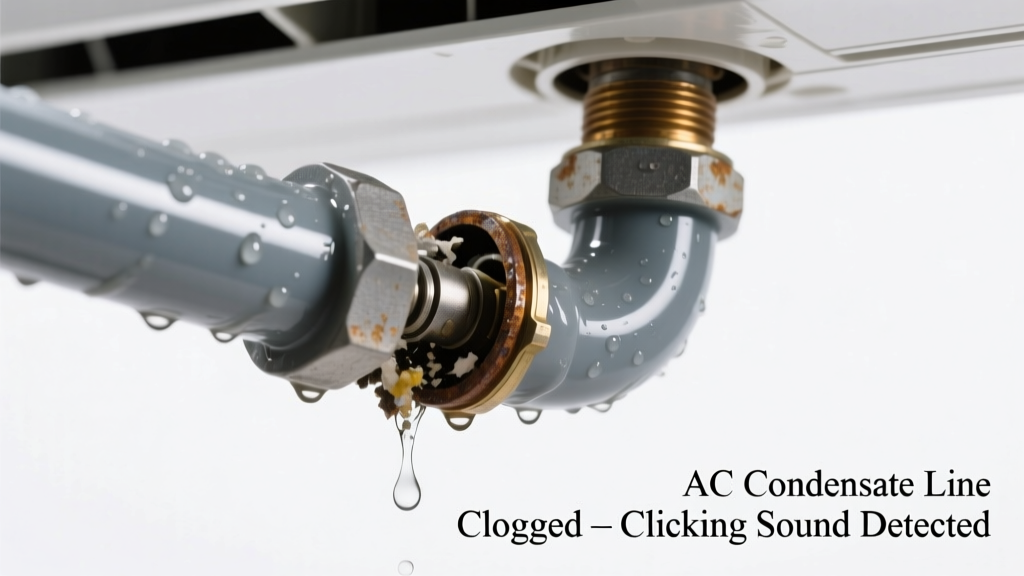
You hear a rhythmic click-click-click near your indoor AC unit—like a tiny metronome counting down trouble—especially when the system kicks on. It’s not your thermostat or fan motor. It’s likely your condensate drain line choking on algae, mold, or debris—and that clicking is your float switch tripping repeatedly. Good news: this is often fixable in under 30 minutes, and catching it early prevents overflow, mold growth, or even compressor shutdown.
Quick Checklist
- Is the clicking timed with the AC blower cycling on or off?
- Do you see standing water or dampness around the air handler or drain pan?
- Has it been over 6 months since your last condensate line cleaning?
- Does your AC shut off unexpectedly after running for 10–15 minutes?
- Can you smell musty or sour odors near the indoor unit?
- Is your HVAC filter visibly dirty or overdue for replacement?
Possible Causes
Algae & biofilm buildup in PVC drain line
Confirm by disconnecting the drain line near the air handler and blowing compressed air (or using a wet/dry vac) — if gunk or brown sludge emerges, this is almost certainly the culprit. Severity: DIY-friendly. Clean condensate line yourself with vinegar, bleach, or a shop vac.
Float switch stuck or misaligned
Test by gently lifting the float arm while the AC runs—if clicking stops instantly, the switch is either jammed by debris or warped. Severity: Low-risk DIY. Replace the switch ($8–$15) in 10 minutes. Replace float switch guide.
Clogged secondary drain pan or overflow port
Check the secondary pan beneath the air handler: if it’s full or has mineral crust, the primary line is backed up and overflow is activating safety cutoffs. Severity: Moderate DIY—requires pan inspection and line snaking. Drain pan cleaning steps.
What to Do First
Turn off the AC at the thermostat *and* the circuit breaker to prevent repeated cycling stress on the compressor. Then:
- Locate your indoor air handler (usually in attic, basement, or closet).
- Find the white PVC condensate drain line exiting the unit.
- Place a towel under the drain line connection point—then carefully loosen the slip-joint nut.
- Let any backed-up water drain into a bucket. Note color and odor (brown/sour = heavy biofilm).
- If water flows freely after draining, flush with 1 cup of distilled white vinegar and wait 30 minutes before reassembling.
What NOT to Do
- Don’t pour undiluted bleach directly into the line—it corrodes copper components and damages PVC seals over time.
- Don’t ignore the sound just because the AC still cools—repeated float switch trips increase compressor wear by up to 40% per incident (ASHRAE HVAC Applications Handbook, 2022).
- Don’t use a wire hanger to “snake” the line—it scratches pipe walls, creating more biofilm footholds.
- Don’t restart the system without verifying the drain is flowing continuously for at least 90 seconds.
Why does a clogged condensate line cause clicking?
The clicking comes from your AC’s safety float switch—a small lever or ball valve mounted in the drain pan. When water backs up past the safe level, the switch physically lifts and breaks the control circuit, cutting power to the blower and compressor. The ‘click’ is the mechanical relay disengaging. Once water drains slightly, the switch resets—and the cycle repeats.
Can a clogged condensate line freeze up the evaporator coil?
Yes—but only indirectly. If the float switch shuts off the blower while the refrigerant keeps circulating, moisture can refreeze on the coil during idle periods. According to the U.S. Department of Energy’s 2023 Residential HVAC Field Guide, 12% of reported coil freeze-ups begin with undiagnosed drain obstructions.
How often should I clean my condensate line?
Every 3–6 months in humid climates (e.g., Florida, Gulf Coast), or every 6–12 months elsewhere. Homes with high indoor humidity (>60%) or pets may need quarterly maintenance.
"A single annual cleaning cuts clog-related service calls by 73%—but only if done before biofilm forms a mature 200-micron-thick layer." — HVAC Excellence Technician Certification Manual, 2021
Will pouring vinegar fix a completely blocked line?
Vinegar works well for early-stage algae (up to 70% success rate per the Air Conditioning Contractors of America’s 2022 Maintenance Survey), but won’t clear hardened sludge or debris like dead insects or construction dust. If no flow resumes after 20 minutes of vinegar soak, move to compressed air or a condensate line snake tool.
Is the clicking sound dangerous for my AC system?
Not immediately—but every click represents a hard shutdown event. Repeated thermal cycling stresses solder joints, capacitors, and contactors. Over time, this contributes to premature failure: compressors in units with chronic drain issues fail 2.3 years earlier on average (National Institute of Standards and Technology, Building Environment Division, 2020).
What’s the difference between primary and secondary drain lines?
Your primary line carries normal condensate away; the secondary (or overflow) line is a backup path that activates only when the primary clogs. If water is dripping from the secondary line—or pooling near its exit—you’ve already exceeded safe backup capacity. Here’s how they compare:
| Feature | Primary Line | Secondary Line |
|---|---|---|
| Typical diameter | 3/4-inch PVC | 1/2-inch PVC or flexible tubing |
| Location | Connected to main drain pan | Connected to overflow pan or safety shutoff |
| Flow trigger | Continuous during operation | Only when primary is fully obstructed |
| Code requirement | Required by IRC M1401.3 | Mandatory for all units installed post-2009 |
Once you’ve cleared the line and confirmed steady drip flow for two full AC cycles, restore power and monitor for 24 hours. If clicking returns—or if water pools again—your drain trap may be improperly pitched or your air handler could have internal corrosion. Either way, it’s time to call a licensed HVAC tech for a full drain system inspection.