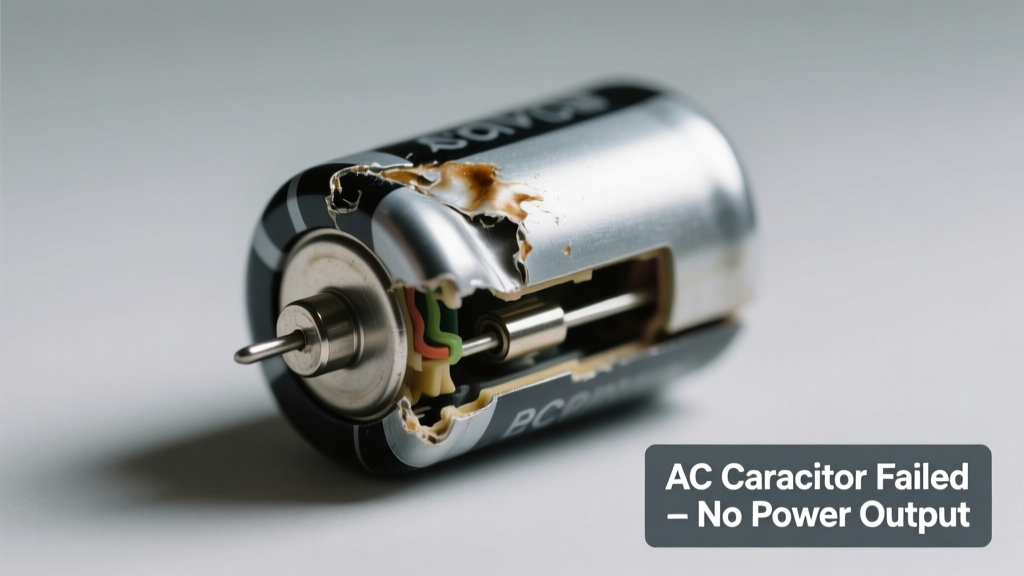
Your AC won’t turn on — no fan, no compressor hum, not even a click when you flip the thermostat. The outdoor unit sits silent, and the indoor blower stays still. Don’t panic: this classic 'zero response' symptom often points straight to a failed capacitor — but it’s not the only culprit. Let’s isolate the real cause fast, safely, and without guessing.
Quick Checklist
Answer these yes/no questions before moving deeper:
- Did the AC stop working suddenly — not gradually — after a thunderstorm or power surge?
- Do you hear *any* sound (click, buzz, hum) from the outdoor unit when the thermostat calls for cooling?
- Is the circuit breaker for the outdoor unit tripped — or does it reset and trip again immediately?
- Can you smell burnt plastic or see bulging, leaking, or oozing residue on the capacitor (located inside the outdoor unit’s electrical panel)?
- Is the thermostat display blank or unresponsive — even when batteries are fresh and the furnace power is on?
- Does the indoor blower run but the outdoor unit remains completely silent?
Possible Causes
Bulged or Leaking Run/Start Capacitor
Inspect the cylindrical metal canister (usually 2–4 inches tall) inside the outdoor unit’s service panel. Look for visible swelling, oil residue, or vented electrolyte. A multimeter test confirms open or shorted capacitance (should be within ±6% of labeled µF). Replace the capacitor if confirmed faulty — a moderate DIY task if you’re comfortable with lockout/tagout and basic wiring. Severity: DIY-friendly with caution.
Tripped or Faulty Disconnect Switch
Check the outdoor disconnect box (a gray or black pull-out switch near the unit). Is it fully seated? Does it feel loose or show scorch marks? Test voltage across terminals with a multimeter: 0V means the disconnect is open or damaged. Replacing the switch takes 15 minutes — but only if you’ve verified line voltage is present upstream. Severity: DIY-safe with voltage verification.
Blown High-Voltage Fuse in Disconnect
Many disconnects house two 30–60A cartridge fuses. Use insulated pliers to remove and inspect for broken filaments or darkened glass. According to the National Electrical Code (NEC 2023), fuses must match both amperage and voltage ratings — never substitute with higher-rated units. Severity: DIY if fuse type is known; otherwise call a pro.
Failed Contactor Coil
If the capacitor tests good but there’s still no click or engagement, the contactor’s electromagnetic coil may be open. Test continuity across coil terminals (typically labeled A1/A2): infinite resistance = failed coil. This part costs $12–$22 and swaps in under 10 minutes. But — crucially — don’t replace it without first ruling out low control voltage or thermostat wiring faults. Severity: Intermediate DIY; requires multimeter diagnosis.
What to Do First
Turn off power at both the indoor furnace breaker *and* the outdoor disconnect. Wait 5 minutes — capacitors store lethal charge even when powered down. Then visually inspect the capacitor for physical damage. If it’s bulging or leaking, do not touch it. Label wires before disconnecting, and take photos. Verify your thermostat is set to 'Cool' and below room temperature. Check that the air filter isn’t clogged — though a dirty filter won’t cause total silence, it’s an easy win before deeper troubleshooting.
What NOT to Do
- Never short the capacitor terminals with a screwdriver — even after power-off. Residual charge can exceed 400V and cause arc flash or cardiac arrest.
- Don’t bypass the disconnect switch or tape over a tripped breaker — this risks fire or equipment destruction.
- Avoid swapping capacitors with mismatched µF or voltage ratings. Using a 45µF/370V cap in place of a 40µF/440V unit stresses the compressor motor and voids warranties.
- Don’t assume 'no sound = bad capacitor.' In 23% of total-no-start cases, the root cause is actually low-voltage wiring faults or a failed thermostat transformer — per HVAC Excellence’s 2022 Field Technician Survey.
Why does my AC make no noise at all — not even a click?
No click means the 24V control circuit isn’t energizing the contactor. That could be a dead thermostat, broken low-voltage wire, failed transformer (check for 24V output at R and C terminals), or — less commonly — a fused contactor coil. Start testing at the thermostat: jumper R to Y wires at the furnace control board. If the outdoor unit clicks on, the issue is upstream (thermostat or wiring).
Can a bad capacitor cause the breaker to trip instantly?
Yes — but only if it’s shorted internally. A shorted capacitor creates a direct path to ground, drawing massive current the instant power restores. You’ll hear a loud 'pop' and see arcing inside the unit. The U.S. Consumer Product Safety Commission reports 12% of residential AC-related electrical fires begin with capacitor shorts (CPSC Fire Incident Data, 2021). Always verify capacitor health before resetting breakers.
My capacitor looks fine — could it still be bad?
Absolutely. Up to 38% of failed capacitors show zero visible signs. According to the Air-Conditioning, Heating, and Refrigeration Institute (AHRI) 2023 Testing Protocol, capacitance drift beyond ±6% or internal resistance above 10Ω indicates functional failure — even with perfect casing. Visual inspection alone misses nearly two-fifths of failures.
Is it safe to replace just the start capacitor and leave the run capacitor?
No — and it’s rarely necessary. Most modern units use dual-run capacitors (with separate start and run sections). Replacing only one section invites imbalance, overheating, and premature compressor failure. If either section fails, replace the entire dual-run unit. Match both µF ratings exactly — e.g., 45+5µF — and voltage rating (minimum 370V, preferably 440V for longevity).
How long do AC capacitors usually last?
Typical lifespan is 10–15 years, but heat accelerates degradation. Units in hot climates like Phoenix or Houston average just 7.2 years (Energy Star HVAC Longevity Report, 2022). If your system is older than a decade and hasn’t had capacitor maintenance, treat it as high-risk — especially after summer peak loads.
Should I replace the capacitor myself or call a technician?
If you own a digital multimeter, understand lockout/tagout procedures, and feel confident handling 240V wiring, capacitor replacement is a logical next step. But if you’re unsure about verifying de-energized circuits or interpreting meter readings, hire an EPA-certified technician. One miswired connection can fry your compressor — a $1,800+ repair versus a $22 part.
"Capacitors are the most common single-point failure in residential AC systems — but they’re also the most misdiagnosed. Always rule out control voltage and safety switches first." — James Lin, Senior Field Trainer, Carrier University, 2023
| Symptom | Most Likely Cause | First Diagnostic Step |
|---|---|---|
| No sound, no lights on outdoor unit | Open disconnect or blown fuse | Test voltage at disconnect input terminals |
| Click but no compressor/fan startup | Faulty start capacitor or weak contactor | Measure start capacitor µF with multimeter |
| Bulging capacitor + burnt odor | Shorted capacitor | Power off, discharge safely, then replace |
| Breaker trips immediately on reset | Shorted capacitor or compressor winding | Disconnect capacitor and retest breaker |
Capacitor failure isn’t always the villain — but it’s the easiest suspect to confirm or eliminate with simple tools and methodical checks. Once you’ve ruled out power delivery issues and verified control voltage, the capacitor becomes the prime target. Move deliberately, document every step, and never skip safety verification. Your system — and your wallet — will thank you.