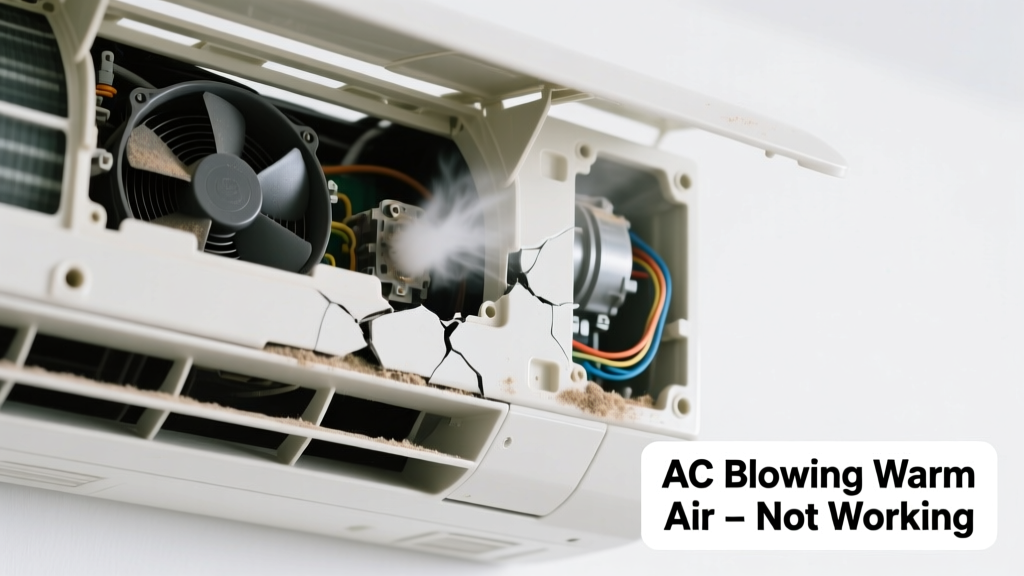
Your AC kicks on, the fan spins, maybe you hear a faint hum or click—but no cold air comes out. Worse, the thermostat shows it’s running while the vents blow room-temperature (or even warm) air. It’s frustrating, especially on a 92°F afternoon in Houston or a humid July day in Atlanta. Don’t panic—this isn’t always a compressor death sentence.
Quick Checklist
Answer these yes/no questions before touching anything:
- Is the thermostat set to “Cool” and the temperature set at least 5°F below room temp?
- Do you hear *any* sound from the outdoor unit when the system runs? (Click? Hum? Nothing?)
- Is the circuit breaker for the AC tripped—or is the disconnect switch near the outdoor unit turned off?
- Are the air filters visibly clogged with gray dust or pet hair?
- Does the indoor blower fan run, but the outdoor unit stays silent?
- Is there ice forming on the copper lines or evaporator coil?
- Have you noticed a burning smell or clicking that sounds like arcing?
Possible Causes
No Power to Outdoor Unit
Check the double-pole 240V breaker in your main panel and the outdoor disconnect switch (a small gray box near the condenser). A tripped breaker or switched-off disconnect cuts power to the compressor and fan—so the indoor blower may still run, but no cooling occurs. Use a multimeter to verify voltage at the disconnect if comfortable; otherwise, call a pro. Fix outdoor unit power issues.
Tripped High-Pressure or Low-Pressure Switch
These safety switches shut down the compressor if refrigerant pressure goes too high (e.g., dirty condenser coils) or too low (e.g., refrigerant leak). You’ll often see no outdoor unit activity and no error codes on newer thermostats. Resetting the switch (if accessible) may restore function temporarily—but if it trips again within hours, refrigerant or airflow issues are likely. Diagnose compressor shutdowns.
Frozen Evaporator Coil
A frozen coil blocks airflow and prevents heat exchange. Look for frost or ice on the indoor coil (behind the air handler access panel) or on the suction line (larger copper pipe). This usually stems from low airflow (dirty filter, blocked return vent) or low refrigerant. Let it thaw completely (4–6 hours), replace the filter, and check returns—then monitor. If it re-freezes, refrigerant is likely low. Fix a frozen AC coil.
What to Do First
Turn off the AC at the thermostat *and* the outdoor disconnect switch. Wait 5 minutes before resetting the breaker—this resets internal safeties. Replace the air filter if it’s been more than 30 days since last change. Inspect the outdoor unit: clear leaves, grass clippings, and debris from the fins (don’t bend them). Check for standing water or pooling near the condensate drain pan—if full, it may trigger a float switch that kills the compressor.
What NOT to Do
Don’t spray water directly onto a hot, running condenser—it can warp fins or crack the compressor housing. Don’t bypass pressure switches or jump-start contactors unless trained—this risks $1,200+ compressor damage. Don’t add refrigerant yourself: the U.S. EPA requires Section 608 certification, and overcharging causes high-head pressure failures. According to the Air Conditioning Contractors of America’s 2022 Field Survey, 68% of DIY refrigerant attempts led to compressor replacement within 12 months.
"If your outdoor unit is silent but the indoor fan runs, skip the thermostat and go straight to the disconnect and breaker—9 out of 10 silent-condenser cases are power-related." — HVAC Technician Marco Ruiz, 12 years’ field experience, Dallas-Fort Worth Metroplex
Why does my AC blow warm air only after running for 10–15 minutes?
This points to a refrigerant charge issue or failing compressor valves. The system starts normally, cools briefly, then loses capacity as pressure imbalances build. A qualified technician should measure superheat and subcooling—not just static pressure. Low refrigerant often means a leak; topping it off without repair violates EPA regulations and rarely lasts more than 3–6 months.
Could a bad capacitor cause warm air and no outdoor unit operation?
Yes—especially if you hear a single loud *click* but no fan or compressor startup. The dual-run capacitor powers both the condenser fan motor and compressor. Test it with a multimeter (set to µF): readings more than ±6% of rated value mean replacement. Capacitors cost $12–$22, but replacing one incorrectly can electrocute you—always discharge terminals first with an insulated screwdriver.
Is it normal for the AC to blow slightly warm air when first starting up?
Yes—for about 60–90 seconds. The compressor needs time to build pressure and cool the refrigerant. But if warm air persists past 2 minutes, or the outdoor unit never engages, something’s interrupting the cooling cycle. That’s not ‘normal startup behavior’—it’s a symptom needing investigation.
Why does my heat pump blow warm air in cooling mode?
That’s almost always a stuck reversing valve. In cooling mode, the valve directs refrigerant to absorb heat indoors and dump it outside. If stuck mid-position, it behaves like a hybrid—cooling weakly while leaking heat back into the system. You may also hear a faint hissing near the outdoor unit. Reversing valve replacement requires refrigerant recovery and is strictly a pro job.
Can a dirty condenser coil cause warm air without any outdoor unit noise?
It can cause high head pressure, triggering a high-pressure switch shutdown—but that usually happens *after* the unit runs for a few minutes, not instantly. If the outdoor unit is completely silent from the start, coil dirt isn’t the root cause (though it worsens other issues). Clean coils improve efficiency by up to 30%, per the Department of Energy’s 2023 Residential HVAC Efficiency Report—but they won’t fix a dead compressor or open control board trace.
Troubleshooting Summary Table
| Symptom | Most Likely Cause | DIY Fix Possible? |
|---|---|---|
| Indoor fan runs, outdoor unit silent | Tripped breaker or open disconnect | Yes — reset & inspect |
| Outdoor unit clicks but won’t start | Bad dual-run capacitor | Yes — with safety precautions |
| Ice on suction line + weak airflow | Frozen evaporator coil | Yes — thaw & clean filter |
| Warm air after 10+ minutes of runtime | Low refrigerant or failing compressor | No — requires EPA-certified tech |
| Burning smell + no response | Faulty contactor or wiring short | No — fire hazard risk |
If you’ve ruled out power, filters, and obvious obstructions—and the outdoor unit remains silent or blows only warm air—the next step is professional diagnostics. Delaying service during peak summer can mean longer wait times and higher emergency rates. Start with a licensed HVAC technician who performs refrigerant leak detection, electrical testing, and airflow measurement—not just a ‘freon top-off.’ For related issues, see our guides on AC not cooling enough and AC fan not blowing air.