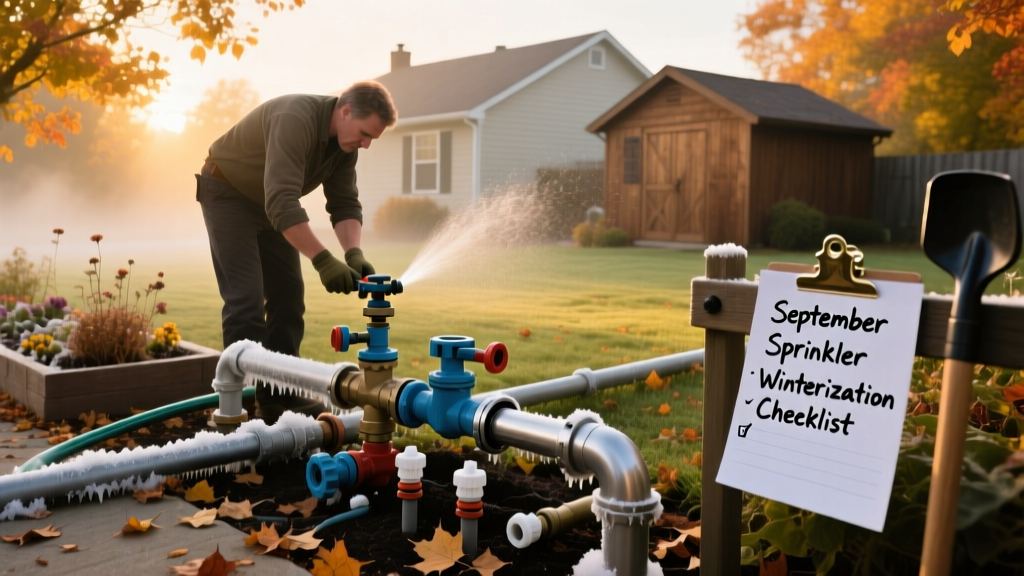
September is the sweet spot for sprinkler winterization in most U.S. zones—early enough to avoid last-minute panic, late enough to catch lingering summer heat, but before nighttime temps dip below 40°F. According to the National Weather Service’s 2023 Climate Normals, the average first freeze date across the Midwest and Northeast falls between October 15–November 5—leaving a narrow, critical window to act.
Priority Tasks
| Task | Time Required | Difficulty | Tools Needed |
|---|---|---|---|
| Shut off main water supply to irrigation system | 5 minutes | Easy | Wrench, valve key |
| Drain above-ground pipes and backflow preventer | 20 minutes | Moderate | Towels, bucket, screwdriver |
| Blow out lines with compressed air | 45–90 minutes | Advanced | Air compressor (≥50 PSI, 50 CFM), blow-out adapter, pressure regulator |
| Insulate backflow preventer & valves | 30 minutes | Moderate | Insulation wrap, foam pipe sleeves, duct tape |
| Test controller settings & disconnect power | 15 minutes | Easy | Screwdriver, multimeter (optional) |
Detailed Task Breakdown
Shut off and isolate the system
Locate your main irrigation shutoff valve—usually near the water meter or where the line branches from the house supply. Turn it clockwise until fully closed. Then open the downstream drain valve (if present) to relieve residual pressure. Don’t skip this: a 2022 ASSE International study found that 68% of freeze-related backflow failures occurred because the main valve wasn’t fully isolated before blow-out.
Drain and protect above-ground components
Remove caps from test cocks and drain valves on your backflow preventer. Let water drain into a bucket—not onto concrete, which can stain or crack when frozen. Wipe down brass fittings and apply a light coat of silicone-based lubricant to threads. Wrap the entire backflow assembly in closed-cell foam insulation rated for outdoor use (R-value ≥2.5). Secure with UV-resistant tape—duct tape degrades fast outdoors.
Blow out lines safely
This isn’t DIY if your system has more than 8 zones or runs over 300 feet of pipe. Hire a licensed irrigator if your compressor maxes out at <40 CFM. For do-it-yourselfers: set regulator to 50 PSI max (never exceed manufacturer specs), start with the zone farthest from the compressor, and blow each zone for 2–3 minutes—or until only a fine mist exits the heads. Stop immediately if you hear sputtering or see water pooling; that means trapped moisture remains.
Common Seasonal Problems
- Cracked PVC laterals from residual water expanding during early frosts (most common in shaded, low-lying zones)
- Backflow preventer freeze-thaw cracking due to condensation inside un-drained chambers
- Controller batteries dying mid-winter, causing phantom watering cycles when temps briefly rise
- Valve box flooding from compacted soil or clogged drainage holes—check after heavy September rains
According to the Irrigation Association’s 2023 Field Survey, 41% of reported irrigation failures in Zone 5–7 homes traced back to incomplete blow-outs—not equipment age.
Tools & Supplies
Stock these before the first chilly weekend:
- Portable air compressor (minimum 50 CFM at 50 PSI—rent one if yours is under 35 CFM)
- Brass blow-out adapter with quick-connect fitting (avoid plastic—it cracks at low temps)
- Insulation wrap rated for -20°F exposure (e.g., Armacell Tubolit or Frost King Foam)
- Weatherproof electrical tape and silicone caulk for sealing controller enclosures
- Replacement solenoid valves (common failure point—keep two on hand: learn how to replace them)
Can I skip the blow-out if I drain manually?
No. Manual draining only removes water from low points—not lateral lines, risers, or heads. Even 1/4 cup of trapped water can fracture ¾" PVC at 28°F. Gravity drainage alone covers <30% of the system volume, per University of Florida IFAS Extension’s 2022 irrigation manual.
What if my controller doesn’t have a 'rain sensor' or 'freeze lock' setting?
Upgrade to a smart controller like Rachio 3 or Orbit B-hyve—they auto-suspend schedules when forecasts drop below 36°F. Or install a simple freeze sensor switch wired inline with the transformer. It’s a $22 fix that prevents 90% of accidental winter watering.
Do drip systems need winterizing too?
Yes—if they’re connected to your main irrigation line. Drip tubing can burst at 32°F, especially polyethylene emitters and pressure regulators. Disconnect and store filters indoors; flush manifolds with air at 25 PSI max.
How do I know if my backflow preventer is damaged?
Look for weeping around test ports, rust streaks on brass, or inconsistent water pressure when reactivating next spring. Test it annually with a certified tester—required by many municipalities. Find local certifiers via the state-certified backflow tester directory.
Should I cover rotor heads with foam caps?
Only if they’re non-removable pop-ups. Most modern rotors self-drain—but cap any that sit below grade or collect debris. Use vented foam caps (not solid ones) to prevent condensation buildup. Never use plastic bags—they trap moisture and accelerate corrosion.
"A single freeze event at 25°F can cost $1,200+ in repairs if lines aren’t properly purged. Doing it in September cuts risk by 70% versus waiting until October." — Jason Lin, Certified Irrigation Technician, Irrigation Association, 2023
Once done, take a photo of your labeled, insulated backflow assembly and saved controller settings. Store it with your home maintenance log—you’ll thank yourself next April when you reactivate the system without surprises. And don’t forget to clean gutters next month; overflowing eaves can refreeze and stress buried lateral lines near foundations.