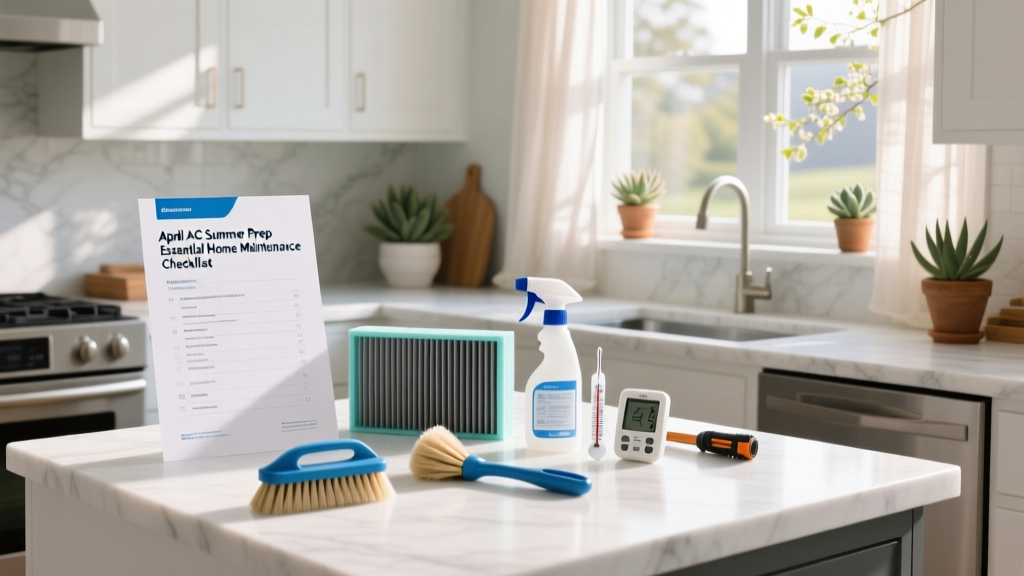
April is the sweet spot—warm enough to test your AC safely, cool enough to avoid strain on the system, and early enough to catch problems before triple-digit days hit. According to the U.S. Department of Energy, homeowners who perform spring maintenance reduce mid-summer service calls by 62% and improve system efficiency by 10–15%.
Priority Tasks
| Task | Time Required | Difficulty | Tools Needed |
|---|---|---|---|
| Replace air filter | 5 minutes | Easy | Replacement filter (check size: e.g., 16x25x1) |
| Clear condensate drain line | 15–20 minutes | Moderate | Shop vac, vinegar, turkey baster, wet/dry vacuum |
| Clean outdoor condenser coil | 30–45 minutes | Moderate | Garden hose with spray nozzle, coil cleaner, soft brush |
| Inspect thermostat calibration | 10 minutes | Easy | Digital thermometer, smartphone (for smart thermostat app) |
| Check refrigerant lines for damage | 12 minutes | Moderate | Flashlight, gloves, notepad |
| Schedule professional tune-up | 5 minutes (call/email) | Easy | Contractor contact info, service history notes |
Detailed Task Breakdown
Replace your air filter
Locate your return-air grille—usually in a hallway ceiling or wall—and remove the old filter. Note its dimensions (e.g., 20x25x1) and MERV rating (MERV 8–11 is ideal for most homes). Slide in the new filter with airflow arrow pointing toward the blower. A dirty filter can increase energy use by 15% and cause evaporator coil freezing, per ASHRAE’s 2022 Residential HVAC Efficiency Report.
- Check filter monthly during peak season—replace every 30–90 days depending on pets, allergies, or construction nearby
- Mark your calendar or set a phone reminder for May 1 and June 1
- Keep two spare filters taped to the furnace access panel for quick swaps
Clear the condensate drain line
Your AC removes humidity by condensing water on the evaporator coil—then drains it outside via a PVC pipe. Algae and mold clog this line fast. First, locate the drain line access point (often near the indoor unit or attic). Pour ½ cup white vinegar into the line’s cleanout port. Wait 30 minutes, then flush with warm water using a turkey baster. If water backs up, use a wet/dry vac on blow mode to dislodge the blockage.
- Test the drain pan overflow switch by pouring ¼ cup water into the pan—if the AC shuts off, the safety works
- Add 1 tablespoon of hydrogen peroxide to the pan monthly to inhibit algae growth
Common Seasonal Problems
Early April is when latent issues surface—not because they’re new, but because rising humidity exposes them. Watch for: musty odors at startup (indicates microbial growth in ducts or drain pan), delayed cooling after thermostat adjustment (points to low refrigerant or capacitor failure), or a faint buzzing sound from the outdoor unit (often a failing contactor).
According to the National Association of Home Builders’ 2023 HVAC Field Survey, 41% of premature compressor failures begin with undetected refrigerant leaks that worsen between March and May—before homeowners notice performance loss.
"If your AC takes longer than 15 minutes to drop indoor temps by 3°F after startup in April, don’t wait—get refrigerant pressure and superheat checked. That delay is rarely just 'old age.'" — Carlos Mendez, NATE-certified HVAC technician since 1998
Tools & Supplies
You don’t need specialty gear—but having these on hand avoids last-minute trips to the hardware store:
- Coil cleaner (non-acidic, like Nu-Calgon Evap Foam)
- Replacement capacitors (common sizes: 370V 35/5µF and 440V 40/5µF)
- Insulated screwdrivers (for safe electrical checks)
- Digital multimeter (for testing voltage and continuity)
- Condensate tablets (e.g., tablets containing sodium hypochlorite for slow-release cleaning)
Store everything in a labeled plastic bin next to your furnace—add it to your March gutter cleaning checklist routine so you grab it en route to the attic.
Why does my AC run constantly in April—even when it’s only 68°F outside?
That’s often a sign of low refrigerant charge or a dirty evaporator coil restricting airflow. Neither is normal for mild weather. Test it: turn the thermostat to 'Fan Only' for 10 minutes—then switch back to 'Cool.' If the system still runs nonstop, the issue is likely refrigerant-related or a faulty expansion valve. Don’t top off refrigerant yourself—it’s illegal without EPA 608 certification and masks underlying leaks.
Can I clean the outdoor condenser coil with a pressure washer?
No. High-pressure water bends delicate aluminum fins and forces debris deeper into the coil. Use a garden hose with a wide-spray nozzle instead—and always spray from the inside out (toward the fan side) to push dirt away from the coil tubes. For stubborn grime, apply coil cleaner, let sit 5–10 minutes, then rinse gently. See our full guide on how to clean an AC condenser coil.
My thermostat says 'Cool On' but no cold air comes out—what’s first?
Check the circuit breaker for your outdoor unit (not just the furnace). Then verify the disconnect switch near the condenser is fully ON—not halfway. Next, inspect the air filter—if it’s black or stiff, replace it immediately. If those are fine, listen for a humming sound from the outdoor unit: a hum with no fan spin points to a bad capacitor; silence suggests a tripped safety switch or failed contactor.
Is April too early to schedule a pro tune-up?
It’s the ideal window. Most HVAC contractors book 2–3 weeks out by mid-May. A certified technician will check refrigerant levels, measure superheat/subcooling, test capacitor function, lubricate moving parts, calibrate the thermostat, and inspect electrical connections. The U.S. EPA estimates that properly maintained systems last 3–5 years longer—and save $120+ annually on energy bills.
What if I find bent fins on the outdoor unit?
Use a fin comb (available at HVAC supply stores or online for under $15) to carefully straighten them. Start at the top and work down, matching the original angle. Don’t force it—bent fins reduce airflow by up to 22%, per Carrier’s 2021 System Performance Study. If more than 30% of fins are damaged, consider replacing the coil during your next major service.
Don’t wait until the first 90°F day to discover your AC’s weak link. April maintenance isn’t about fixing what’s broken—it’s about verifying what’s working, catching small issues before they escalate, and building confidence in your system’s reliability. Pair this with your May lawn fertilizing guide and you’ll tackle spring like a seasoned homeowner—not a panicked one.