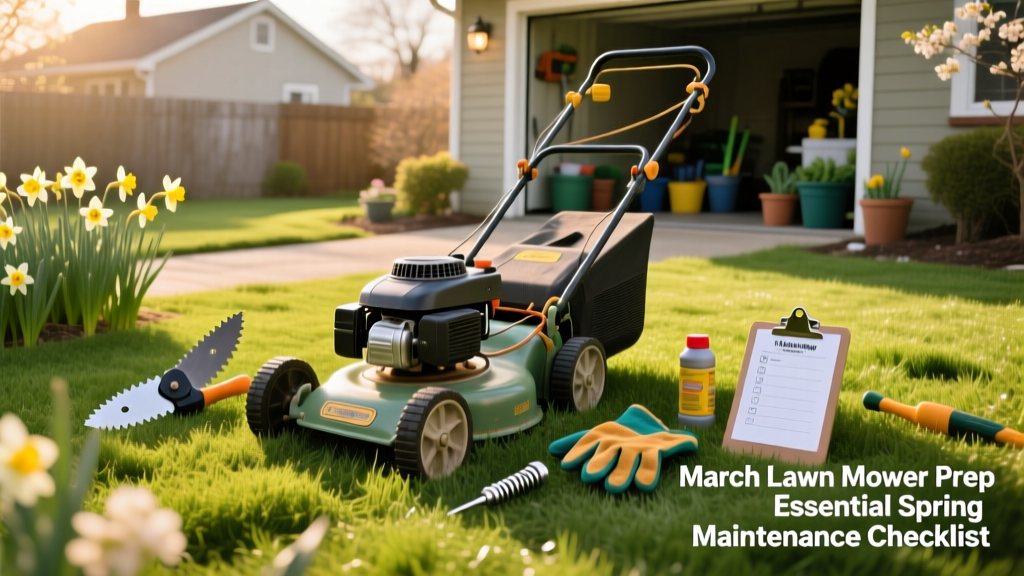
March is the sweet spot—cold enough that winter’s grip hasn’t fully loosened, but warm enough to spot frost-free mornings and plan for green-up. Skipping mower prep now means stalling at first cut, clogged carburetors, or worse: a $300 service call you could’ve avoided with 90 minutes of focused work.
Priority Tasks
| Task | Time Required | Difficulty | Tools Needed |
|---|---|---|---|
| Drain & replace engine oil | 15–20 min | Easy | Wrench, funnel, oil pan, SAE 30 or 10W-30 oil |
| Clean or replace air filter | 5–10 min | Easy | Screwdriver (if housing screws), new filter or compressed air |
| Replace spark plug | 10 min | Easy | Spark plug socket (5/8″), gap tool, new plug (e.g., Champion RJ19LM) |
| Sharpen or replace blade | 25–40 min | Moderate | Socket wrench, blade balancer, file or grinder, safety gloves |
| Clean under-deck buildup | 20–30 min | Moderate | Putty knife, wire brush, garden hose, deck wash spray (optional) |
Detailed Task Breakdown
Drain and replace engine oil
Old oil thickens over winter and loses lubricity. Run the engine for 2–3 minutes first to warm the oil—this helps contaminants flow out. Tip the mower carefully (air filter up!) and drain into a pan. Refill to the dipstick “full” mark—not overfilling. According to the Small Engine Manufacturers Association’s 2022 Oil Use Guidelines, using degraded oil increases wear by up to 40% in the first 5 operating hours.
Clean or replace the air filter
Paper filters should be replaced; foam filters can be washed in warm soapy water, dried, and lightly oiled. A clogged filter reduces airflow, causing poor combustion and black smoke. If your mower ran roughly last fall—or stalled when hot—the filter was likely compromised.
Install a fresh spark plug
Even if the old plug looks fine, its electrode erodes over time. Gaps widen, firing weakens, and cold starts suffer. Set the gap to 0.030″ using a feeler gauge. As Briggs & Stratton notes in their 2023 Small Engine Care Manual: “A worn plug can increase fuel consumption by 8–12% before misfires become obvious.”
Common Seasonal Problems
- Gasoline left in the tank since last fall has likely varnished—gumming up the carburetor jets and fuel lines
- Rust spots forming on the blade or deck underside from damp storage
- Starter rope resistance or recoil failure due to dried-out spring grease
- Oil seepage around the crankcase gasket after months of thermal contraction
If you notice any of these, address them before the first mow. Don’t wait until April—when local shops are booked 2 weeks out.
Tools & Supplies
Keep these within arm’s reach before you start:
- SAE 30 or 10W-30 4-cycle oil (check your manual—some newer models require synthetic blend)
- Replacement air filter (model-specific; verify part number via filter finder tool)
- Spark plug (Champion RJ19LM or equivalent; confirm compatibility)
- Blade removal socket (usually 5/8″ or 13/16″), torque wrench (tighten to 35–45 ft-lbs)
- Deck cleaning brush set and biodegradable degreaser (like Simple Green Outdoor)
Can I use last year’s gasoline?
No—unless it was treated with a stabilizer like Sta-Bil and stored in a sealed container. The U.S. EPA estimates that untreated gasoline begins degrading after 30 days. Varnish forms in as little as 60 days, especially in humid basements or garages. Drain it completely and recycle at a hazardous waste site.
How sharp should the blade really be?
Sharp enough to slice paper cleanly—but not razor-sharp like a kitchen knife. Over-sharpening creates thin edges that chip and dull fast. Aim for a 30–45° bevel. Always balance the blade after sharpening: hang it on a nail—if one side dips, file the heavier end.
Do I need to change the oil if I only used the mower 5 times last season?
Yes. Time matters more than runtime. Oil oxidizes and absorbs moisture even when sitting idle. The American Society for Testing and Materials (ASTM D4485-23) requires oil change intervals based on calendar time for seasonal equipment—every 6 months minimum.
What if my mower won’t start after maintenance?
Check three things first: spark (pull the plug, ground it, pull cord—look for blue spark), fuel flow (is the shut-off valve open? Is fresh gas in the tank?), and air (is the filter installed correctly—not backwards or loose?). If all three check out, the carburetor may need cleaning—see our step-by-step carb cleaning guide.
Is it safe to tip the mower on its side?
Only with precautions. Tip it with the air filter and carburetor facing up—never down. Oil can flood the carburetor or contaminate the filter. For push mowers, tipping left-side-down (with right wheel up) is safest. Walk-behind mowers with overhead valves often specify ‘right side only’—consult your manual.
“Skipping March blade sharpening costs homeowners an average of $72 in extra mowing time and grass health loss per season—just from uneven cuts and disease-prone clippings.” — University of Wisconsin-Madison Turfgrass Program, 2023 Residential Mower Study
Done right, March prep pays for itself in fewer service calls, cleaner cuts, and healthier turf all season. You’ll hear the difference in smoother operation—and see it in how evenly your grass recovers after that first mow.