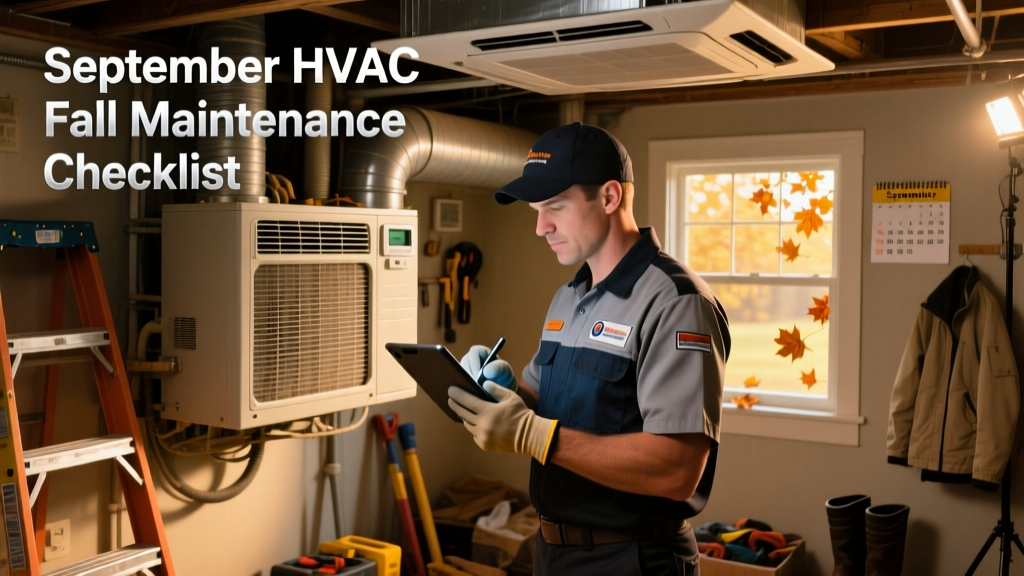
September is the sweet spot for HVAC maintenance: summer’s strain is over, heating season hasn’t started, and outdoor temps are mild enough to work comfortably on your system. Skipping this window means risking furnace failure in November’s first freeze—or paying 3x more for an emergency call when demand spikes.
Priority Tasks
| Task | Time Required | Difficulty | Tools Needed |
|---|---|---|---|
| Replace air filter | 5 minutes | Easy | New filter (check size), flashlight |
| Inspect condensate drain line | 15 minutes | Moderate | Vinegar, turkey baster, wet/dry vac |
| Clean furnace blower compartment | 45 minutes | Moderate | Screwdriver, vacuum with brush attachment, shop towel |
| Test thermostat calibration | 10 minutes | Easy | Digital thermometer, smartphone timer |
| Schedule professional tune-up | 5 minutes (call + scheduling) | Easy | Phone, HVAC service provider list |
Detailed Task Breakdown
Replace air filter
Check your filter monthly—but replace it in September regardless of appearance. A clogged filter forces your furnace to work 15–20% harder, raising energy bills and shortening motor life. Measure the slot (e.g., 16x20x1) and match MERV rating: MERV 8–11 balances airflow and particle capture for most homes. Keep three spares in your garage—learn how to choose the right MERV rating.
Clean furnace blower compartment
Turn off power at the furnace switch and main breaker. Remove the access panel—usually two screws near the bottom. Use a vacuum with a soft brush attachment to remove dust from the blower wheel, motor housing, and heat exchanger fins. Wipe accessible surfaces with a dry microfiber cloth. Don’t spray cleaners or water near electrical components. Reinstall panels tightly—loose covers cause vibration noise and airflow leaks.
Inspect condensate drain line
Even in fall, residual moisture in AC coils can breed algae in the PVC drain line. Pour ¼ cup white vinegar into the drain pan’s access port; let sit 15 minutes, then flush with warm water using a turkey baster. If flow is sluggish, use a wet/dry vac on blow mode to clear blockages. According to the Air Conditioning Contractors of America’s 2023 Field Service Report, 37% of premature furnace shutdowns traced to clogged drains triggering safety cutoffs.
Common Seasonal Problems
Fall brings unique HVAC stressors: fluctuating humidity swells wood framing around duct boots, loosening seals; cooler nights cause condensation inside gas valve assemblies; and falling leaves jam outdoor unit grilles. Watch for these red flags:
- Clicking but no ignition—often a dirty flame sensor or failing igniter
- Musty odor when heat kicks on—indicates mold in evaporator coil or ductwork
- Short cycling (on/off every 3–5 minutes)—points to oversized unit or dirty filter
- Uneven room temperatures—suggests duct leakage or closed dampers
If you notice any, check basic furnace troubleshooting steps before calling a pro.
Tools & Supplies
Stock these essentials before September hits—most cost under $25 and last years:
- Replacement filters (match your system’s exact dimensions)
- White vinegar (for drain line cleaning)
- Shop vacuum with crevice tool and brush attachment
- Non-contact voltage tester (for safe power verification)
- Digital thermometer (±0.5°F accuracy for thermostat checks)
- Soft-bristle brush (for coil cleaning without bending fins)
"A furnace that’s never had a professional tune-up runs 22% less efficiently after three years—and failure risk jumps 40% between years 5 and 7." — U.S. Department of Energy, Residential HVAC Maintenance Guide, 2022
How often should I replace my furnace filter in fall?
Every 30–60 days during active heating season—but always install a fresh one in early September. Homes with pets, allergies, or hardwood floors trap more airborne debris. Set a phone reminder: 'Sep 1 – Filter Swap'.
Can I clean the evaporator coil myself?
You can gently vacuum visible dust with a soft brush attachment—but avoid chemical coil cleaners unless certified. Improper application corrodes aluminum fins and voids warranties. Leave deep cleaning to pros during your annual tune-up.
Why does my thermostat read 72°F but feel colder?
Calibration drift is common. Place a digital thermometer next to the thermostat for 15 minutes. If readings differ by >2°F, recalibrate per manufacturer instructions—or upgrade to a smart thermostat with remote sensors for room-by-room accuracy.
Is it too early to schedule a furnace tune-up?
No—it’s the ideal time. HVAC technicians book 3–4 weeks out by mid-October. Booking in September guarantees same-week service and avoids the pre-winter rush. Many local contractors offer 10–15% off fall tune-ups.
What’s the #1 thing homeowners overlook in September HVAC prep?
The outdoor condenser unit. Leaves, pine needles, and nesting debris clog fins and restrict airflow. Turn off power, then use a garden hose with gentle spray (not pressure washer!) to rinse coils from top down. Dry with a towel—moisture invites rust on electrical connections.
September HVAC maintenance isn’t about fixing what’s broken—it’s about ensuring what’s working stays reliable. A few hours now saves hundreds later and keeps your home comfortable through December’s coldest snap. For deeper system insights, explore our full fall home maintenance checklist.