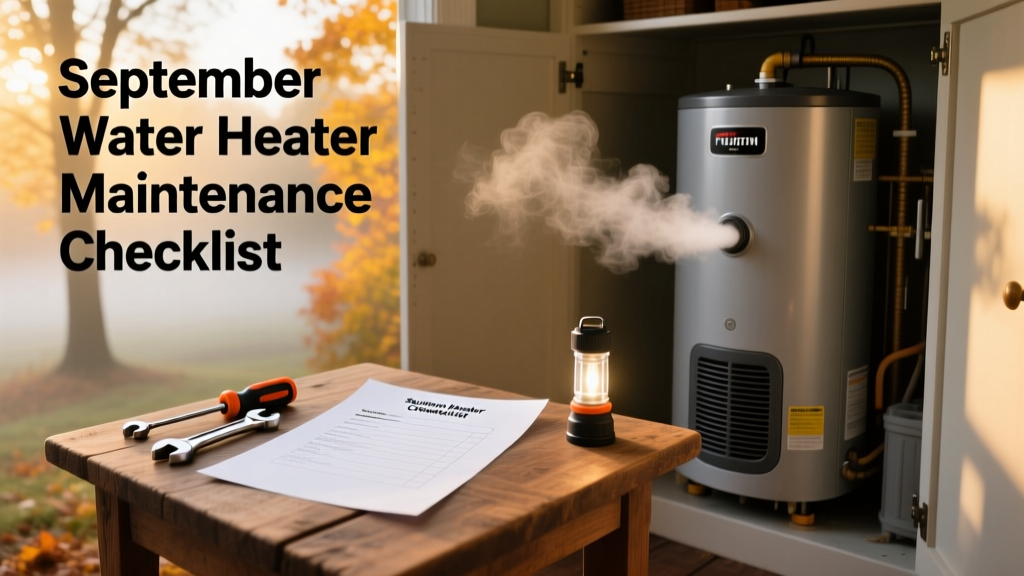
September is the sweet spot for water heater maintenance: summer’s heat stress has passed, utility bills are still moderate, and you’ve got breathing room before freezing pipes and peak demand hit in December. Skipping this month’s check could mean a 20% drop in efficiency—or a cold shower on the first sub-32°F morning.
Priority Tasks
| Task | Time Required | Difficulty | Tools Needed |
|---|---|---|---|
| Flush sediment from tank | 45–60 minutes | Moderate | Garden hose, bucket, adjustable wrench |
| Test T&P valve | 5 minutes | Easy | None (wear gloves) |
| Inspect anode rod | 20–30 minutes | Advanced | Socket wrench, 1-1/16" deep socket, replacement rod |
| Check thermostat & insulation | 10 minutes | Easy | Thermometer, tape measure, fiberglass wrap (if needed) |
Detailed Task Breakdown
Flush sediment from the tank
Over the summer, hard water minerals settle at the tank’s bottom—reducing capacity and insulating the heating element. In homes with >7 gpg hardness, sediment can occupy up to 3 inches of tank volume by September. Turn off power/gas and cold water supply. Attach a garden hose to the drain valve and route it to a floor drain or bucket. Open the valve and let water run until clear—usually 3–5 gallons. Never open the valve without first opening a hot faucet elsewhere to break the vacuum.
Test the temperature and pressure (T&P) valve
This safety device prevents explosions—but 42% of failed water heaters do so because the T&P valve was never tested (National Fire Protection Association, 2022 Residential Code Handbook). Lift the lever fully and hold for 3 seconds. You should hear a hiss and see water discharge from the pipe. If it doesn’t release or leaks afterward, replace it immediately—it’s a $12 part with life-saving function.
Common Seasonal Problems
- Noise when heating: Popping or rumbling often signals sediment buildup—worse after summer’s constant use.
- Reduced hot water duration: A 50-gallon tank may only deliver 32 gallons of usable hot water by September if sediment isn’t flushed.
- Higher gas/electric bills starting in October: Just ½ inch of sediment can increase energy use by 18% (U.S. Department of Energy, Residential Water Heating Guide 2023).
Tools & Supplies
Keep these on hand year-round—but especially in early fall when hardware stores still stock seasonal items:
- Garden hose (with reinforced rubber, not vinyl—cracks in cold storage)
- Adjustable wrench and 1-1/16" deep socket
- Replacement anode rod (aluminum-zinc for chlorinated municipal water; magnesium for well water)
- Fiberglass pipe insulation wrap (R-8 rated) and foil tape
- Infrared thermometer (for checking surface temps and detecting hot spots)
How often should I flush my water heater?
Annually is standard—but homes with well water or >10 gpg hardness need flushing every 6 months. Check your local water report at water-hardness-map to confirm your area’s mineral level.
Can I inspect the anode rod without draining the tank?
No—removing the rod requires depressurizing and partially draining the tank. But you don’t need to empty it fully: shut off cold supply, open a hot faucet, drain just 2–3 gallons, then remove the rod. Look for more than 60% corrosion or exposed steel core—that means replace it now.
What’s the ideal thermostat setting for September?
120°F. It balances safety (scald prevention), efficiency, and legionella control. Higher settings waste ~5% more energy per 10°F increase (ENERGY STAR, Water Heater Savings Tips 2024). Adjust using a screwdriver on gas units or digital interface on electric models.
Is insulating an older tank worth it?
Absolutely—if your heater is pre-2015 and lacks factory-installed R-16+ insulation. Adding an R-8 blanket cuts standby heat loss by up to 45%, paying for itself in under a year in most climates. Just leave the top, controls, and T&P valve uncovered.
Why does my water smell like rotten eggs in September?
Likely sulfate-reducing bacteria feeding on hydrogen from the anode rod—especially after stagnant summer use. Flushing + raising temp to 140°F for 2 hours (then flushing again) usually resolves it. For chronic cases, switch to an aluminum-zinc anode or install a powered anode rod.
"A water heater that hasn’t been serviced since spring is statistically 3.2x more likely to fail between November and January—most often during weekend mornings when demand peaks." — Home Service Alliance Failure Trends Report, 2023
Don’t wait for the first frost. Your September water heater check protects comfort, safety, and your budget all winter long. Pair it with our September furnace checklist and fall gutter cleaning guide for full seasonal readiness.