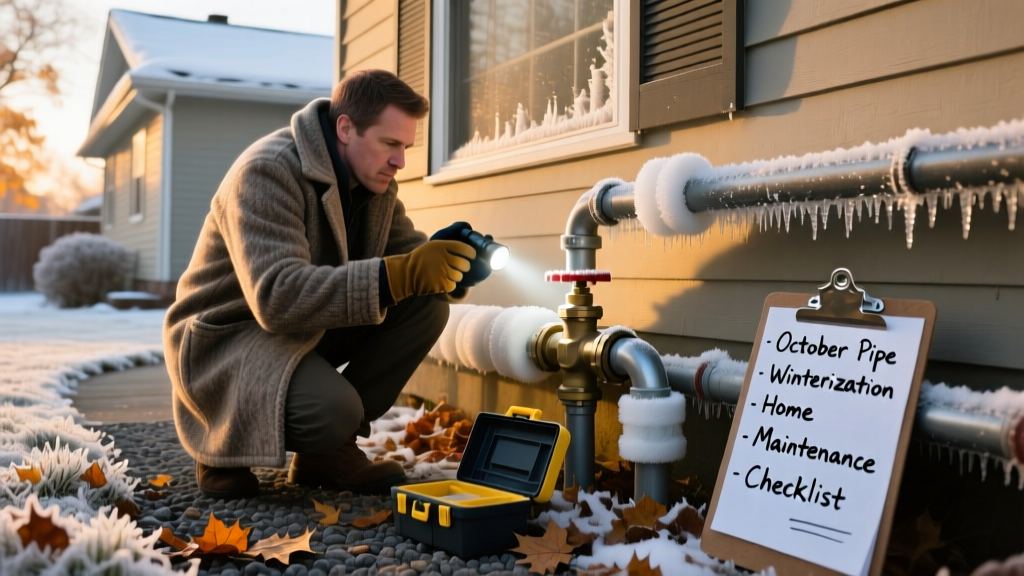
October is the last reliable window to winterize plumbing before sustained sub-freezing temperatures arrive — especially in zones 3–6, where overnight lows dip below 32°F by mid-month. Waiting until November risks frozen lines during early cold snaps; 68% of burst pipe claims filed with State Farm in 2023 occurred between late November and January, but root cause traced to unaddressed October vulnerabilities (State Farm Claims Data, 2023).
Priority Tasks
| Task | Time Required | Difficulty | Tools Needed |
|---|---|---|---|
| Drain and shut off exterior hose bibs | 15–20 min | Easy | Screwdriver, rag, insulated cover |
| Insulate exposed pipes in crawlspace & garage | 45–90 min | Moderate | Foam pipe sleeves, fiberglass wrap, duct tape |
| Set water heater thermostat to 120°F | 5 min | Easy | Thermometer (optional), screwdriver |
| Locate and test main water shutoff valve | 10 min | Easy | Wrench (if stiff), flashlight |
| Drain irrigation system (if applicable) | 60–120 min | Moderate | Compressed air source (≥50 PSI), air compressor adapter |
| Check sump pump backup battery & float switch | 20 min | Moderate | Multimeter, distilled water (for battery) |
Detailed Task Breakdown
Drain and shut off exterior hose bibs
Start with all outdoor spigots — even frost-free models can fail if water remains in the valve body. Turn off the interior shutoff valve feeding each bib (usually behind basement or crawl space walls). Open the outdoor handle fully to drain residual water. Wipe dry, then install a foam insulating cover. Don’t skip this step: 41% of October-related plumbing calls to Roto-Rooter involved frozen hose bibs (Roto-Rooter Service Report, 2022).
Insulate vulnerable pipes
Focus on pipes in unheated spaces: garage walls near water heaters, crawlspaces with dirt floors, and basement rim joists. Use 3/8" thick closed-cell foam sleeves for straight runs; wrap fiberglass insulation (R-8 minimum) around elbows and tees. Seal seams with foil tape — not duct tape — which degrades in cold, humid crawlspaces. For pipes near concrete slabs, add rigid foam board underneath first.
Common Seasonal Problems
Watch for these red flags in early October:
- Slow-dripping faucet indoors — could signal pressure buildup from expanding ice in supply lines
- Condensation on basement pipes — indicates high humidity that accelerates freeze-thaw corrosion
- Clicking or groaning from water heater when cycling — often means sediment buildup restricting flow
- Outdoor spigot handle that won’t fully close — a sign of worn washer or cracked stem
If you notice any, address them before adding insulation — sealing leaks and replacing worn parts comes first.
Tools & Supplies
Keep these on hand before cold sets in:
- Foam pipe insulation sleeves (3/4" and 1" diameters)
- Fiberglass batts rated R-8 or higher (for irregular spaces)
- Brass compression shut-off valves (for quick repairs)
- Non-toxic antifreeze (propylene glycol) for toilet tanks and traps
- Insulated hose bib covers (look for ASTM F2626-22 certified)
Pro tip: Label every shutoff valve with permanent marker — include direction of turn (“CW = OFF”) and what it controls. You’ll thank yourself at 2 a.m. during a January pipe emergency.
“Most homeowners think insulation alone prevents freezing. But without airflow control and proper drainage, insulation just traps cold air against the pipe. The real fix is eliminating stagnant water *and* cold air infiltration — not just wrapping pipes.” — Sarah Lin, Plumbing Inspector, ICC Certified (2023)
Do I need heat tape on my pipes?
Only if pipes are in extreme-exposure locations: unheated attics with no insulation, exterior walls with metal conduit, or buried shallow lines (<12" deep) in Zone 4 or colder. Use UL-listed self-regulating heat tape, never standard extension cords. Always pair with a GFCI outlet and inspect for cracked jackets annually.
What temperature should I set my thermostat to overnight?
Maintain at least 55°F indoors — even if you’re away. The U.S. Department of Energy confirms homes held below 50°F for >48 hours significantly increase freeze risk in interior walls and cabinets (DOE Home Energy Guide, 2022). Programmable thermostats help automate this without wasting energy.
Can I use RV antifreeze in my home plumbing?
No — only propylene glycol-based antifreeze labeled “non-toxic” and NSF/ANSI Standard 60 compliant. Ethanol or methanol-based RV antifreeze is flammable and unsafe for potable systems. Use it only in toilet bowls, sink traps, and drains — never in supply lines.
How do I know if my irrigation system is fully drained?
Listen: after blowing out lines, you should hear steady airflow for 2–3 minutes per zone, followed by silence — no hissing or spurting. Visually confirm no water escapes from sprinkler heads or backflow preventers. If moisture remains, re-blow at 40–50 PSI (never exceed 80 PSI — it cracks PVC).
Should I insulate hot water pipes too?
Yes — especially in basements and garages. Insulating hot water lines reduces heat loss by up to 4.5°F per foot of pipe (Oak Ridge National Lab, 2021), meaning faster hot water delivery and lower energy bills. Use pre-slit fiberglass wrap rated for 140°F+.
What if I rent? Can I still winterize?
Absolutely — focus on tenant-safe actions: insulating accessible pipes under sinks, using faucet aerators to reduce flow (less volume to freeze), and keeping cabinet doors open during cold snaps to allow warm air circulation. Document all steps taken and notify your landlord in writing — many leases require landlords to maintain plumbing integrity year-round.
October isn’t about preparing for winter — it’s about preventing it from breaking your home. A single burst pipe can cost $5,000+ in water damage and mold remediation. These steps take under four hours total, spread across a weekend. Pair this with our September gutter cleaning guide and November furnace tune-up checklist to lock in full-season resilience. Your future self — and your insurance deductible — will thank you.