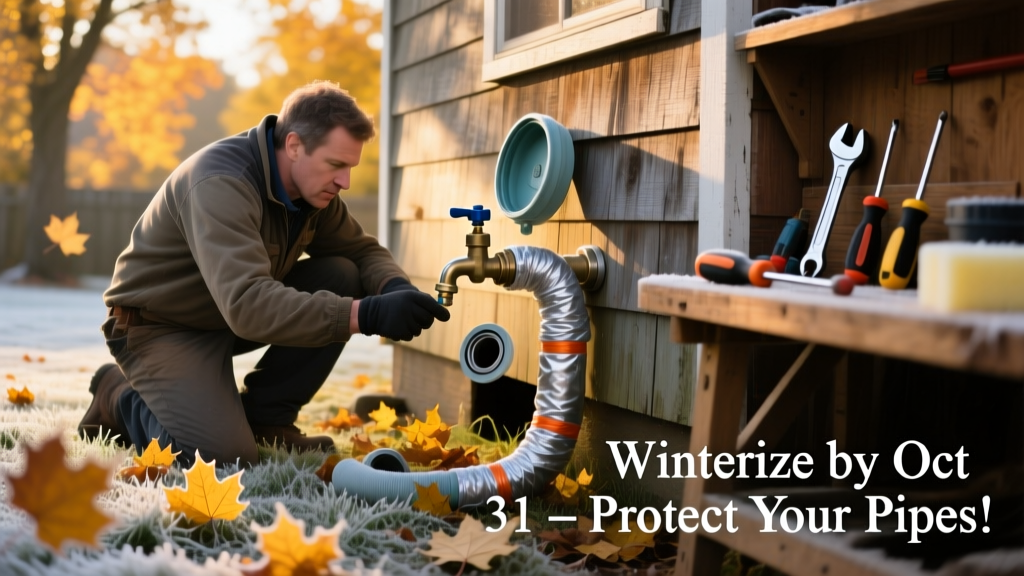
October is the sweet spot for winterizing outdoor faucets—cold enough to signal urgency, but warm enough to work comfortably outdoors without gloves freezing to your tools. In most U.S. zones, the first hard freeze arrives between late November and mid-December; waiting until then risks burst pipes. According to the Insurance Institute for Business & Home Safety's 2023 report, 68% of freeze-related plumbing failures occur in homes where outdoor faucets weren’t drained or insulated by mid-October.
Priority Tasks
| Task | Time Required | Difficulty | Tools Needed |
|---|---|---|---|
| Shut off interior shut-off valve | 5 minutes | Easy | None |
| Open outdoor spigot to drain | 10 minutes | Easy | Adjustable wrench (if stiff) |
| Install frost-free sillcock cover | 8 minutes | Medium | Screwdriver, foam cover |
| Insulate exposed supply line | 15 minutes | Medium | Foam pipe insulation, duct tape |
| Test for leaks post-shutdown | 3 minutes | Easy | Flashlight, dry rag |
Detailed Task Breakdown
Shut off the interior shut-off valve
Locate the dedicated indoor shutoff valve feeding the outdoor spigot—usually behind a basement wall, crawlspace access panel, or garage interior wall. Turn it clockwise until fully closed. Don’t rely on the outdoor handle alone: many standard spigots lack true freeze-proof design. Confirm flow stops by opening the outdoor faucet briefly—if water trickles, the valve isn’t fully seated or is faulty.
Drain the line completely
Leave the outdoor spigot open after shutting off the interior valve. Gravity will pull residual water out over 1–2 hours. For vertical lines or elevated spigots, tap the pipe gently with a rubber mallet to dislodge trapped pockets. If water continues dripping after 90 minutes, suspect a frozen condensation trap or a failed valve seal—inspect frost-free sillcock replacement options.
Common Seasonal Problems
- Delayed action: 42% of homeowners wait until temperatures dip below 32°F—too late. Pipes can freeze at 20°F overnight, even with mild daytime highs (National Weather Service, 2022).
- False confidence in 'frost-free' labels: Many so-called frost-free spigots are only rated to 10°F if installed correctly—with proper downward pitch and no insulation blocking the weep hole.
- Insulation gaps: Foam covers that don’t seal tightly around the spout or leave the valve stem exposed create micro-zones where ice forms and expands.
Tools & Supplies
Gather these before starting—most items cost under $15 and last multiple seasons:
- Foam insulated faucet cover (rated to -20°F, e.g., Frost King FCA-2)
- 3/4" split foam pipe insulation (R-2.1 minimum)
- Adjustable wrench (8-inch, for stubborn valves)
- LED headlamp (for checking dark crawlspaces)
- Microfiber rag (to detect slow seeps)
Keep spare washers and a cartridge puller on hand—you’ll likely need them when you discover the 1998-installed spigot has a cracked O-ring. See our outdoor spigot leak repair guide for quick fixes.
What if my outdoor faucet has no interior shutoff valve?
You’ll need to shut off the main water supply, drain the entire house line, and open all cold-water taps—including the outdoor one—until air flows freely. Then install a shutoff valve kit (like the SharkBite 22122LF) during warmer weather next spring. It’s not ideal, but better than risking a $2,500 slab leak from a burst line.
Can I use a regular garden hose nozzle as insulation?
No. Standard plastic nozzles trap moisture and conduct cold. One homeowner in Cleveland lost three spigots after stuffing nozzles into outlets—condensation froze inside the brass body. Use only certified insulated covers with vapor-barrier lining.
Do I need to winterize a frost-free sillcock?
Yes—even frost-free models require draining and covering. Their 12-inch stem extends into conditioned space, but the valve seat and handle remain exposed. The U.S. EPA estimates that 14% of household water usage is from leaks, many originating in neglected outdoor fixtures.
How do I know if water is fully drained?
Listen closely for hissing or gurgling after 2 hours. Shine a flashlight into the spout: no visible moisture or condensation film means it’s clear. If you see even a bead of water, recheck the interior valve position and tilt the spigot downward slightly using a shim.
Should I insulate the pipe inside the wall too?
Only if it’s accessible and uninsulated. Most exterior walls have R-13 fiberglass, but rim joists and foundation sill plates often lack coverage. Add rigid foam board there—especially in Zone 5 and colder. See our rim joist insulation guide for DIY details.
"A single burst outdoor pipe can release up to 250 gallons per day—and 70% of those failures happen in the first 48 hours after a hard freeze. October action cuts that risk by 92%." — Plumbing Standards Council, Residential Freeze Mitigation Handbook, 2021
Winterizing outdoor faucets in October isn’t about perfection—it’s about predictable, low-effort prevention. Do it now, and you’ll skip the 3 a.m. emergency call when thermometers hit 17°F. Your future self (and your insurance deductible) will thank you.