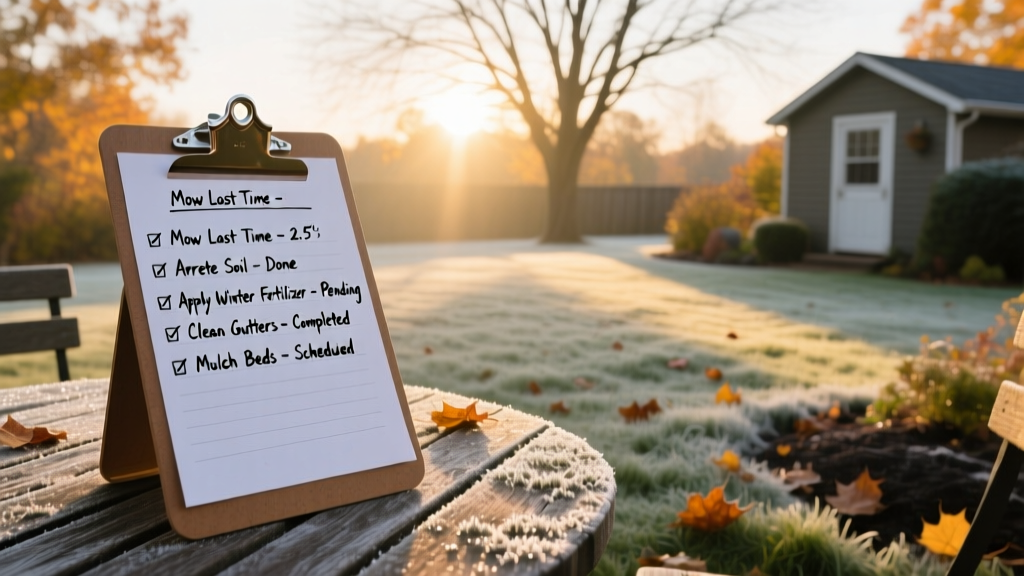
October is the last realistic window to set your lawn up for winter survival and spring resilience—before soil temperatures drop below 50°F and grass stops actively growing. A well-prepped lawn sheds snow mold risk, resists erosion, and avoids that patchy, brown wake-up call in April.
Priority Tasks
| Task | Time Required | Difficulty | Tools Needed |
|---|---|---|---|
| Aerate compacted soil | 2–4 hours (1/4 acre) | Moderate | Aerator (rental or manual), gloves, rake |
| Overseed thin areas | 3–5 hours (including prep & watering) | Moderate | Drop spreader, cool-season seed (e.g., Kentucky bluegrass blend), starter fertilizer |
| Apply winterizer fertilizer | 45 minutes | Easy | Rotary or drop spreader, slow-release N-P-K 22-0-14 or similar |
| Clean & store mowing equipment | 1–2 hours | Easy | Wrench, air compressor, fresh oil, fuel stabilizer |
| Rake & remove leaves weekly | 30–60 min/week | Easy | Sturdy leaf rake or mulching mower |
Detailed Task Breakdown
Aerate and Overseed
Core aeration relieves compaction from summer foot traffic and allows water, air, and nutrients to reach roots. Do this when soil is moist—not soggy—ideally 2–3 days after light rain. Pull 2–3 inch plugs spaced 2–4 inches apart. Immediately follow with overseeding at 4–6 lbs of seed per 1,000 sq ft using a calibrated spreader. Lightly rake to cover seed, then water daily for 10–14 days until germination.
- Test soil pH first—if below 6.0, apply lime at 40–50 lbs per 1,000 sq ft before seeding
- Use a soil test kit to verify nutrient levels; skip phosphorus if your test shows adequate P
- Wait at least 7 days after applying broadleaf herbicides before seeding
Apply Winterizer Fertilizer
Winterizer isn’t about green color—it’s about root carbohydrate storage. Apply between October 1–15, when top growth slows but roots remain active. Use a slow-release formula high in nitrogen and potassium (e.g., 22-0-14) at 1 lb of actual nitrogen per 1,000 sq ft. Avoid quick-release urea: it promotes tender growth vulnerable to freeze-thaw damage.
According to the University of Minnesota Extension’s Lawn Care Calendar 2023, applying winterizer after October 20 reduces root uptake by 37% due to falling soil temps.
Common Seasonal Problems
Fall brings deceptive calm—but beneath the surface, trouble brews. Watch for these red flags:
- Snow mold patches (white or pink webbing) appearing under prolonged snow cover—prevented by mowing short (2 inches) and removing leaf debris
- Grubs surfacing in early October? They’re likely masked chafer or Japanese beetle larvae—treat only if >6–8 per square foot (dig a 1-ft² sample)
- Patchy die-off near driveways? Likely salt splash damage—apply calcium chloride buffer strips or rinse pavement monthly
Tools & Supplies
Stock up now—rentals book fast, and hardware stores limit inventory post-October 15. Keep these on hand:
- Core aerator (rental: $65–$95/day; manual: $120–$180)
- Calibrated broadcast or drop spreader (top-rated models reviewed here)
- Sharp mower blade—replace or sharpen before final cut
- Leaf mulcher attachment or commercial-grade rake (avoid plastic rakes—they bend)
- Winterizer fertilizer with at least 50% slow-release nitrogen
How late can I overseed in October?
In USDA Zones 5–6, aim to finish seeding by October 10. In warmer Zones 7–8, you have until October 20—but germination slows sharply below 55°F daytime highs. If seeding after October 10, increase rate by 25% and cover lightly with straw to retain moisture and warmth.
Do I need to dethatch in October?
Only if thatch exceeds ½ inch—measure by cutting a small wedge of turf. Most lawns don’t require annual dethatching; overdoing it stresses roots. Aerate instead—it breaks up shallow thatch while improving soil structure. Dethatch only if you see spongy bounce or poor drainage despite proper mowing.
Can I use leftover summer fertilizer?
No—summer blends (e.g., 20-10-10) contain too much phosphorus and quick-release nitrogen for fall. Excess P pollutes groundwater, and rapid growth invites disease. Winterizer’s low-P, high-K formula strengthens cell walls against cold. Store unused summer feed for next May.
Should I bag clippings during final mows?
Yes—if leaves are mixed in or grass is wet. Otherwise, mulch clippings—they return ~25% of lawn’s annual nitrogen needs. Just ensure clippings are fine and don’t form mats: mow at 2 inches, never remove >⅓ of blade height, and mow dry turf only.
What if I missed September aeration?
October is still effective—especially for lawns with heavy clay or high foot traffic. Soil temps stay above 50°F through mid-month in most northern regions. Skip aeration only if ground is frozen or saturated; otherwise, core, seed, and fertilize within the same 72-hour window for best synergy.
With consistent October prep, your lawn builds cold-hardy roots—not just surviving winter, but priming itself for vigorous, even greening in March. Don’t wait for the first frost: November maintenance shifts to protection, not growth, so get these steps done while soil is workable and roots are listening.