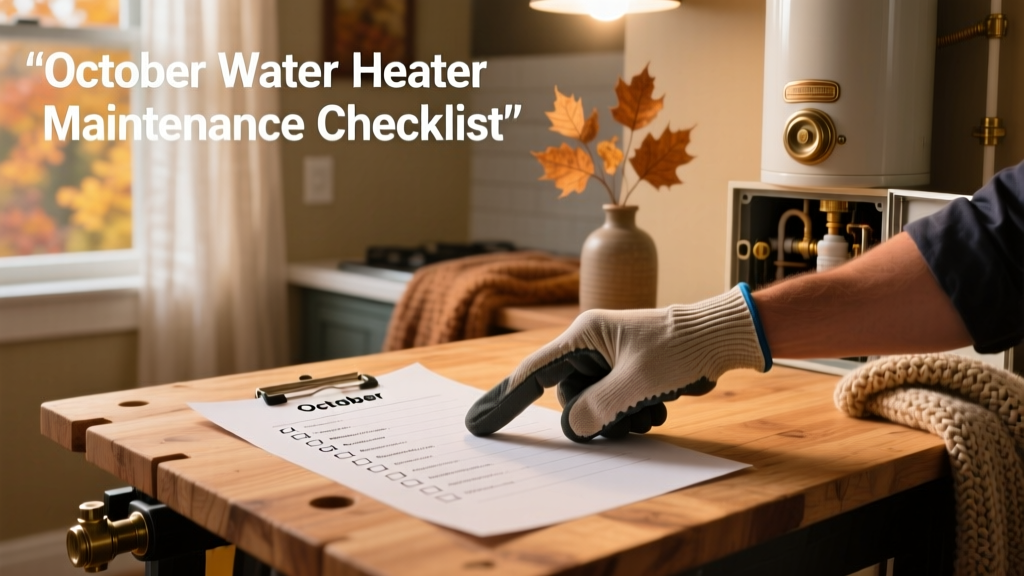
October is the sweet spot for water heater maintenance—cool enough to work comfortably outdoors or in the basement, but warm enough to avoid frozen pipes during testing. With heating season just weeks away, catching sediment buildup, thermostat drift, or pressure relief valve failure now prevents cold showers and costly emergency repairs in December.
Priority Tasks
| Task | Time Required | Difficulty | Tools Needed |
|---|---|---|---|
| Flush tank sediment | 45–75 min | Moderate | Garden hose, bucket, adjustable wrench, gloves |
| Test T&P valve | 5 min | Easy | None (but keep bucket nearby) |
| Inspect anode rod | 20–30 min | Advanced | Socket wrench (1-1/16"), pipe wrench, replacement rod |
| Check insulation & leaks | 10 min | Easy | Flashlight, dry rag, thermometer (optional) |
Detailed Task Breakdown
Flush the tank sediment
Drain at least 2–3 gallons from the bottom valve to remove mineral buildup. Sediment reduces efficiency by up to 30% and accelerates tank corrosion (U.S. Department of Energy, 2022). Turn off power/gas first. Attach a garden hose to the drain valve, route it to a floor drain or bucket, then open the valve. Let water run until clear—usually 3–5 minutes for electric tanks, longer for gas if sediment is heavy.
- Never open the drain valve without first opening a hot water faucet upstairs—this prevents vacuum lock
- If water remains cloudy after 5 gallons, flush another 2 gallons and recheck
- For homes on well water or hard water (>7 gpg), repeat flushing every 3 months
Test the temperature & pressure (T&P) valve
Lift the lever on the T&P valve fully and hold for 3 seconds. You should hear a hiss and see water discharge into your bucket. If it doesn’t release—or leaks afterward—it must be replaced immediately. According to the American Society of Mechanical Engineers’ 2021 Boiler and Pressure Vessel Code, T&P valves fail silently in 12% of units over age 5.
Common Seasonal Problems
As outdoor temps drop below 50°F, thermal contraction can reveal hidden cracks in fittings or loosened connections. You’ll also notice more frequent pilot light outages on older gas heaters—often due to condensation in the vent stack or spider webs in the orifice. Electric units may trip breakers when simultaneous loads (oven + dishwasher + heater) peak in early fall.
- Discolored or metallic-tasting hot water? Likely corroding anode rod or internal tank lining
- Reduced hot water volume despite normal recovery time? Check for failing dip tube (common in 1993–2007 Rheem and Bradford White models)
- Popping or rumbling noises? Sediment layer is boiling underneath—flush immediately
Tools & Supplies
Keep these within reach before starting: a 5-gallon bucket, non-contact voltage tester (for electric units), a digital thermometer (to verify thermostat accuracy), and a replacement anode rod (aluminum-zinc for municipal water; magnesium for wells). Stock two extra T&P valves—one standard 3/4" NPT, one with extended shank for tight spaces.
"Most water heater failures occur between November and February—but 87% show warning signs in October if you know where to look." — Home Performance Institute, Water Systems Field Manual 2023
How often should I flush my water heater?
Annually is the minimum for city water. Homes with well water or hardness above 120 ppm should flush every 6 months. Delaying beyond 18 months risks permanent sediment fusion to the tank bottom—a condition no flush can reverse.
Can I replace the anode rod myself?
Yes—if your heater has an accessible hex head on top (most tank-style units do). But don’t force it: seized rods often require penetrating oil and 24 hours of dwell time. If the rod is less than 1/2" thick or shows >6" of exposed core wire, replace it. Learn more in our anode rod replacement guide.
Why does my gas water heater smell like sulfur in October?
Cooler air changes airflow dynamics in the combustion chamber, sometimes causing incomplete burning of hydrogen sulfide in the water. Try raising the thermostat to 140°F for 2 hours, then flushing. If odor persists, test for sulfate-reducing bacteria—especially if you’re on a well (see well-specific fixes here).
Is insulating my water heater worth it in October?
Absolutely—if it’s an older model (pre-2015) with less than R-16 jacket insulation. A $25 fiberglass blanket cuts standby heat loss by 25–45%, saving ~$40/year (ENERGY STAR, 2023). Just leave the top, controls, and T&P valve uncovered—and never insulate a direct-vent or condensing unit.
What’s the ideal October thermostat setting?
120°F balances safety, efficiency, and legionella prevention. Setting higher invites scald risk and scale buildup; lower invites bacterial growth. Use a calibrated thermometer at the nearest faucet—not the dial—to confirm actual output temp.
October’s crisp air is your ally—not just for raking leaves. It’s the last calm before heating season chaos. A 90-minute water heater tune-up now buys you peace of mind through January’s coldest snaps—and helps your unit last 12+ years instead of 8. Don’t wait for the first chilly morning to wonder why the shower went cold.