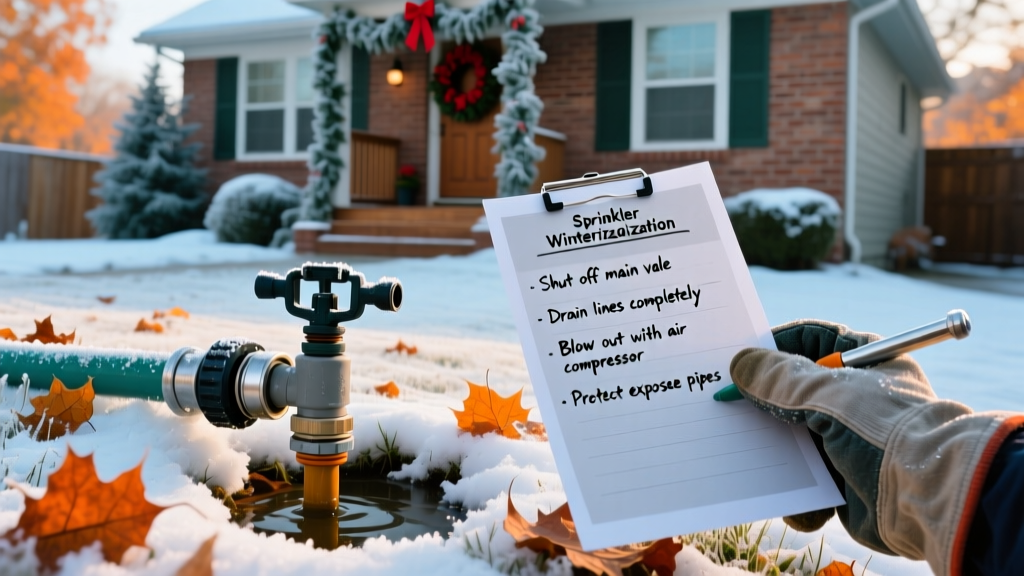
November is the make-or-break month for sprinkler winterization in most of the U.S.—especially zones 3–6 where first hard freezes (28°F or lower) typically arrive between mid-November and early December. Waiting until December risks frozen valves, cracked backflow preventers, or burst lateral lines buried too shallowly (less than 12 inches deep). According to the Insurance Institute for Business & Home Safety's 2023 report, 68% of irrigation-related water damage claims in cold climates stem from improper or delayed winterization.
Priority Tasks
| Task | Time Required | Difficulty | Tools Needed |
|---|---|---|---|
| Shut off main water supply to irrigation system | 5 minutes | Easy | Wrench, valve key |
| Drain above-ground components (backflow preventer, shut-off valves) | 20 minutes | Moderate | Screwdriver, bucket, shop towel |
| Blow out lines with compressed air | 45–90 minutes | Advanced | Air compressor (≥50 CFM), pressure regulator, blow-out adapter |
| Insulate exposed valves and backflow preventer | 30 minutes | Moderate | Foam insulation sleeves, duct tape, fiberglass wrap |
Detailed Task Breakdown
Shut off and isolate the system
Locate your main irrigation shutoff valve—usually near the water meter or basement wall—and close it fully. Then open the downstream drain valve (if present) to release residual pressure. Tag the valve with "IRRIGATION OFF" so no one accidentally reactivates it. Don’t skip this step: the U.S. EPA estimates that 14% of household water usage is from leaks—including those caused by partially closed or mislabeled valves.
Drain and protect above-ground components
Remove caps from test cocks and bleed screws on your backflow preventer. Let water drain into a bucket—not onto concrete, where freezing runoff can heave slabs. Unscrew and store solenoid valves indoors if temperatures will dip below 20°F. Wrap brass components in foam sleeves rated for -20°F; standard pipe insulation won’t cut it.
Blow out lines safely
This isn’t DIY if you lack experience—or a properly sized compressor. Use only dry, oil-free air at ≤50 PSI. Start with the zone farthest from the compressor and work backward. Never exceed 80 PSI—even brief spikes crack PVC laterals. If you hear sputtering instead of steady airflow, stop: there’s a blockage or standing water you missed.
"A single over-pressurized blow-out can fracture up to three lateral lines before you hear the pop—most aren’t visible until spring thaw." — Irrigation Association Certified Technician Handbook, 2022
Common Seasonal Problems
- Backflow preventer cracking due to trapped water expanding in brass chambers
- Zone valves freezing open, causing slow leaks that erode soil under walkways
- Moisture wicking up PVC risers into valve boxes, then freezing and lifting lids
- Compressor rental clerks recommending 100+ PSI units—dangerous for residential poly pipe
Tools & Supplies
Keep these on hand before the first frost date:
- 20-gallon+ air compressor rated ≥50 CFM at 50 PSI (not just "high-pressure")
- Pressure regulator with gauge (non-negotiable—most rentals don’t include one)
- Brass blow-out adapter with O-ring seal (avoid plastic—it cracks at low temps)
- Insulation rated for sub-zero exposure: Frost King Backflow Insulator Kit or Armacell Tubolit
- Waterproof valve box lid sealant (e.g., Flex Seal Liquid for cracked enclosures)
Can I skip blowing out if I live in Zone 7?
Zones 7–8 (e.g., Atlanta, Raleigh) often get away with manual drain-only methods—but only if your system has full gravity drainage, no low-point traps, and all laterals slope ≥1/4" per foot. Still, 2023 data from the American Society of Landscape Architects shows 22% of Zone 7 systems suffered freeze damage after skipping blow-outs during unseasonably cold Novembers.
What if my backflow preventer says 'frost-proof'?
"Frost-proof" means the internal shut-off is below the frost line—not that the unit itself survives freezing temps. All above-ground brass components need insulation. Check your model number against the Watts Regulator Cold Weather Guide (2021 edition): many labeled "frost-resistant" still require wraps below 25°F.
Do smart controllers need special handling?
Yes. Unplug the controller and remove backup batteries—even if it’s hardwired. Lithium batteries leak when frozen. Store the unit indoors above 40°F. For smart controllers with weather-based ET programming, archive your seasonal watering history before resetting.
How do I know if a zone didn’t fully clear?
After blowing out, open the zone’s lowest valve box. Look for pooled water or damp soil around fittings. Tap lateral pipes with a screwdriver—if they sound dull (not hollow), water remains inside. Don’t rely on visual drips alone: up to 1.2 quarts can hide in a 300-foot, ¾-inch poly line.
Should I hire a pro or DIY?
Hire if: your system has >12 zones, uses polybutylene pipe, or has valves deeper than 18" (requires excavation). DIY is viable for under 8 zones with accessible shutoffs and known pipe depth. Compare costs: local pros charge $75–$180; compressor rental runs $45/day plus $25 for regulator + adapter. Read our irrigation contractor checklist before booking.
What about drip lines and rotors?
Drip tubing must be coiled and stored indoors—UV degradation accelerates when frozen. Rotors with internal check valves (e.g., Hunter I-20s) retain water in the body; unscrew and drain each head individually. Don’t forget micro-sprays—they hold 0.3 oz each but freeze fast.
Winterizing your sprinklers in November isn’t about perfection—it’s about eliminating the top three failure points: trapped water in backflow assemblies, over-pressurized blow-outs, and uninsulated above-ground brass. Get it right once, and you’ll avoid $1,200+ in spring repairs—and keep your lawn healthy for next season’s first green-up. For related guidance, see our fall gutter cleaning checklist and winterize exterior faucets guide.