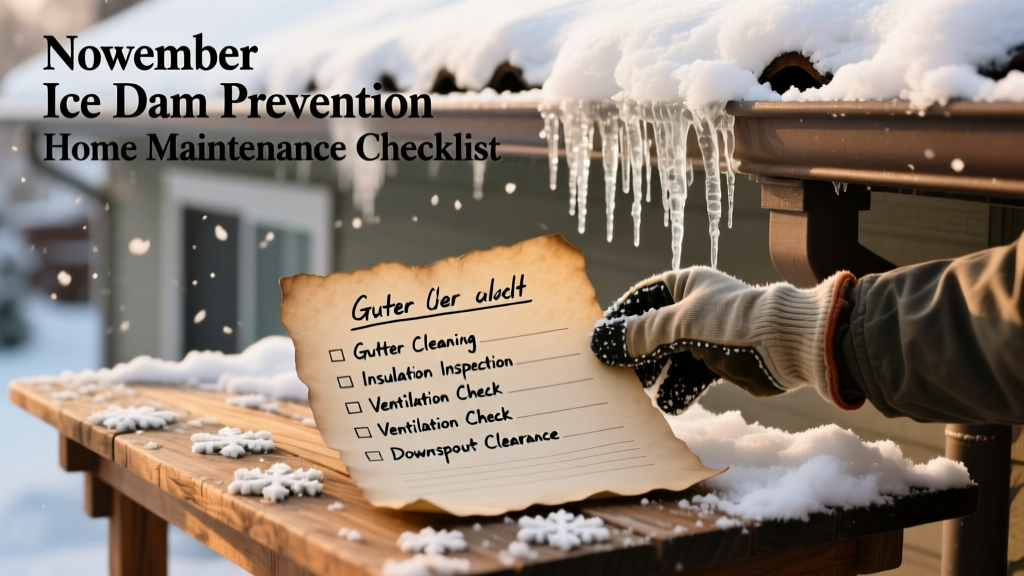
November is the last realistic window to stop ice dams before subfreezing temps lock in—once snow piles up and temperatures hover near 32°F, your roof’s thermal performance determines whether meltwater refreezes at the eaves. According to the Insurance Institute for Business & Home Safety's 2023 report, 68% of ice dam claims stem from preventable attic insulation or ventilation gaps—not weather alone.
Priority Tasks
| Task | Time Required | Difficulty | Tools Needed |
|---|---|---|---|
| Clean gutters and downspouts | 1.5–2 hours | Medium | Ladder, gloves, gutter scoop, garden hose |
| Seal attic bypasses (recessed lights, ducts, plumbing) | 3–4 hours | High | Expandable foam, caulk gun, flashlight, safety glasses |
| Verify attic insulation depth (R-49 minimum) | 30 minutes | Low | Tape measure, flashlight |
| Install roof de-icing cables (if needed) | 2–3 hours | Medium | Roof ladder, cable kit, UL-listed GFCI outlet |
| Check soffit and ridge vent clearance | 45 minutes | Medium | Flashlight, stiff brush, ladder |
Detailed Task Breakdown
Clean gutters and downspouts
Remove all leaves, pine needles, and debris—especially where downspouts connect. Flush each section with a garden hose using a spray nozzle set to "jet" mode. If water backs up or leaks at seams, replace worn hangers or seal joints with roofing cement. A clogged gutter can’t shed meltwater, turning every warm day into an ice dam trigger.
- Work from a stable extension ladder with standoff arms to protect shingles
- Never stand on the top three rungs—OSHA guidelines require at least three points of contact
- Dispose of debris in heavy-duty yard bags; avoid dumping onto shrubs or foundations
Seal attic bypasses
Use a flashlight at night to spot light leaks from below—these are air leaks that carry warm indoor air into the attic. Focus on recessed can lights (use IC-rated covers), attic hatches, whole-house fan openings, and pipe/duct penetrations. Apply fire-rated expanding foam around rigid conduits; use aluminum tape for flexible duct seams. The U.S. Department of Energy estimates sealing bypasses reduces attic heat gain by up to 30%.
Common Seasonal Problems
Watch for these early warning signs during November’s first cold snaps:
- Icicles thicker than 1 inch forming along eaves (not just isolated drips)
- Wet stains or frost on attic rafters or roof sheathing
- Visible gaps between insulation and top plates at exterior walls
- Soffit vents blocked by insulation baffle failure or bird nests
If you see any of these, prioritize sealing and ventilation checks *before* Thanksgiving—delaying past mid-November cuts your margin for error when snow arrives.
Tools & Supplies
Keep these on hand before the first hard freeze:
- Telescoping gutter cleaner (e.g., Gutter Getter Pro)
- Fire-rated expanding foam (Great Stuff Fireblock or Touch ‘n Foam Pro System 600)
- R-30 or R-60 unfaced fiberglass batts (for topping existing insulation)
- Attic ventilation baffles (e.g., AccuVent or Smart Vent)
- UL-listed roof de-icing cable (e.g., Heat Tape Pro 240V)
How much attic insulation do I really need?
In Climate Zones 5–7 (most of the northern U.S. and Canada), the DOE recommends R-49 minimum—roughly 14–16 inches of fiberglass or 10–12 inches of cellulose. Measure depth at multiple spots: if average is under 12 inches, add more. Don’t compress existing insulation—it loses R-value fast.
Can I install de-icing cables myself?
Yes—if you’re comfortable on a roof and follow manufacturer specs precisely. Route cables in a zigzag pattern along eaves and overhangs only—not up valleys or ridges. Use roof clips, not staples, and plug into a GFCI outlet tested monthly. Note: cables treat symptoms, not causes—always pair them with insulation and air sealing.
What’s the difference between soffit and ridge vents?
Soffit vents draw cool, dry air in at the eaves; ridge vents exhaust warm, moist air at the peak. They work as a system. If insulation blocks soffit vents (a common flaw), airflow stalls—and warm air pools at the roof deck, melting snow unevenly. Install rigid vent baffles before adding insulation to maintain a 1-inch air channel.
Do gutter guards prevent ice dams?
No—they may even worsen them. Solid-top guards trap heat against the roof edge and restrict water flow during rapid melt events. Mesh guards still clog with fine debris and offer no thermal benefit. Clean gutters remain more effective than any guard for ice dam prevention.
When should I call a pro instead of DIY?
Call a certified home energy auditor (look for RESNET or BPI credentials) if you find >2 inches of frost on rafters, persistent mold in the attic, or if your insulation is wet or compressed. Also consult a licensed roofer if you spot missing shingles, cracked flashing, or sagging gutters—these indicate structural issues no checklist fixes.
"Most ice dams aren’t caused by cold weather—they’re caused by heat escaping where it shouldn’t. Fix the attic, and the roof stays cold." — Dr. Jonathan Sturm, Building Science Advisor, Building Science Corporation, 2022
November isn’t about reacting to winter—it’s about setting your roof up to stay cold and dry. Do these six tasks now, and you’ll spend December watching snow melt evenly—not chipping ice off gutters at 6 a.m. For related guidance, see our attic insulation depth chart and gutter cleaning schedule.