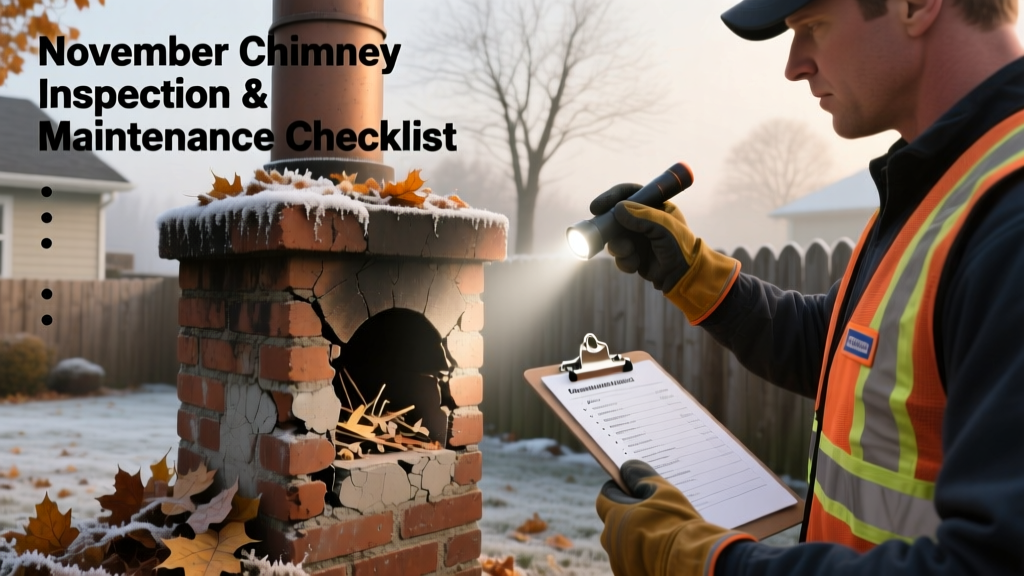
November is the last realistic window to inspect and service your chimney before sustained wood-burning begins—especially in colder regions where overnight lows dip below freezing. Waiting until December means risking creosote buildup ignition, blocked flues from nesting debris, or undetected masonry cracks worsened by freeze-thaw cycles. According to the U.S. Consumer Product Safety Commission’s 2022 data, 14% of home heating fires involve chimneys, and 73% occur between December and February—most preventable with pre-season attention.
Priority Tasks
| Task | Time Required | Difficulty | Tools Needed |
|---|---|---|---|
| Visual exterior inspection | 20 minutes | Easy | Ladder (20-ft), binoculars, notebook |
| Flue interior scan with mirror/light | 15 minutes | Moderate | Flashlight, angled inspection mirror, gloves |
| Clean damper mechanism & test operation | 10 minutes | Easy | Wire brush, lubricating oil, rag |
| Check smoke & carbon monoxide detector batteries | 5 minutes | Easy | 9V battery, screwdriver (if hardwired) |
| Schedule professional sweep if used >25 fires/year | 5 minutes (call time) | Easy | Phone, calendar app |
Detailed Task Breakdown
Inspect exterior masonry and cap
Set up a stable ladder and examine every inch of brickwork, mortar joints, and crown for hairline cracks, spalling (surface flaking), or loose bricks. Pay special attention to the chimney cap: confirm it’s securely fastened, rust-free, and covers the entire flue opening without gaps. A damaged cap lets rain in—accelerating corrosion and freeze-thaw deterioration. If you spot mortar crumbling deeper than ¼ inch or more than three cracked bricks, flag it for a mason before first snowfall.
Scan interior flue with mirror and light
With the damper fully open, shine a bright LED flashlight down the flue while holding an angled inspection mirror at the fireplace opening. Look for glazed creosote (shiny black deposits), bird nests, squirrel debris, or obstructions like fallen mortar. Glazed creosote is highly combustible and can’t be removed with standard brushes—it requires rotary cleaning or chemical treatment. If you see more than ⅛-inch of buildup, schedule a certified chimney sweep immediately.
Test and clean damper operation
Manually open and close the damper using its lever or handle. Listen for grinding or sticking. Wipe away soot and debris with a stiff wire brush, then apply a drop of high-temperature lubricant (like CRC Dry Lubricant) to pivot points. A seized damper prevents proper draft—and forces smoke into your living room when you light your first fire.
Common Seasonal Problems
Frost heave can shift foundation-mounted chimney supports by as much as ⅛ inch by late November, especially on clay soils—causing subtle misalignment that stresses flue liners. Squirrels often seal off flues with leaf-and-stick nests in early fall; by mid-November, those nests are compacted and nearly impenetrable without tools. And according to the Insurance Institute for Business & Home Safety’s 2023 report, 68% of chimney-related insurance claims filed after Thanksgiving involved water intrusion damage originating from uncapped or cracked crowns.
"If you haven’t swept your chimney by November 15th and plan to burn regularly this winter, you’re already behind. Creosote doubles in thickness with every 10–15 fires—so that ‘just one more’ weekend fire adds real risk." — Certified Chimney Sweep, National Fireplace Institute, 2023
Tools & Supplies
- 20-foot extension ladder with standoff arms (for roof-level access)
- LED headlamp + handheld flashlight (minimum 300 lumens)
- Stainless steel wire brush (3-inch diameter, chimney-rated)
- High-temp damper lubricant (not WD-40)
- Chimney cap sealant (e.g., Butyl Roof Cement for minor crown cracks)
- Carbon monoxide detector test kit (see our CO detector testing guide)
How often should I inspect my chimney if I only use it occasionally?
Even if you burn fewer than 12 fires per year, annual visual inspection is non-negotiable. Occasional use still deposits acidic condensate that corrodes stainless steel liners and dissolves mortar over time. The Chimney Safety Institute of America (CSIA) recommends inspection every 12 months regardless of usage frequency.
Can I clean creosote myself with a DIY brush kit?
You can remove level 1 creosote (powdery soot) safely with a nylon or poly brush and rod system—but never attempt level 2 (tar-like) or level 3 (glassy, rock-hard) deposits yourself. Those require specialized rotary tools or chemical agents applied by CSIA-certified professionals. DIY attempts on glazed creosote increase flue liner abrasion and risk dislodging unstable deposits onto your firebox.
What’s the difference between a chimney cap and a chase cover?
A chimney cap fits over the flue tile itself and prevents rain, animals, and downdrafts. A chase cover sits atop the entire wood-framed chimney enclosure (common on factory-built fireplaces) and seals the top of the chase—not the flue. Both need inspection, but only the cap protects the flue interior. Missing or warped chase covers cause rot in framing and insulation—check for pooling water or rust stains along seams.
Why does my chimney smell musty in November—even when unused?
That damp, earthy odor is almost always caused by moisture trapped in the flue during October rains, combined with organic debris (leaves, spider webs, dead insects) decomposing inside. It’s not mold—but persistent odor signals poor ventilation or a missing/defective top-sealing damper. Install a top-mount damper with gasket seal (see installation tips) to block humid air infiltration.
Do gas fireplace vent pipes need November inspection too?
Yes—especially direct-vent and B-vent systems. Check exterior termination caps for wasp nests, ice damming, or snow blockage. Inspect PVC vent runs (common on high-efficiency units) for cracks, UV degradation, or disconnected joints. The U.S. EPA estimates that 14% of household water usage is from leaks—but for gas fireplaces, even tiny vent leaks can allow combustion gases—including carbon monoxide—to backdraft indoors.
Don’t wait for frost on the glass doors or the first shiver of cold air to remind you. A 45-minute November chimney check saves hours of emergency calls, avoids insurance claim complications, and ensures your hearth stays safe—not scary—through January thaws and February blizzards.