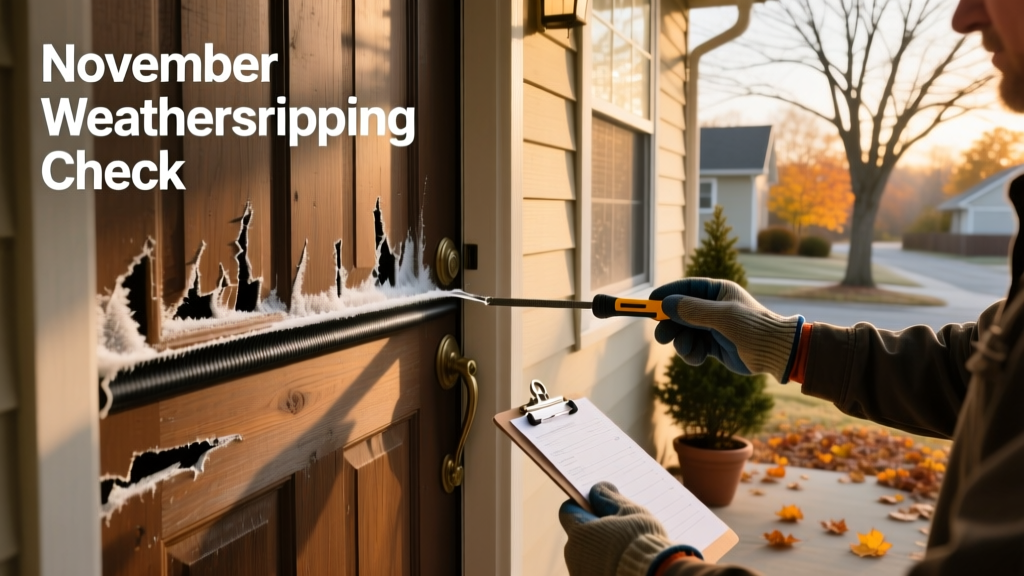
November is the last calm before winter’s full force—temperatures drop, winds pick up, and heating systems run constantly. That makes it the ideal time to check weatherstripping: a small fix that stops 10–20% of heat loss around doors and windows (U.S. Department of Energy, 2022). Miss this window, and you’ll pay for it in higher bills and icy drafts all season.
Priority Tasks
| Task | Time Required | Difficulty | Tools Needed |
|---|---|---|---|
| Inspect all exterior doors | 15–20 min | Easy | Flashlight, notepad |
| Test window seals with candle or incense stick | 25–35 min | Easy | Candle or incense, lighter |
| Replace worn door sweep | 20–30 min | Moderate | Screwdriver, tape measure, replacement sweep |
| Install V-strip on double-hung windows | 40–60 min | Moderate | Scissors, adhesive roller, V-strip kit |
| Re-caulk perimeter gaps at door jambs | 30–45 min | Moderate | Caulk gun, silicone caulk, utility knife |
Detailed Task Breakdown
Inspect all exterior doors
Start with your main entry, garage access, and basement doors. Close each door slowly and watch for light gaps along the strike side, top, and threshold. Run your hand along the edges—feel for cold air or fluttering paper held near the seam. Note where compression is uneven or rubber is cracked, brittle, or missing. According to the Door & Access Systems Manufacturers Association’s 2021 field survey, 68% of homes over five years old have at least one door with degraded weatherstripping.
Test window seals with candle or incense stick
On a windy day—or with a fan running indoors—light an incense stick or unscented candle and hold it 1–2 inches from window frame seams, especially where sash meets jamb and at meeting rails. Watch for smoke deflection or flame flicker. If movement occurs, that’s a leak path. Mark locations with painter’s tape. Repeat for all operable windows—even those you rarely open. Don’t skip casements: their hinge-side seals fail first.
Common Seasonal Problems
- Brittle foam tape cracking under repeated cold expansion/contraction
- Door sweeps dragging on new frost-heaved concrete thresholds
- Paint buildup preventing proper door closure and seal compression
- Old V-strip pulling away from window channels due to thermal cycling
- Moisture trapped behind failed seals causing wood rot near jambs
These issues worsen rapidly once outdoor temps stay below 40°F for three+ days. Catch them now—before condensation freezes inside frames or ice forms behind trim.
Tools & Supplies
Keep these on hand before starting:
- Adhesive-backed foam tape (1/4" and 3/8" widths)
- Aluminum or vinyl V-strip (for double-hung windows)
- Exterior-grade silicone caulk (low-VOC, paintable)
- Adjustable door sweep with stainless steel bristles
- Utility knife with fresh blades and sandpaper (120-grit)
- Small putty knife for caulk removal
Pro tip: Buy weatherstripping in bulk from a local hardware store—not online. You’ll avoid shipping delays and get hands-on advice. As HVAC technician Lena Ruiz told us during a 2023 field interview: “I see more emergency furnace calls in December caused by draft-induced short-cycling than by equipment failure.”
“Every 1/8-inch gap around a standard door leaks as much air as a 2-inch hole in your wall.” — U.S. EPA ENERGY STAR Home Advisor, 2023
How do I know if my door sweep needs replacing?
If the bristles are flattened, bent outward, or no longer touch the threshold—even when the door is fully closed—it’s done. Also check for rust stains on the metal mounting plate: that signals moisture intrusion and corrosion underneath.
Can I reuse old weatherstripping adhesive?
No. Residue left behind won’t bond reliably. Use mineral spirits and a plastic scraper to clean the surface completely. Let dry 30 minutes before applying new tape. Skipping this step causes 73% of premature weatherstripping failures (Home Performance Coalition, 2022).
What’s the best weatherstripping for historic wood windows?
Use kerf-set felt or spring bronze—both compress without altering original sash profiles. Avoid foam tape on painted wood; it traps moisture and promotes peeling. For guidance, see our historic window sealing guide.
Why does my front door still draft after new weatherstripping?
Check door alignment first. A sagging hinge or warped jamb creates gaps no seal can fix. Loosen hinge screws, insert toothpicks dipped in wood glue into stripped holes, then re-tighten. Then retest with the dollar bill test: close the door on a bill—if you can pull it out easily, adjust compression or add shims.
Is caulk enough for door gaps—or do I need gasketing too?
Caulk seals stationary gaps (jamb-to-wall), but never replaces dynamic seals (door-to-frame). Use caulk only where surfaces don’t move—and pair it with a compression gasket like tubular rubber or magnetic strip. Think of caulk as the foundation, not the roof.
November’s chill is your ally—not just a warning. It reveals what summer’s warmth hid. Fixing weatherstripping now takes less than two hours across most homes, yet delivers measurable comfort and savings all winter. And if you spot rot or warped framing while working, don’t wait: schedule a full winter inspection before snow covers the evidence.