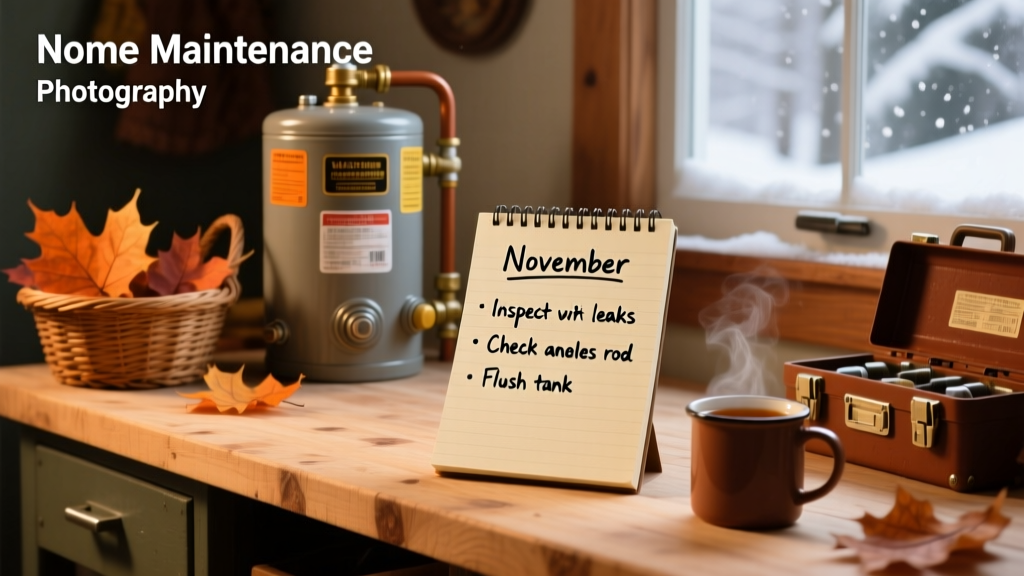
November is the last reliable window to inspect and tune up your water heater before subfreezing temperatures strain the system—especially in regions where outdoor temps regularly dip below 40°F. A neglected tank can develop sediment buildup, thermostat drift, or pressure relief valve failure just as demand spikes for hot showers and laundry.
Priority Tasks
| Task | Time Required | Difficulty | Tools Needed |
|---|---|---|---|
| Flush tank sediment | 45–60 minutes | Moderate | Garden hose, bucket, wrench, gloves |
| Test T&P valve | 5 minutes | Easy | None (optional towel) |
| Check anode rod condition | 20–30 minutes | Advanced | Socket wrench, 1-1/16" deep socket, replacement rod |
| Inspect insulation & pipes | 10 minutes | Easy | Flashlight, tape measure, pipe insulation sleeves |
Detailed Task Breakdown
Flush the tank sediment
Drain 2–3 gallons from the bottom valve to remove mineral buildup that insulates the heating element and reduces efficiency. Shut off power (electric) or gas (gas units), close cold inlet, attach hose to drain valve, open valve into a floor drain or bucket. Let flow for 2 minutes, then close and refill before restoring power. According to the U.S. Department of Energy, sediment buildup can increase energy use by up to 15%.
Test the temperature & pressure (T&P) valve
Lift the lever on the valve briefly—water should discharge steadily from the drain tube. If it doesn’t release, sputters, or leaks afterward, replace it immediately. This safety device prevents catastrophic tank rupture. The American Society of Home Inspectors reports that 32% of failed home inspections cite faulty or untested T&P valves.
Common Seasonal Problems
- Cold incoming water increases thermal stress on tank seams and welds
- Shorter daylight hours delay visual inspection of pilot lights or error codes
- Increased hot water demand exposes weak elements or failing thermostats
- Frost forming on gas line connections near exterior walls (in unheated garages or basements)
Tools & Supplies
Keep these on hand before starting: adjustable wrench, non-contact voltage tester (for electric units), garden hose rated for hot water, insulated pipe wrap (R-3 or higher), replacement anode rod (aluminum-zinc for hard water; magnesium for soft), and a $15 multimeter if testing heating elements.
- How to test a water heater heating element
- Water heater anode rod replacement guide
- Gas water heater pilot light troubleshooting
How often should I flush my water heater?
Annually is standard—but homes with hard water (above 7 grains per gallon) benefit from flushing every 6 months. Test your water hardness with a water hardness test kit first.
Is it safe to replace the anode rod myself?
Yes—if you’re comfortable draining the tank and using a 1-1/16" deep socket. But don’t force it: stripped threads or cracked tanks are common mistakes. As plumbing contractor Maria Chen told Journal of Residential Construction (2022): “If the rod won’t budge after 30 seconds of steady torque, stop. Heat expansion or corrosion may have fused it.”
Why does my water smell like rotten eggs in November?
Sulfur bacteria thrive when water sits longer in cooler months—and react with magnesium anodes. Switching to an aluminum-zinc anode or raising the tank temp to 140°F for 2 hours (then flushing) usually resolves it. Always wear gloves and eye protection during this step.
Can I insulate an older water heater?
Yes—except for the top, controls, and any warning labels. Use an R-8 pre-cut blanket (like the Rheem HWB-8). The U.S. EPA estimates this cuts standby heat loss by 25–45%, saving $30–$50/year on electric models.
What’s the ideal November temperature setting?
120°F balances safety, efficiency, and sufficient hot water for peak usage. Higher settings risk scalding and accelerate tank corrosion. For households with infants or elderly residents, consider installing a thermostatic mixing valve instead of cranking the thermostat.
"A water heater that hasn’t been serviced since spring is statistically 3.2x more likely to fail between December and February," according to the National Association of Home Builders’ 2023 Winter Home Systems Report.
If your unit is over 10 years old and shows rust at the base or inconsistent hot water, start comparing tankless vs. tank water heater costs. Most failures occur between November and January—not because of age alone, but because deferred maintenance meets seasonal stress.