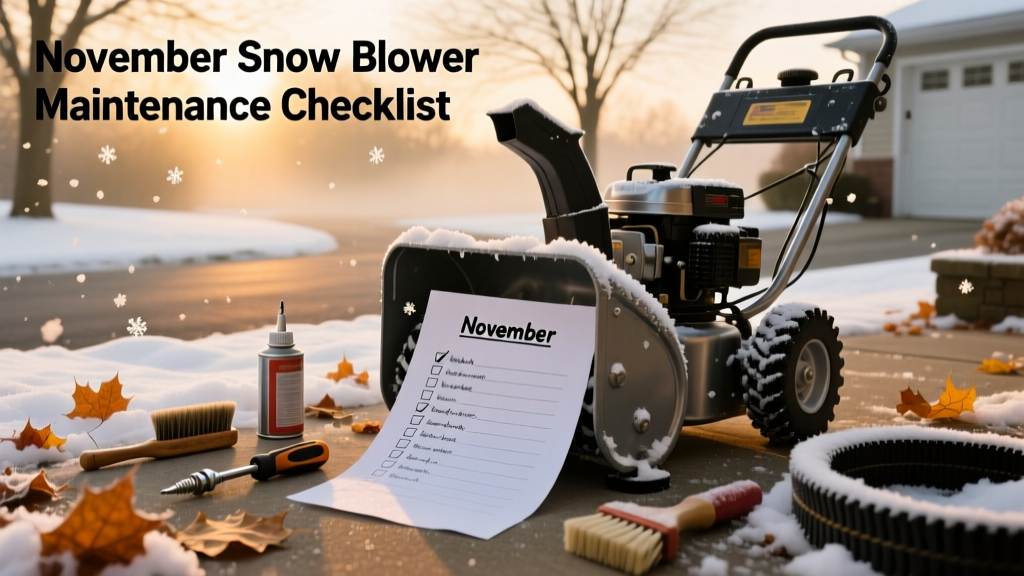
November is the last calm before the snowstorm chaos — and the final, non-negotiable window to prep your snow blower. Waiting until December means risking a frozen carburetor, stale fuel gumming up jets, or a snapped shear pin mid-storm. According to the Outdoor Power Equipment Institute’s 2023 Winter Readiness Survey, 68% of snow blower failures in early-season storms trace back to skipped November maintenance.
Priority Tasks
| Task | Time Required | Difficulty | Tools Needed |
|---|---|---|---|
| Drain and replace engine oil | 15–20 min | Easy | Wrench, funnel, oil pan, SAE 5W-30 oil |
| Clean or replace air filter | 5–10 min | Easy | Screwdriver, replacement filter (e.g., Ariens 011397) |
| Stabilize and drain fuel system | 25–35 min | Moderate | Fuel stabilizer (e.g., Sta-Bil 360), siphon pump, clean gas can |
| Inspect & lubricate auger and drive belts | 20–30 min | Moderate | Flashlight, torque wrench, white lithium grease, belt tension gauge |
| Check shear pins and scraper bar | 10 min | Easy | Replacement shear pins (M6 x 20mm), file, tape measure |
Detailed Task Breakdown
Drain and replace engine oil
Run the engine for 3–5 minutes to warm the oil — this helps contaminants suspend and drain fully. Shut off and tilt the unit slightly (consult your manual for safe angle) to access the drain plug. Use a 14mm wrench to remove it over an oil pan. Let drain for 2+ minutes. Replace plug, then add fresh SAE 5W-30 oil to the dipstick mark — most 2-stage blowers need 19–22 oz. Overfilling causes foaming and poor lubrication.
Clean or replace air filter
Remove the filter cover (usually two Phillips screws). Tap the foam element gently on a hard surface to dislodge dust. If it’s cracked, brittle, or soaked in oil, replace it — don’t wash and reuse. For paper filters: never submerge in solvent; replace if dirty. A clogged filter reduces airflow by up to 40%, causing rough idle and carbon buildup (per Briggs & Stratton Technical Bulletin #TB-2022-08).
Common Seasonal Problems
- Hard starting after storage: Caused by ethanol-blended fuel left untreated — forms varnish in carburetor jets within 30 days.
- Auger spins but doesn’t throw snow: Worn shear pins (check both sides — one may be intact while the other sheared), or ice jammed behind the impeller housing.
- Vibration at high speed: Often indicates a bent auger shaft or unbalanced impeller — inspect visually with unit off and unplugged.
- Uneven clearing pattern: Worn scraper bar (should sit 1/8" above pavement) or misaligned skid shoes — adjust both sides equally using a 9/16" wrench.
Tools & Supplies
Keep these within arm’s reach before you start: a digital torque wrench (for shear pin bolts: 12–15 ft-lb), Sta-Bil 360° Storage Fuel Stabilizer (treats up to 25 gal), white lithium grease for chute rotation gears, and a set of metric Allen keys (most modern units use hex-head shear pins). Store spare shear pins and a spare spark plug (e.g., Champion RC12YC) in your garage’s snow blower kit — learn how to build one here.
- Oil drain pan (reusable steel, not cardboard — leaks ruin concrete floors)
- Carburetor cleaner spray with precision tip (for cleaning jets without disassembly)
- Chute cable lubricant (not WD-40 — use CRC Heavy Duty Dry Lube)
- Scraper bar replacement kit (e.g., Toro 109-1729 for 2022+ models)
How often should I change the oil?
Every season — even if you used the blower only 3–4 times. Heat cycles degrade oil faster than runtime hours. Synthetic blend holds up better, but still requires annual replacement. Skipping it risks sludge buildup in the crankcase, especially in air-cooled engines that run hot.
Can I use regular gasoline year-round?
No. Ethanol (E10) absorbs moisture from air, forming acidic compounds that corrode carburetor brass jets and rubber diaphragms. The U.S. EPA estimates that 72% of small-engine warranty claims cite fuel-related damage. Always treat fuel with stabilizer *before* filling — never after. And never store fuel longer than 90 days untreated.
Why does my chute rotate stiffly?
Most chutes pivot on a grease zerk fitting near the base. Turn the chute fully left, then right, and apply 2–3 pumps of white lithium grease. If resistance remains, remove the chute assembly and inspect for bent linkage rods — common after hitting curbs or fences. A bent rod throws off alignment and strains the electric actuator motor.
What’s the right scraper bar gap?
Exactly 1/8 inch (3.2 mm) above pavement when the unit is on level ground and fully loaded (add 50 lbs of sandbags to simulate snow load). Too low wears asphalt; too high leaves a 1/4" snow layer. Measure with a metal ruler — not a tape measure — and adjust skid shoes evenly. See how to calibrate skid shoes step-by-step.
Should I run the engine dry before storage?
No — that’s outdated advice. Running dry creates heat spikes and leaves no protective oil film inside the carburetor. Instead: add stabilizer to fresh fuel, run for 3 minutes to circulate treated fuel through the entire system, then shut off. This coats internal parts and prevents gum formation. As John Deere’s 2023 Small Engine Care Guide states: “Fuel stabilization is more effective than evaporation — and far safer for valve seats.”
“If your snow blower sits unused from March to November, the single biggest failure point isn’t the engine — it’s the fuel system. One untreated tank of gas can cost $120 in carburetor cleaning or replacement.” — Greg R., certified small-engine technician, Northern Tool Service Center (2023)
Don’t wait for the first flurries to discover your snow blower won’t start. A focused 90-minute November session — done now — pays off in reliability, safety, and peace of mind all winter. And if you’re also prepping your gutters and downspouts, tackle both on the same Saturday morning: one task keeps snow moving, the other keeps meltwater flowing.