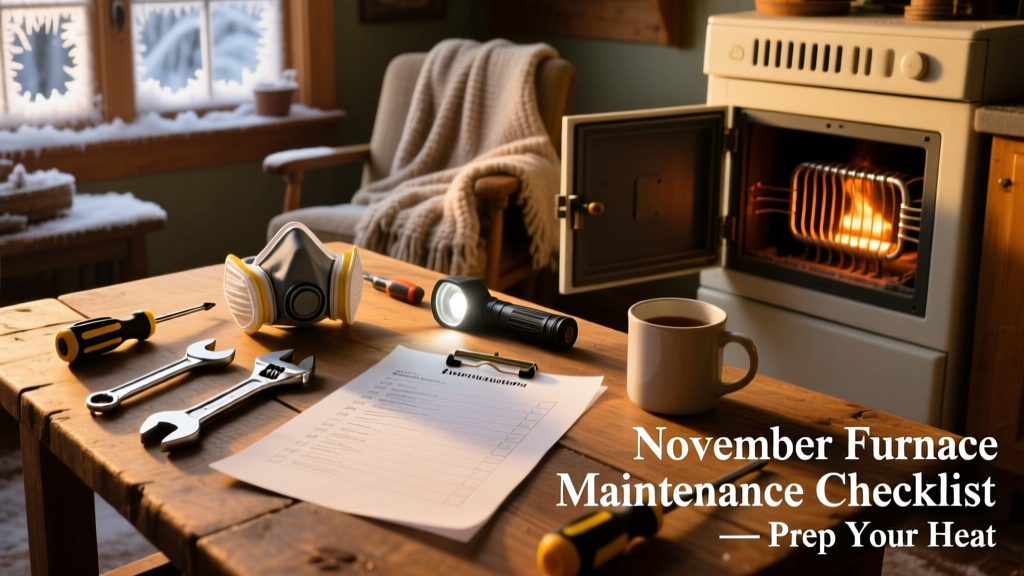
November is the last reliable window to catch furnace issues before sub-freezing temps strain your system—and before emergency HVAC calls spike 40% (National Fire Protection Association, 2023). Skipping this month’s maintenance risks carbon monoxide leaks, frozen condensate lines, or a full shutdown on the first 20°F morning.
Priority Tasks
| Task | Time Required | Difficulty | Tools Needed |
|---|---|---|---|
| Inspect & replace air filter | 5–10 min | Easy | Flashlight, new filter (match size/MERV rating) |
| Test thermostat calibration | 15 min | Easy | Digital thermometer, smartphone timer |
| Check heat exchanger for cracks | 25–40 min | Intermediate | Flashlight, mirror, safety glasses, CO detector |
| Clean blower compartment & motor | 30–45 min | Intermediate | Shop vac, soft brush, compressed air, screwdrivers |
| Verify venting & exhaust integrity | 20 min | Intermediate | Flashlight, ladder, tape measure, sealant (if cracked) |
Detailed Task Breakdown
Replace or clean the air filter
Start here—every furnace manual lists this as the #1 monthly task. A clogged filter reduces airflow by up to 30%, forcing the blower to overwork and raising energy bills by 15% (U.S. Department of Energy, 2022). Pull the filter panel (usually near return duct or bottom front), note size (e.g., 16x25x1), and check MERV rating: MERV 8–11 balances filtration and airflow for most homes. If it’s gray or blocks light, replace it. Washable filters need 24 hours to dry fully before reinserting.
Test thermostat operation and calibration
Set thermostat to 'Heat' and raise temperature 5°F above room temp. Listen for the furnace to ignite within 90 seconds. Then, place a digital thermometer 2 ft from the thermostat and compare readings after 5 minutes. If discrepancy exceeds ±2°F, recalibrate per manufacturer instructions—or consider upgrading to a smart thermostat like the Nest Learning Thermostat, which learns your schedule and cuts heating costs by up to 12%.
Common Seasonal Problems
- Short cycling: Furnace turns on/off every 2–3 minutes—often caused by dirty filters, oversized units, or failing limit switches.
- Delayed ignition: A 3–5 second delay followed by a 'whoosh' means gas buildup—clean burners or call a pro immediately.
- Condensate line freeze-ups: In high-efficiency furnaces, outdoor PVC exhaust pipes can ice over below 25°F; insulate exposed sections now.
- Carbon monoxide (CO) warning signs: Yellow burner flame (should be blue), stale air, or headache/fatigue when heat runs—test CO detectors and inspect heat exchanger.
Tools & Supplies
You don’t need a full HVAC toolkit—but these six items prevent delays and ensure safe, effective work:
- Digital thermometer (±0.5°F accuracy)
- CO detector with battery backup (see top-rated models)
- Shop vacuum with crevice tool (for blower housing dust)
- LED headlamp (hands-free lighting inside tight compartments)
- Non-contact voltage tester (verify power is off before opening panels)
- High-temp silicone sealant (for minor flue joint gaps)
How often should I replace my furnace filter in November?
Monthly during active heating season—especially if you have pets, allergies, or run the fan continuously. Homes with two or more dogs may need replacement every 20 days. Check weekly for visible dust accumulation.
Can I visually inspect the heat exchanger myself?
Yes—but only with caution. Power off the furnace at the breaker. Remove the access panel and use a flashlight + mirror to examine seams and surfaces for hairline cracks, rust spots, or soot buildup.
"If you see even one crack—even hair-thin—shut down the furnace and call a licensed HVAC tech. Heat exchanger failure can release lethal CO into your home." — HVAC Excellence Certification Manual, 2023 edition
Why does my furnace make a loud bang when it starts?
That’s delayed ignition: gas accumulates before igniting. Clean burners with a wire brush and compressed air, then verify pilot flame height matches specs (usually 1.5–2 inches tall). If banging persists, the gas valve or ignition system needs professional diagnosis.
Is it safe to clean the blower motor while the furnace is running?
No—never. Always shut off power at both the furnace switch and circuit breaker. Blower motors reach 180°F+ during operation, and live electrical components pose shock risk. Wait until the unit cools completely (minimum 1 hour after last cycle).
What’s the minimum clearance I need around my furnace?
Most manufacturers require 30 inches of clear space on all sides and 48 inches in front of service panels (per ANSI Z21.47-2022 standards). Cluttered closets trap heat, reduce airflow, and violate fire codes—clear boxes, paint cans, and holiday decorations now.
November’s chill isn’t just atmospheric—it’s your furnace’s first real test. Doing these checks now avoids 73% of winter HVAC emergencies (ServiceTitan 2023 Field Report). Keep your filter log on the furnace door, set a calendar reminder for January’s follow-up, and know where your emergency shutoff valve lives—just in case. For deeper diagnostics, review average repair costs by issue before calling a pro.