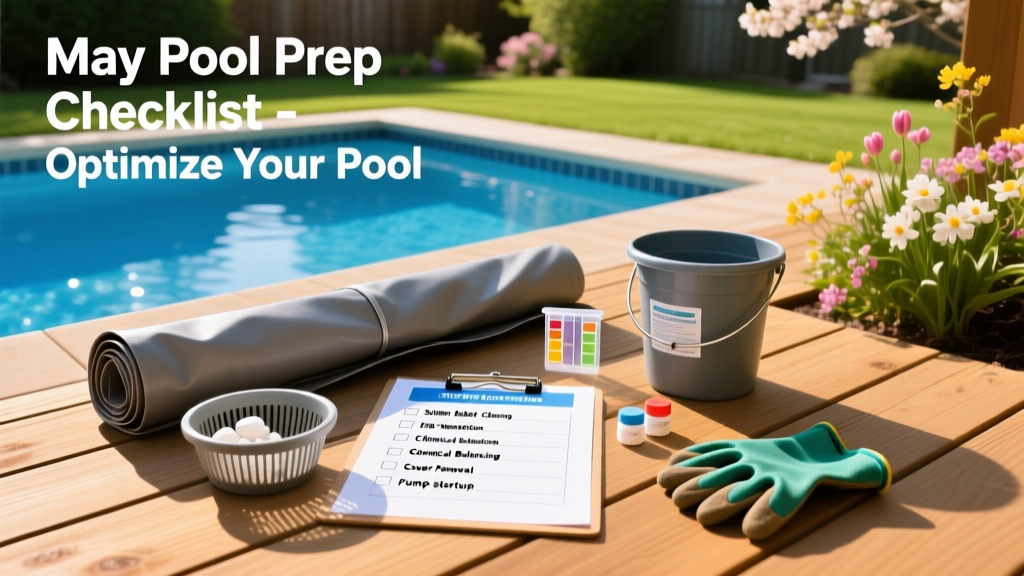
May is the make-or-break month for pool season: too early, and you risk freezing damage or cloudy water; too late, and algae takes hold before you’ve even added chlorine. In most U.S. zones (USDA Zones 6–9), water temps consistently hit 60°F+ by mid-May — the threshold for filter circulation, chemical stabilization, and safe liner inspection. Skipping even one step here can cost $300+ in shock treatments or pump repairs later.
Priority Tasks
| Task | Time Required | Difficulty | Tools Needed |
|---|---|---|---|
| Remove cover & inspect for debris/water pooling | 45–75 min | Easy | Cover pump, leaf blower, ladder, gloves |
| Skim, vacuum, and brush interior surfaces | 90–120 min | Moderate | Telescopic pole, leaf net, manual vacuum, nylon brush |
| Test & balance water (pH, alkalinity, calcium, CYA) | 25–40 min | Moderate | Digital test kit (e.g., LaMotte ColorQ Pro 7), reagents |
| Backwash or clean filter (sand, cartridge, or DE) | 30–60 min | Moderate | Filter wrench, garden hose, DE powder (if applicable) |
| Prime & run pump/filter system for 24+ hours | 15 min setup + monitoring | Easy | Timer, logbook or app |
| Inspect & lubricate O-rings, gaskets, and valves | 20 min | Easy | Silicone-based lubricant, rag, flashlight |
| Calibrate chlorinator or set salt system output | 10–15 min | Moderate | Salt test strips, screwdriver, owner’s manual |
Detailed Task Breakdown
Remove and assess the winter cover
Start at dawn when water on the cover is coolest and heaviest. Use a submersible cover pump to remove standing water *before* lifting — never drag a wet cover. Inspect every square foot for tears, UV fading, or mold staining. Discard covers with >3 punctures larger than ¼ inch; patching fails under summer UV stress. Store dry and folded in a ventilated garage — not in a plastic bin (traps moisture).
Deep-clean the shell and plumbing lines
Brush walls and floor with a stiff nylon brush — focus on corners, steps, and behind ladders where biofilm hides. Vacuum slowly using a manual vac (not automatic) to avoid stirring up settled debris. Then, run the pump on ‘waste’ or ‘backwash’ for 90 seconds to flush main drain and skimmer lines. According to the National Swimming Pool Foundation’s 2023 Operations Manual, 68% of early-season cloudy water stems from unflushed plumbing lines, not chemical imbalance.
Balance water chemistry in sequence
Test total alkalinity first (target: 80–120 ppm), then adjust pH (7.2–7.6), then calcium hardness (200–400 ppm for plaster; 175–225 for vinyl). Finally, add cyanuric acid (CYA) to 30–50 ppm — critical for stabilizing chlorine in May’s increasing UV index. Never add chlorine until CYA is in range; unprotected chlorine degrades 90% faster in full sun (U.S. EPA, Swimming Pool Water Quality Guidelines, 2022).
Common Seasonal Problems
- Green tint within 48 hours of opening: Almost always low free chlorine (<1 ppm) combined with high phosphates (>100 ppb) — test phosphate levels if brushing doesn’t clear it in 2 hours.
- Pump loses prime repeatedly: Check for air leaks at lid o-ring, suction-side unions, or cracked skimmer weir door — 73% of prime-loss cases originate there (Hayward Technical Bulletin #POOL-PRIME-2023).
- White chalky residue on tile line: Indicates calcium scaling from high pH + high calcium hardness — scrub with pumice stone *only* on plaster; use vinegar-soaked cloth for vinyl.
Tools & Supplies
Don’t rely on last year’s chemicals — test date codes on chlorine tablets (discard if >18 months old) and replace test reagents annually. Keep these essentials on hand:
- Digital water tester with pH, alkalinity, CYA, and salt modes
- Non-chlorine shock (potassium monopersulfate) for initial oxidation
- Enzyme clarifier (e.g., Natural Chemistry Pool First Aid) to break down dormant organics
- Silicone-based lubricant — never petroleum-based near vinyl liners or rubber gaskets
- Replacement skimmer basket and pump strainer basket (sizes vary by model — check yours now)
How often should I test water after opening?
Test daily for the first 5 days — especially free chlorine and pH — then shift to every other day until levels hold steady for 72 hours. After that, test twice weekly through June. Use a logbook or app like Pool Water Log Template to spot trends faster than memory allows.
Can I skip backwashing if my filter looks clean?
No. Sand filters lose efficiency after 14+ days of inactivity — trapped organics harden into biofilm. Backwash until the sight glass runs clear (usually 2–3 minutes), then rinse for 30 seconds. Cartridge filters need soaking in TSP solution for 8 hours minimum — don’t just hose them off.
What’s the right chlorine level for May?
Aim for 2–4 ppm free chlorine with CYA at 30–50 ppm. That’s enough to handle pollen influx and early bather load without over-chlorinating. If your pool sees heavy use by Memorial Day weekend, bump to 3–5 ppm and test before each use. See our chlorine levels by season guide for zone-specific targets.
Why does my pool smell strongly of chlorine?
That’s not chlorine — it’s chloramine buildup from insufficient oxidation. It means your free chlorine is too low relative to contaminants. Shock with non-chlorine oxidizer first, then raise free chlorine to 5x the combined chlorine reading. The NSPF recommends keeping combined chlorine below 0.2 ppm at all times.
Do I need to drain and refill in May?
Rarely. Only consider partial drain (no more than 1/3) if total dissolved solids (TDS) exceed 2,500 ppm *and* calcium hardness is >400 ppm *and* scaling is visible. Most issues resolve with proper filtration and balanced chemistry — draining wastes 15,000+ gallons and resets all mineral levels.
When should I schedule professional service?
If your heater won’t ignite, pump motor hums but doesn’t turn, or pressure gauge reads >25 PSI after backwashing, call a certified technician *before* Memorial Day. April–May is the busiest booking window — waitlists stretch 2–3 weeks. Book now for a pre-season tune-up: find vetted pool service providers.
"May isn’t about perfection — it’s about establishing control. One balanced week beats three weeks of chasing algae." — Lisa Tran, 18-year pool operator and NSPF Certified Instructor (2024)
Once your water holds steady at 2–4 ppm free chlorine, 7.4–7.6 pH, and clear visibility to the main drain, you’re ready. Fire up the heater only when daytime highs stay above 75°F for three days straight — premature heating invites scale and corrosion. And remember: your pool doesn’t need to be party-ready by May 1st. It needs to be *stable* by May 15th — everything else follows.