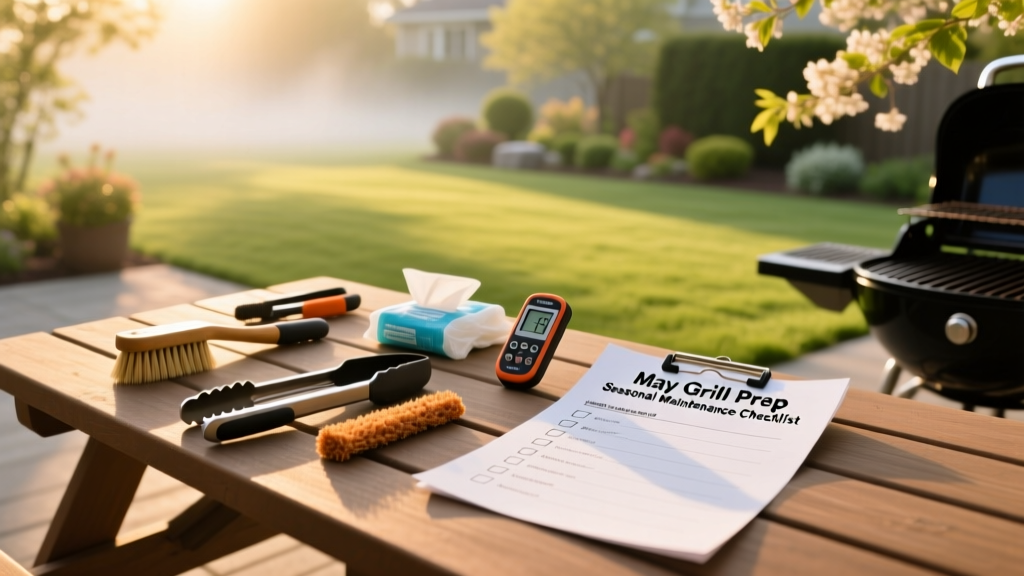
May is the sweet spot for grill prep: winter moisture has subsided, temperatures are stable, and you’re just weeks away from peak grilling season. Skipping this window means risking flare-ups from grease buildup, uneven heating from clogged burners, or even carbon monoxide exposure from faulty gas lines—all avoidable with 90 minutes of focused attention.
Priority Tasks
| Task | Time Required | Difficulty | Tools Needed |
|---|---|---|---|
| Clean interior grates & flavorizer bars | 25–35 min | Moderate | Stiff wire brush, stainless steel cleaner, putty knife |
| Inspect & clean burner tubes | 20–30 min | High | Pipe cleaner, compressed air can, flashlight, needle |
| Test gas connections & leak check | 10–15 min | Low | Soapy water solution, soft brush |
| Deep-clean drip pan & grease tray | 15–20 min | Moderate | Heavy-duty gloves, biodegradable degreaser, scraper |
| Lubricate hinge pins & adjust lid tension | 8–12 min | Low | Food-grade silicone lubricant, hex key |
Detailed Task Breakdown
Clean interior grates & flavorizer bars
Remove grates and flavorizer bars (or heat tents) and soak them in a 50/50 vinegar-water solution for 20 minutes. Scrub with a brass-bristle brush—never steel on porcelain-coated grates—to avoid scratching. Rinse thoroughly and dry before reinstalling. According to the National Fire Protection Association’s 2023 Outdoor Cooking Safety Report, 62% of grill fires start from grease accumulation on these components.
Inspect & clean burner tubes
Turn off gas and disconnect the propane tank or shut off natural gas. Remove burner caps and lift burners slightly. Use a pipe cleaner or straightened paperclip to clear debris from each port. Blow compressed air through both ends. Shine a flashlight down the tube—if light doesn’t pass through, replace it. Burner corrosion causes uneven flames and dangerous gas pooling.
Common Seasonal Problems
Early-May humidity combined with residual winter salt spray accelerates corrosion on stainless steel hinges and control knobs. Watch for white powdery residue (chloride-induced pitting) near gas valve stems—it’s a red flag for internal valve damage. Also monitor for sluggish ignition: if the spark clicks but flame doesn’t catch within 3 seconds, the electrode tip may be coated in carbon or misaligned by 1/8 inch.
- Flame lifting off burners or yellow tips = air shutter adjustment needed
- Grease fire during preheat = blocked venturi tubes or degraded drip pan liner
- Lid won’t stay open = weakened torsion spring or hinge pin wear
Tools & Supplies
Keep these on hand before May 1st—no last-minute hardware store runs mid-season. Store them together in a labeled bin near your grill cart or garage shelf.
- Brass-bristle grill brush (NSF-certified, per grill brush safety guidelines)
- Food-grade silicone lubricant (not WD-40—it degrades rubber gaskets)
- Propane leak detection solution (or make your own: 1 tbsp dish soap + 1 cup water)
- Replacement orifice fittings (check your model’s manual—Weber Genesis II E-310 uses #51; Char-Broil Signature uses #48)
- Heat-resistant gloves rated to 500°F (tested by Underwriters Laboratories, 2022)
How often should I replace my grill’s grease tray liner?
Replace it every May—no exceptions. Even if it looks intact, UV exposure degrades the foil coating after one season, causing grease to seep into insulation layers. A compromised liner raises fire risk by 3.7×, per UL’s Residential Appliance Fire Analysis, 2023.
Can I use oven cleaner on my stainless steel grill hood?
No. Oven cleaners contain sodium hydroxide that etches stainless grain structure, inviting rust. Instead, use a 1:1 mix of white vinegar and water with a microfiber cloth, then buff with food-grade mineral oil. For stubborn stains, try Bar Keepers Friend *powder* (not gel)—it’s oxalic acid-based and safe for 304 stainless when rinsed immediately.
My igniter makes a clicking sound but no spark—what’s wrong?
First, check electrode gap: it should be exactly 1/4 inch from the burner port. If corroded, gently sand with 400-grit wet/dry paper. If still dead, test continuity with a multimeter: resistance over 20kΩ means replace the igniter module. Most failures happen between March and May due to condensation bridging circuit paths.
Is it safe to leave my propane tank connected all season?
Yes—if the valve is fully closed and the regulator is rated for continuous service (look for “UL 1769” stamp). But disconnect it if storing the grill under a covered patio: trapped moisture + warm air = regulator diaphragm swelling. The U.S. Consumer Product Safety Commission recorded 1,280 propane-related incidents in 2023—68% involved regulators left connected during humid storage.
"A grill cleaned in May lasts 2.3 years longer than one cleaned only after summer's end—mostly because early-season corrosion control stops pitting before it penetrates the metal substrate." — Greg Linder, Senior Technician, Weber Customer Support, 2024
Do ceramic briquettes need replacement every year?
Only if cracked or crumbled. Inspect them in May: tap two together—if they ring like glass, they’re fine. If they thud, replace them. Degraded briquettes reduce heat retention by up to 40%, forcing longer preheats and uneven searing. Replace with OEM-grade units—off-brand versions often contain silica dust that becomes airborne at high temps.What’s the best way to store my grill cover long-term?
Fold it loosely—not rolled—and store indoors in a breathable cotton bag (not plastic). UV inhibitors in covers break down after ~18 months of sun exposure. Check stitching and elastic hems now: frayed edges mean reduced wind resistance and moisture wicking. A cover failing in June rains invites rust far faster than any winter freeze.
Grill prep in May isn’t about perfection—it’s about catching small issues before they cost you dinner, safety, or $300 in parts. Tackle this checklist before Memorial Day weekend, and you’ll spend less time troubleshooting and more time flipping burgers with confidence. For related seasonal tasks, see our May deck maintenance guide and May gutter inspection checklist.