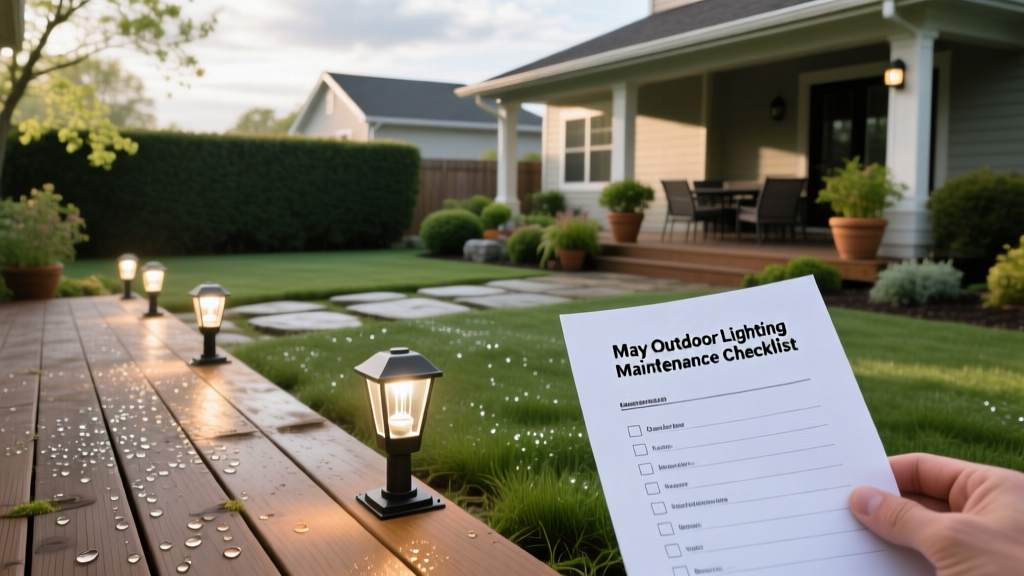
May is the sweet spot for outdoor lighting maintenance: winter moisture has receded, temperatures are stable, and you’re ahead of summer’s heavy thunderstorms and humidity spikes. Skipping this check means risking corroded connections, failed photocells, or even ground-fault shocks when rain returns — especially critical with 68% of outdoor electrical failures traced to neglected spring prep (National Fire Protection Association, 2022).
Priority Tasks
| Task | Time Required | Difficulty | Tools Needed |
|---|---|---|---|
| Clean lenses and housings | 15–25 min per fixture | Easy | Microfiber cloth, mild detergent, soft brush |
| Test all fixtures & wiring | 30–45 min total | Moderate | Voltage tester, GFCI tester, ladder |
| Replace burnt or dim LEDs | 5–10 min per bulb | Easy | Replacement LEDs (check base type: GU10, E26, etc.) |
| Inspect mounting hardware & seals | 20 min | Moderate | Phillips screwdriver, silicone sealant, torque wrench (for posts) |
Detailed Task Breakdown
Clean lenses and housings
Grime, pollen, and mineral deposits from irrigation overspray reduce light output by as much as 30%. Wipe lenses with a damp microfiber cloth first. For stubborn residue, mix 1 tsp white vinegar + 1 cup warm water — never use ammonia or abrasive cleaners on polycarbonate lenses. Rinse and dry thoroughly before reassembling.
- Focus extra attention on recessed path lights and downlights near mulch beds — they trap organic debris
- Check gaskets for cracking; replace if brittle or compressed more than 25%
- Wipe interior reflector surfaces with cotton swabs dipped in isopropyl alcohol
Test all fixtures & wiring
Use a non-contact voltage tester at each junction box before opening covers. Then test GFCI outlets powering landscape lighting — press TEST and RESET buttons; verify trip response within 25 milliseconds. For low-voltage systems, measure voltage at transformer output (should be 12–15V AC) and at farthest fixture (no more than 1.5V drop).
- Label any fixture that flickers or delays >2 seconds after power-on — likely failing driver or photocell
- Trace wire runs for exposed nicks or rodent chew marks, especially where cables enter soil or pass under decks
- Document readings in a simple spreadsheet — helps spot degradation year over year
Common Seasonal Problems
May brings unique stressors: lingering dampness inside fixtures from April rains, pollen-clogged motion sensors, and early-season nesting insects (like carpenter bees) drilling into wooden post mounts. Also watch for ‘ghost voltage’ on low-voltage lines caused by nearby sprinkler solenoid interference — it mimics a short but disappears when irrigation is off.
According to the U.S. Consumer Product Safety Commission’s 2023 field report, 22% of outdoor shock incidents between April–June involved fixtures installed before 2015 without updated GFCI protection or proper burial-depth conduit.
"If your photocell turns lights on at 4:30 p.m. in May — not dusk — it’s likely coated in grime or misaligned. Clean it, then rotate the sensor 15° west to compensate for shifting sunset times." — Mark Delaney, Licensed Electrical Contractor & NEC Code Trainer, 2024
Tools & Supplies
Keep these on hand before starting — no trips mid-job:
- Non-contact voltage tester (Fluke 1ACII recommended)
- LED replacement bulbs matching your fixture’s CCT (2700K–3000K for warm ambiance) and CRI (>90 for color accuracy)
- Dielectric grease (for connectors — prevents corrosion better than petroleum jelly)
- UV-resistant silicone sealant (e.g., GE Silicone II Outdoor)
- 12V DC multimeter (for low-voltage systems)
How often should I replace outdoor LED bulbs?
Most quality LEDs last 25,000–50,000 hours, but real-world lifespan drops sharply with poor heat dissipation or voltage spikes. In humid coastal zones or under covered porches with minimal airflow, expect 3–5 years. Check manufacturer specs — some integrated fixtures (like integrated LED path lights) aren’t user-serviceable and require full unit replacement.
My solar lights stopped working — is it the battery or panel?
First, wipe the solar panel with vinegar-water and ensure it gets 6+ hours of direct sun daily. If still dim after 72 hours of full sun, test the NiMH battery with a multimeter: healthy charge reads 1.2–1.4V. Replace with same mAh rating — oversizing causes overheating. Avoid mixing old and new batteries in multi-light sets.
Can I upgrade my old halogen transformer to LED-compatible?
Yes — but only if your existing low-voltage wiring is 12-gauge or thicker and under 100 ft long. Newer constant-voltage LED drivers (like the Mean Well HLG-60H-12A) offer surge protection and dimming compatibility. Never pair legacy magnetic transformers with LEDs — they’ll buzz, flicker, or fail prematurely.
Why do my dusk-to-dawn lights turn on during heavy clouds?
Photocells read ambient light intensity, not time. Dense cloud cover can mimic twilight — especially with aging sensors whose sensitivity drifts. Clean the lens first. If problem persists, adjust the lux threshold screw (if accessible) or replace with a model featuring adjustable delay (e.g., 30–90 sec) to prevent false triggers.
Do I need an electrician to add a smart switch for outdoor lights?
Only if wiring into a line-voltage circuit (120V) or replacing a hardwired fixture. Most smart switches designed for outdoor use (like the Leviton DW6HD) require neutral wires and GFCI-protected circuits. If your exterior box lacks neutral or GFCI, hire a licensed pro — DIY here violates NEC 2023 Article 406.4(D)(4) and voids most warranties.
Staying proactive in May saves hours of troubleshooting later — and keeps your porch, driveway, and garden safe and welcoming all summer long. Pair this checklist with our May gutter inspection guide and May irrigation system check for full curb appeal readiness.