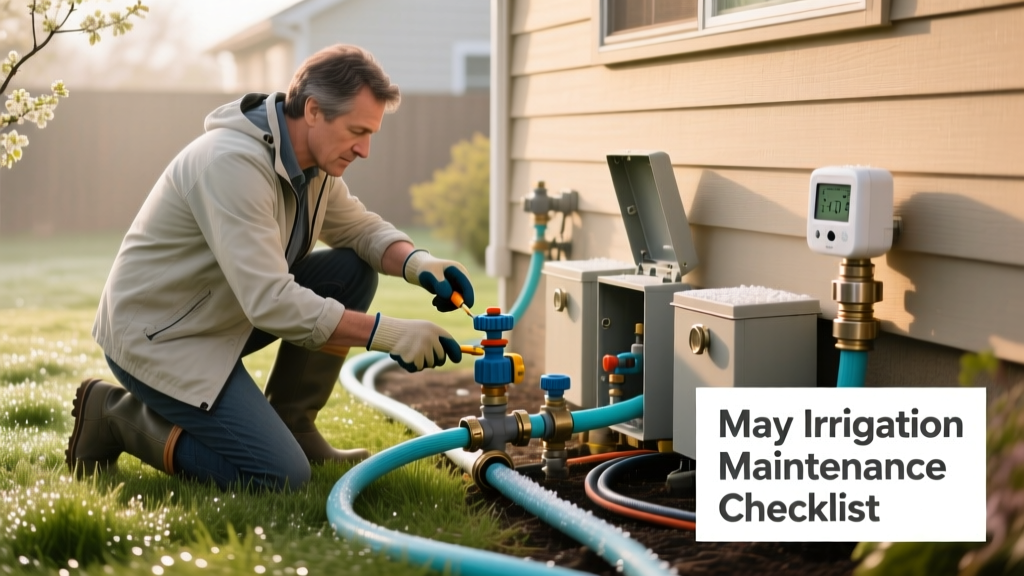
May is the critical pivot point between spring prep and peak summer demand—your irrigation system must be fully functional before temperatures climb above 85°F and evaporation rates jump 40% (U.S. EPA WaterSense, 2023). A single undetected leak can waste 6,300 gallons annually; catching issues now avoids stress, runoff violations, and brown patches by June.
Priority Tasks
| Task | Time Required | Difficulty | Tools Needed |
|---|---|---|---|
| Inspect all sprinkler heads for clogs, misalignment, or breakage | 45–90 min | Easy | Screwdriver, adjustable wrench, rag |
| Test controller programming and seasonal adjustment | 20–30 min | Easy | Controller manual, smartphone (if smart controller) |
| Check mainline and lateral tubing for cracks or bulges | 60–120 min | Moderate | Flashlight, garden trowel, pressure gauge |
| Clean or replace filter screens on drip emitters & valves | 30–45 min | Easy–Moderate | Small brush, vinegar soak container, replacement filters |
| Calibrate precipitation rate across zones using catch cups | 90 min + 24-hr wait | Moderate | 10+ identical tuna cans or rain gauges, ruler, notebook |
Detailed Task Breakdown
Inspect and adjust sprinkler heads
Walk each zone while it’s running. Look for: misting (indicates excessive pressure), dry spots (head tilted or blocked), and puddling (broken head or overspray onto pavement). Use a screwdriver to gently rotate pop-up heads so spray arcs land only on turf or beds—not driveways or windows. Replace cracked nozzles with same GPM rating; mismatched nozzles cause uneven coverage. According to the Irrigation Association’s 2022 Field Survey, 68% of inefficient systems stem from misaligned or damaged heads.
Verify controller settings and weather-based adjustments
Reset start times to avoid midday watering—optimal window is 4–7 a.m. Confirm soil moisture sensor or ET (evapotranspiration) input is active if equipped. For non-smart controllers, manually reduce run times by 15% compared to April; turf needs ~1 inch/week, but May’s cooler mornings mean less evaporation than July. If your controller supports Wi-Fi, cross-check its forecast sync against your local NWS station (e.g., NOAA’s Portland office for OR homeowners).
Common Seasonal Problems
- Valve boxes filling with standing water after spring rains — indicates cracked housing or poor drainage
- Drip lines collapsing under mulch weight, causing emitter blockage or root intrusion
- Timer batteries dying just as daylight saving ends — test and replace even if display looks fine
- Shrubs planted near rotors creating permanent spray shadows — prune or relocate within 18 inches
- Backflow preventer test port weeping — signals internal seal failure; schedule certified tester visit before June 1
Tools & Supplies
Keep these on hand before May 1:
- Brass nozzle kit (matching your rotor type: Hunter I-20, Rain Bird 5000, etc.)
- Pressure regulator (set to 30 PSI for drip zones; 45–60 PSI for rotors)
- Vinegar + small container (for soaking clogged emitters — soak 2 hrs minimum)
- Catch cup set (10+ identical 3″-diameter cans — see our calibration kit guide)
- Backflow preventer test gauge (required for annual certification in 37 states)
How often should I replace drip emitters?
Replace emitters every 3 years—or sooner if flow drops below 0.4 GPH (measured with a graduated cylinder over 60 seconds). Mineral buildup accelerates in hard water areas (e.g., Phoenix, TX Hill Country); use inline filters rated at 120 mesh or finer.
"In Central Valley CA, 72% of failed drip zones traced to emitter clogging within 28 months—most preventable with quarterly flushes and proper filtration." — UC Davis Cooperative Extension Irrigation Report, 2021
What’s the right run time for rotor zones in May?
Start with 25 minutes per zone, then adjust using catch cup data. In clay soils (common in Midwest and Southeast), reduce frequency but increase duration—e.g., 3x/week × 32 min—to encourage deep rooting. In sandy soils (coastal NC, FL), shift to 5x/week × 18 min. Track results for two weeks before finalizing.
Do I need a backflow test in May?
Yes—if your local ordinance requires annual testing (check your city’s plumbing code online). Most jurisdictions mandate certification between May 1–June 15. Hire a state-certified tester, not a general plumber. Unverified backflow devices risk contaminating municipal drinking water—a violation that can trigger fines up to $5,000 (AWWA Standards Manual, 2023).
Can I skip checking valves if the system ran fine last fall?
No. Winter freeze-thaw cycles crack diaphragms—even in mild climates. A failed valve may not show symptoms until high-demand days in June, when pressure drops cause zone overlap or complete failure. Test each valve manually via bleed screw; listen for smooth, full-open flow. Replace diaphragms if water trickles or hisses.
Why does my smart controller keep overriding my schedule?
Most units default to ‘weather-adaptive’ mode, which pulls hyperlocal forecasts—but many misread microclimates (e.g., urban heat islands or shaded yards). Disable auto-adjustment temporarily and log actual soil moisture with a $12 probe (compare top models). Re-enable only after verifying 3 days of consistent readings match forecast trends.
Completing this checklist in early May gives you buffer time to order parts, reschedule pros, or reprogram zones without scrambling during heatwaves. Remember: irrigation isn’t ‘set and forget’—it’s a living system that needs May tuning, just like your HVAC gets a spring check. Stay ahead, not reactive.