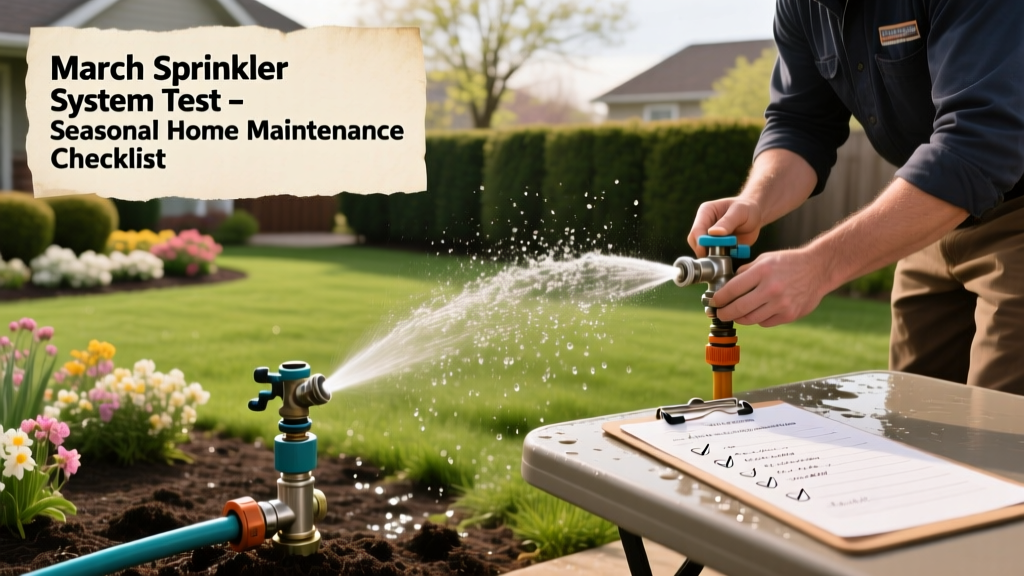
March is the sweet spot—temperatures are rising, frost is retreating, and your irrigation system has likely sat idle since October. Skipping this month’s test risks broken heads, frozen valves, or undetected leaks that waste up to 14% of household water use, per the U.S. EPA’s 2023 WaterSense report.
Priority Tasks
| Task | Time Required | Difficulty | Tools Needed |
|---|---|---|---|
| Inspect main shut-off valve & backflow preventer | 15–20 min | Easy | Wrench, flashlight, cloth |
| Test each zone manually (no auto-timer) | 30–45 min | Moderate | Smartphone timer, notepad, garden hose |
| Adjust spray patterns & clean nozzles | 25–35 min | Moderate | Small brush, needle tool, adjustable wrench |
| Check for leaks, pooling, or uneven coverage | 20 min | Easy | None (visual + walk-through) |
Detailed Task Breakdown
Inspect main shut-off valve & backflow preventer
Start at the source. Locate your main irrigation shut-off valve (usually near the water meter or basement utility area) and confirm it opens/closes smoothly. Then inspect the backflow preventer—look for corrosion, cracked housing, or standing water in the test cocks. According to the American Society of Sanitary Engineering’s 2022 Backflow Prevention Standards, 68% of failed inspections trace back to neglected annual visual checks.
- Turn valve fully open, then fully closed—listen for grinding or resistance
- Wipe test cocks dry; open each briefly—if water drips continuously, the device may need servicing
- Photograph any rust, pitting, or bent levers for your licensed plumber’s review
Test each zone manually
Never rely on the controller’s auto-schedule for your first spring run. Manually activate zones one at a time using the valve box or controller’s manual override. Watch for delayed startup, sputtering, or zones that won’t engage.
- Set controller to "Manual" or "Test" mode
- Activate Zone 1 for 90 seconds—time it
- Walk the zone: note which heads pop up, which spray sideways or drip, and whether coverage overlaps or leaves bare patches
- Repeat for all zones—record results in a notebook or free irrigation log template
Common Seasonal Problems
Early-spring sprinkler failures rarely come from electronics—they stem from physical damage sustained over winter. Frozen pipes crack under ice expansion, even if buried below frost line. Rodents chew insulation off wiring. And sediment settles in valve bodies after months of dormancy.
- Zone won’t turn on: Check for tripped GFCI outlets (common on newer controllers) and verify power at the transformer (should read 24–28 VAC)
- Low pressure across all zones: Likely a clogged filter screen in the backflow preventer or mainline shutoff partially closed
- One head sprays weakly or not at all: Debris jammed in nozzle or diaphragm—remove and soak in vinegar for 10 minutes before reassembling
"If you hear air hissing before water flows—or see misting instead of steady arcs—you’ve got trapped air or a cracked lateral line. Bleed air at the highest head first, then work downhill." — Irrigation Technician Certification Manual, UC Cooperative Extension, 2021
Tools & Supplies
You don’t need a full toolbox—but having these six items on hand cuts testing time in half and prevents mid-task trips to the hardware store.
- Needle-nose pliers (for prying stuck solenoid caps)
- 1/4" hex key (fits most Hunter and Rain Bird rotor adjustment screws)
- Vinegar soak cup (a repurposed plastic container works fine)
- Backflow test gauge (rentable from most irrigation supply houses—required in CA, OR, WA, and CO)
- Waterproof marker (to label zones on valve boxes)
- Printable winterization checklist—cross-reference last fall’s notes for known trouble spots
Why test before setting the timer?
Auto-schedules often fire at dawn—when temperatures dip below freezing in many regions through early March. Running a cold zone can crack PVC or freeze solenoids solid. Manual testing lets you choose warm, sunny windows (ideally above 45°F for two hours prior).
Do I need a backflow certification to test?
No—but if your local code requires annual backflow testing (most municipalities do), only a certified tester can sign off. Your March visual check is preparatory, not compliant. Find a certified tester via your water utility’s online directory or our state-by-state database.
What if I find a leak underground?
Mark the spot with spray paint and dig carefully—don’t use a pickaxe near PVC. Most leaks occur at glued joints or where lateral lines cross tree roots. Small cracks (<1/4") can be patched with epoxy putty rated for potable water (e.g., Oatey Fix-It Stick). Larger breaks need replacement—call a pro if more than two zones show low pressure simultaneously.
Can I adjust my controller now—or wait until April?
Yes—adjust now. Set start times for 6:30 a.m. (not 5 a.m.) to avoid dew-heavy conditions that encourage fungal growth. Reduce run times by 20% versus last fall’s settings—early March soil retains moisture longer. Update ET (evapotranspiration) settings if your controller supports them; the Smart Irrigation Settings Guide walks through local weather station sync.
How often should I replace rotors and nozzles?
Rotors last 5–7 years with annual cleaning; nozzles wear faster—replace every 2–3 years or when spray patterns distort noticeably. Keep spare nozzles on hand in common sizes: 2.0, 3.0, and 4.0 GPM for residential turf. Don’t mix brands—Rain Bird nozzles don’t seal properly in Toro bodies.
Testing in March isn’t about perfection—it’s about catching small issues before they cascade into summer emergencies. A 45-minute walk-around now saves $200+ in emergency service calls and keeps your lawn green without overwatering. You’ve got this—and your grass will thank you.