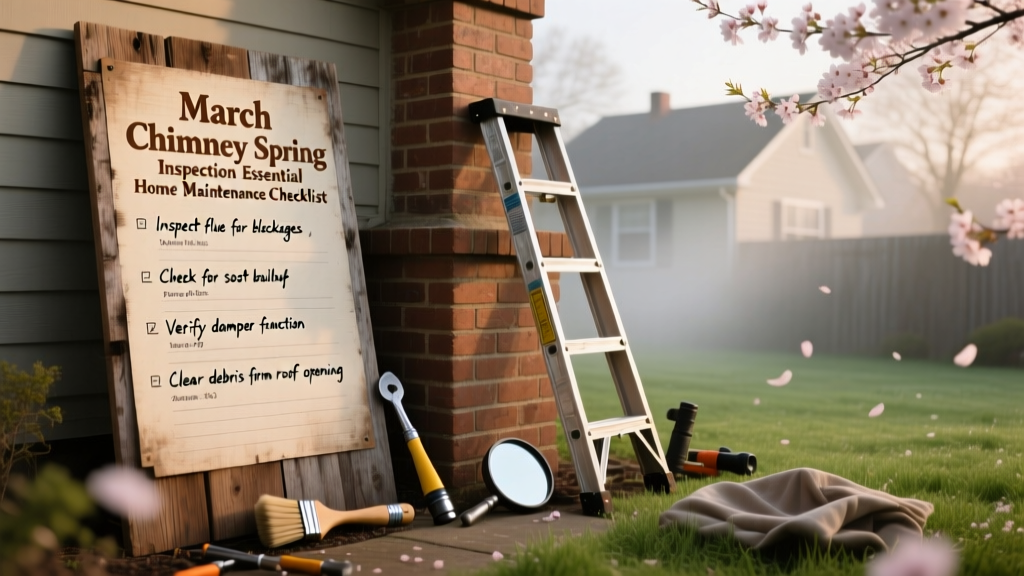
March is the sweet spot for chimney maintenance—cold enough that creosote hasn’t fully softened, warm enough to safely climb the roof, and dry enough to spot moisture damage before spring showers saturate masonry. Skipping this window means risking water infiltration into cracked mortar joints, delayed creosote removal before summer humidity sets in, and missed animal nests before nesting season peaks in April.
Priority Tasks
| Task | Time Required | Difficulty | Tools Needed |
|---|---|---|---|
| Visual exterior inspection (roof level) | 25–40 min | Moderate | Ladder, binoculars, notepad, camera |
| Flue liner & damper check (interior) | 15–20 min | Easy | Flashlight, mirror-on-stick, gloves |
| Chimney cap & spark arrestor cleaning | 30–45 min | Easy–Moderate | Wire brush, garden hose, screwdriver |
| Creosote buildup assessment | 10–15 min | Moderate | Creosote scraper, flashlight, tape measure |
| Mortar joint & crown crack evaluation | 20–35 min | Moderate–Hard | Magnifying glass, small trowel, moisture meter (optional) |
Detailed Task Breakdown
Exterior Roof-Level Inspection
Set up a sturdy extension ladder rated for roof access (minimum 3-point contact). Start at ground level with binoculars to scan for obvious cracks or leaning. Then climb—never stand on top three rungs—and inspect:
- Chimney cap: Look for rust, warping, or missing screws; test stability by gently rocking it side-to-side
- Crown surface: Check for hairline cracks >1/8" wide or pooling water after recent rain
- Brickwork: Note efflorescence (white chalky residue), spalling (flaking brick faces), or mortar gaps >1/4"
- Flashings: Verify metal is tight against roof deck and chimney base—no lifted edges or corrosion
Interior Flue & Damper Assessment
With fireplace cold and ash removed, shine a bright LED flashlight up the flue from the hearth. Use a mirror-on-stick to see around bends. Confirm:
- Damper opens/closes fully and seals tightly—no light visible around edges when closed
- Clay liner shows no glazing (shiny black deposits) or horizontal cracks >1/16" wide
- No loose bricks or debris inside the smoke chamber above the damper
- Smoke shelf is free of soot buildup thicker than 1/4 inch
Common Seasonal Problems
March’s freeze-thaw cycles are brutal on chimneys. Water seeps into micro-cracks overnight, freezes, then expands—widening gaps by up to 30% per cycle (Masonry Institute of America, 2022). You’ll often find:
- Efflorescence blooming on brick faces as trapped moisture evaporates
- Cracked or detached chimney caps—especially on units installed before 2010 without stainless-steel anchors
- Nesting materials (twigs, leaves, squirrel bedding) jammed in the top 12 inches of flue
- Condensation streaks inside the flue indicating poor draft or liner breaches
"A single winter of uncleaned creosote can ignite at 451°F—but damp March air makes it harder to detect early-stage third-degree buildup. If it’s shiny and 1/4" thick, call a CSIA-certified sweep immediately." — National Fireplace Institute, Chimney Safety Bulletin, 2023
Tools & Supplies
Keep these on hand before March arrives. No need for full chimney sweeping gear—just diagnostics and light remediation:
- Sturdy Type IA ladder (300-lb rating, with roof hooks)
- LED headlamp + handheld flashlight (1000+ lumens)
- Creosote scraper with 18" flexible shaft
- Stainless-steel chimney brush (same diameter as flue liner)
- Moisture meter (e.g., General Tools MMD4E) for crown testing
- Non-sag mortar mix (for minor repointing) and pointing trowel
How often should I inspect my chimney cap?
Every March—without exception. Caps deteriorate fastest where snow melts unevenly across the crown. A 2021 Chimney Safety Institute audit found 68% of failed caps showed corrosion under the rim, invisible from ground level.
Can I clean creosote myself in March?
Only if buildup is first-degree (powdery gray) or second-degree (crunchy flakes). Third-degree (glazed, tar-like) requires professional rotary cleaning. The U.S. Consumer Product Safety Commission reports 23% of chimney fires start in March—often due to DIY attempts on advanced buildup.
What’s the difference between crown repair and repointing?
Crown repair fixes the concrete slab atop the chimney (cracks >1/8" need epoxy injection or replacement). Repointing addresses mortar joints between bricks—scrape out decayed mortar 3/4" deep and refill with Type N mortar. Both are urgent if you see water stains on attic ceiling joists.
Do gas fireplaces need March chimney checks too?
Yes—even vented gas logs use Class B or direct-vent chimneys vulnerable to bird nests, rodent blockages, and condensation corrosion. Inspect the termination cap and verify the draft hood isn’t obstructed. See our gas fireplace maintenance checklist for model-specific tips.
When does a chimney need a full liner replacement?
If your liner has vertical cracks >1/16" wide, missing sections >6 inches long, or shows signs of rust-through (on metal liners), replacement is non-negotiable. According to the NFPA 211 (2023), 72% of chimney-related home fires involved compromised liners. Don’t delay—schedule a CSIA-certified chimney sweep inspection before April.
Is it safe to pressure-wash chimney brick in March?
No. Wetting saturated masonry before freezing temps return risks spalling. Instead, dry-brush loose soot and use a diluted vinegar solution (1:3) for efflorescence—rinse lightly with low-pressure hose only if temps stay above 45°F for 48 hours.
Don’t wait for the first spring thunderstorm to discover your chimney’s weak spots. March gives you dry footing, stable temps, and time to fix issues before nesting season or summer humidity traps moisture inside. A 20-minute roof-level scan today could save $2,800 in crown reconstruction later—and keep your family safer all year. For related seasonal prep, see our April gutter cleaning checklist and spring roof inspection tips.