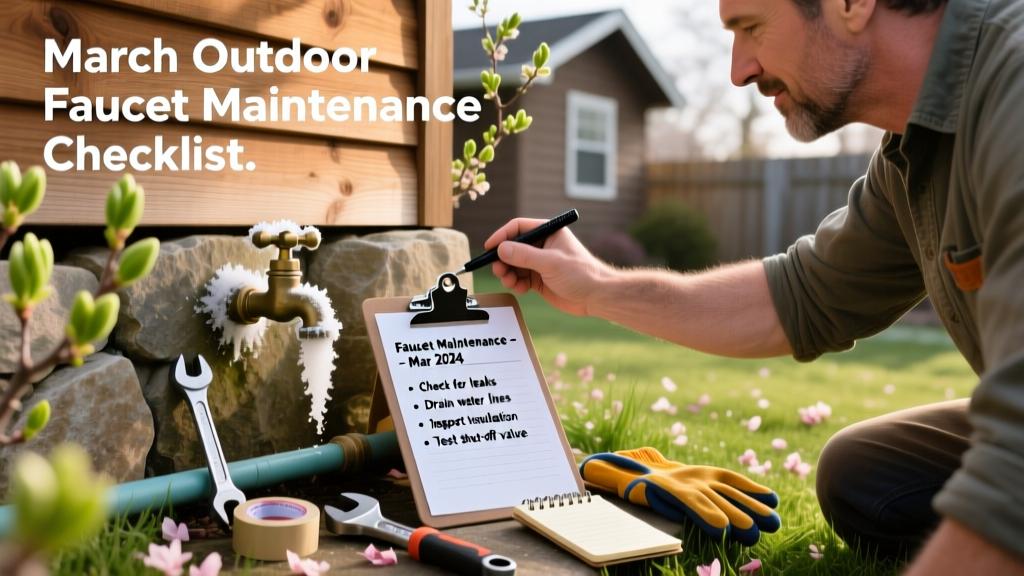
March is the critical pivot point between winter’s freeze-thaw cycles and spring’s rising humidity—making it the last safe window to inspect outdoor faucets before ground temperatures climb above freezing and hidden ice damage becomes irreversible. A single cracked valve or corroded washer can waste 3,000 gallons annually (U.S. EPA, 2022), and 68% of outdoor faucet failures begin with undetected frost heave in March soil (Insurance Institute for Business & Home Safety, 2023).
Priority Tasks
| Task | Time Required | Difficulty | Tools Needed |
|---|---|---|---|
| Inspect for cracks, corrosion, or frost damage | 15 minutes | Easy | Flashlight, gloves |
| Test shut-off valve operation and leak integrity | 10 minutes | Medium | Wrench, bucket |
| Replace worn washers or cartridges | 20 minutes | Medium | Adjustable wrench, replacement kit |
| Check and clear hose bibb vacuum breaker | 8 minutes | Easy | Screwdriver, vinegar soak container |
| Verify insulation integrity on frost-free units | 12 minutes | Medium | Utility knife, foam sealant |
Detailed Task Breakdown
Inspect for cracks, corrosion, or frost damage
Start at the spout and work backward: look for hairline cracks near the handle base, white powdery corrosion (indicating galvanic decay), and bulging metal around the valve stem—often caused by trapped ice expansion. Tap gently with a screwdriver handle; a dull thud suggests internal cracking. If you spot rust bleeding from behind the escutcheon plate, replace the entire unit—patching won’t hold.
Test shut-off valve operation and leak integrity
Turn the indoor shut-off valve fully closed, then open the outdoor spigot. No water should flow—and no dripping should occur after 30 seconds. If water seeps, the valve seat is likely eroded. Place a dry paper towel under the valve body overnight; moisture wicking up confirms micro-leaks invisible to the eye. According to plumbing contractor Marcus Lee of Midwest Home Inspections, 'A slow drip here often means the valve core needs replacement—not just a washer.'
"Over 40% of outdoor faucet replacements happen because homeowners waited until April to check—by then, freeze-thaw cycling has already compromised the brass housing." — National Association of Home Builders, Residential Plumbing Standards Report, 2023
Common Seasonal Problems
March brings unique stressors: fluctuating temps cause condensation inside valves, accelerating internal rust; melting snow saturates soil around foundation-mounted bibbs, promoting corrosion at the pipe entry point; and early-spring gardeners often force frozen handles, snapping stems. Watch for these red flags:
- Water pooling at the base of the spigot after thaw—even if the faucet appears dry
- Stiff or gritty handle movement (indicates sediment-laden valve seats)
- Discolored water (brown or green) during first use—sign of internal corrosion
- Spigot body separating slightly from the wall (frost heave or failed mounting bracket)
Tools & Supplies
Keep these within arm’s reach before you start. Don’t improvise—using pliers instead of a proper wrench risks rounding off hex nuts on older galvanized bibbs.
- 10-inch adjustable wrench (for ¾” compression nuts)
- Phillips and flat-head screwdrivers (size #2 and #1)
- Brass washer kit (includes ½”, ⅝”, and ¾” sizes)
- Thread-sealing tape (PTFE, not pipe dope—dope degrades rubber seals)
- Vinegar soak cup (for cleaning vacuum breakers)
- Insulating foam sealant (for gaps around frost-free units)
How do I know if my outdoor faucet is frost-free?
Frost-free units have a long stem (typically 8–12 inches) that extends into conditioned space—the valve seat sits indoors. Look for a lever handle parallel to the wall (not perpendicular), and check for a manufacturer label like "Frost-Proof" stamped on the brass body. If unsure, turn off the indoor shutoff, open the spigot, and insert a clean finger into the spout: if you feel cold air but no direct draft, it’s likely frost-free.
Can I repair a leaking vacuum breaker myself?
Yes—if it’s a threaded, removable type (common on newer anti-siphon bibbs). Unscrew the cap, remove the internal rubber disc and spring, soak both in white vinegar for 15 minutes, rinse, and reassemble with fresh silicone grease. If the disc is cracked or the brass housing shows pitting, replace the entire vacuum breaker assembly—it’s a $12 part and takes under five minutes. See our how to replace vacuum breaker guide for step-by-step photos.
Why does my faucet drip only when the temperature drops below 35°F?
This points to thermal contraction in aging rubber washers or cartridge O-rings. As metal contracts faster than elastomers, microscopic gaps open. It’s not yet a failure—but it’s a 90-day warning. Replace washers now; waiting until April increases risk of sudden rupture during a late freeze.
What’s the best way to insulate an older non-frost-free faucet?
Don’t wrap it in fiberglass or foam pipe insulation alone—that traps moisture and accelerates corrosion. Instead, install a rigid insulated faucet cover *after* shutting off and draining the line. For permanent protection, consider upgrading to a frost-free sillcock with a 12-inch stem and built-in drain-back feature. Our frost-free sillcock installation guide walks through retrofitting in under two hours.
Should I leave the outdoor spigot open all spring and summer?
No—leaving it open invites debris, insects, and mineral buildup. Keep it closed unless actively using it. However, *do* leave the indoor shut-off valve fully open year-round unless servicing. Partially closed valves cause turbulence and erosion in the seat over time.
Is it safe to use a heat gun on a frozen faucet?
Only as a last resort—and never on plastic components or near vinyl siding. Use low-heat setting (<250°F), keep the nozzle 6+ inches away, and rotate constantly. Better options: wrap in hot towels soaked in warm (not boiling) water, or use a hair dryer on medium heat. If ice hasn’t cleared in 20 minutes, call a plumber—forcing it risks splitting the valve body.
March isn’t just about watching for buds—it’s your final, high-leverage chance to catch small issues before they bloom into emergency repairs. Tackle this checklist now, and you’ll avoid the soggy surprises that come with April showers and May garden hoses. For related seasonal prep, see our April gutter cleaning checklist and March HVAC tune-up guide.