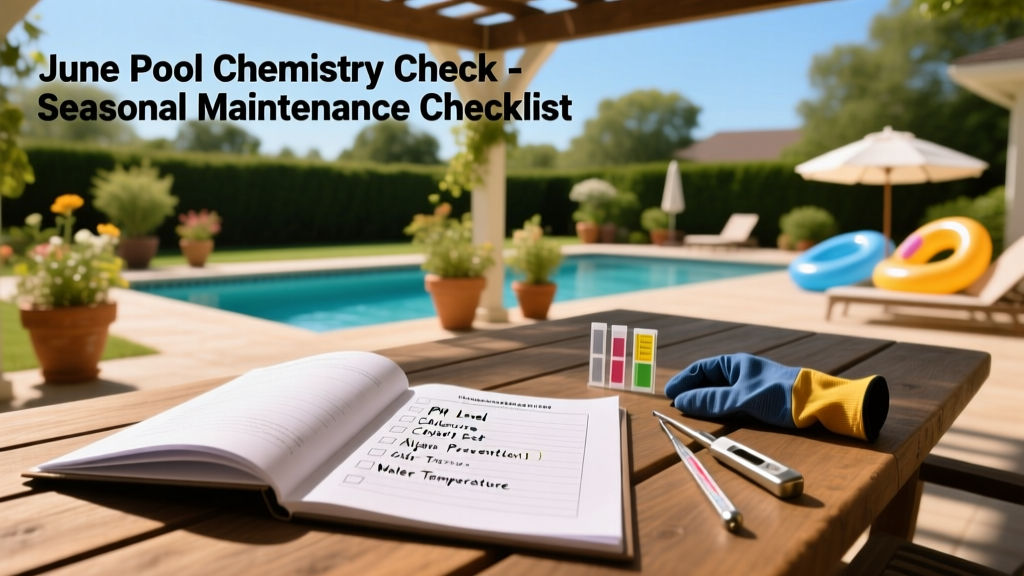
June marks the true start of heavy pool use—sun intensity rises, temperatures climb, and bather load spikes. Without proactive chemistry checks, chlorine demand surges, pH drifts upward, and algae can establish in under 48 hours. According to the National Swimming Pool Foundation’s 2023 Aquatic Facility Operator Handbook, 68% of pool-related service calls in early summer stem from preventable chemical imbalances—not equipment failure.
Priority Tasks
| Task | Time Required | Difficulty | Tools Needed |
|---|---|---|---|
| Test full water panel (pH, chlorine, alkalinity, calcium hardness, CYA) | 12–15 min | Easy | Digital tester or high-quality DPD test kit, logbook |
| Adjust total alkalinity (if < 80 ppm or > 120 ppm) | 20–30 min + 6-hr wait | Moderate | Sodium bicarbonate or muriatic acid, measuring cup, gloves |
| Shock after heavy rain or 3+ consecutive hot days | 10 min application + overnight circulation | Easy | Calcium hypochlorite or non-chlorine shock, pool brush |
| Clean & recalibrate digital tester or replace test strips | 8 min | Easy | Isopropyl alcohol, lint-free cloth, calibration solution (if applicable) |
Detailed Task Breakdown
Test and record all five key parameters
Collect water 18 inches below surface, away from returns or skimmers. Use fresh reagents—test strips older than 6 months lose accuracy. Record values in a physical log or app like Pool Chemistry Log Template. Note: Free chlorine should be 1–3 ppm; cyanuric acid (CYA) must stay between 30–50 ppm for outdoor pools—above 70 ppm, chlorine becomes ineffective even at 5 ppm.
Correct alkalinity before adjusting pH
Total alkalinity (TA) is the pH buffer. If TA is low (< 80 ppm), add sodium bicarbonate (1.4 lbs per 10,000 gallons raises TA by 10 ppm). If high (> 120 ppm), lower with muriatic acid—start with ¼ cup per 10,000 gallons, wait 6 hours, retest. Never adjust pH first: doing so without stable TA causes wild pH swings.
Shock strategically—not on schedule
Shocking isn’t weekly—it’s condition-based. Shock when combined chlorine exceeds 0.5 ppm, after >5 swimmers in one day, or following thunderstorms (rain introduces nitrogen compounds that feed algae). Use unstabilized chlorine (cal-hypo or liquid bleach) for best oxidation. Run pump 8–12 hours post-shock. Avoid shocking in direct sun—UV degrades chlorine before it works.
Common Seasonal Problems
- Green tint overnight: Usually indicates low free chlorine *and* high CYA—test both before adding more chlorine.
- Cloudy water after rain: Often due to diluted sanitizer + phosphates washing in from lawns. Test phosphate level; if >500 ppb, treat with phosphate remover.
- Scaling on tile line: Caused by high calcium hardness (>400 ppm) + high pH. Brush daily, then lower pH to 7.2–7.4 and run filter 24 hrs.
Tools & Supplies
Keep these within arm’s reach by the pool deck or in a labeled tote:
- Digital photometer (e.g., ColorQ Pro 7) or Taylor K-2006 test kit
- Sodium bicarbonate (alkalinity up), muriatic acid (alkalinity/pH down)
- Cal-hypo shock (for routine oxidation) and liquid chlorine (for rapid correction)
- Pool brush, telescopic pole, and a dedicated logbook with June–August pages
Why does my chlorine disappear fast in June—even with normal bather load?
UV degradation accelerates as solar noon intensity increases. The U.S. EPA estimates UV exposure doubles chlorine demand every 10°F rise above 75°F. If your CYA is low (<30 ppm), chlorine burns off in under 2 hours. Raise CYA to 40 ppm using cyanuric acid—then maintain free chlorine at 7.5% of CYA (e.g., 40 ppm CYA → 3 ppm FC).
Can I use baking soda instead of sodium bicarbonate for alkalinity?
No—baking soda *is* sodium bicarbonate (NaHCO₃), but grocery-store baking soda often contains anti-caking agents and isn’t pool-grade. Those additives cloud water and gunk up filters. Always use NSF-certified pool-specific sodium bicarbonate like Clorox Pool&Spa Alkalinity Increaser.
My test shows zero chlorine—but the water looks clear. Is that safe?
No. Clear water ≠ safe water. A 2022 study in the Journal of Water and Health found 41% of residential pools with ‘clear’ water had zero measurable free chlorine and tested positive for Pseudomonas aeruginosa. Always verify sanitizer levels—even if water sparkles.
Should I drain and refill part of the pool in June to lower CYA?
Only as last resort. Draining risks hydrostatic pressure damage to vinyl liners or concrete shells—and wastes 10,000+ gallons. Instead, use a partial drain (15–20%) only if CYA exceeds 100 ppm. Better: switch to liquid chlorine exclusively for 2–3 weeks while maintaining 3–5 ppm FC daily—CYA won’t increase, and natural dilution plus splash-out gradually lowers it.
"June is the make-or-break month for pool water stability. Get alkalinity and CYA dialed in by June 10th, and you’ll spend 70% less time correcting problems all summer." — Lisa Tran, CPO® Instructor, NSPF, 2024
How often should I clean the filter in June?
Backwash sand or DE filters when pressure gauge reads 8–10 psi above clean baseline. For cartridge filters, rinse weekly and deep-clean with filter cleaner every 3–4 weeks. High pollen counts and wind-blown debris make June the #1 month for clogged cartridges—inspect yours every Sunday morning.
Staying ahead in June means fewer emergencies in July. Your filtration system, heater, and liner all last longer when water chemistry stays in the optimal band—not just 'acceptable.' Revisit your July pool maintenance tasks next month, but for now—test, log, adjust, repeat. Consistency beats intensity every time.