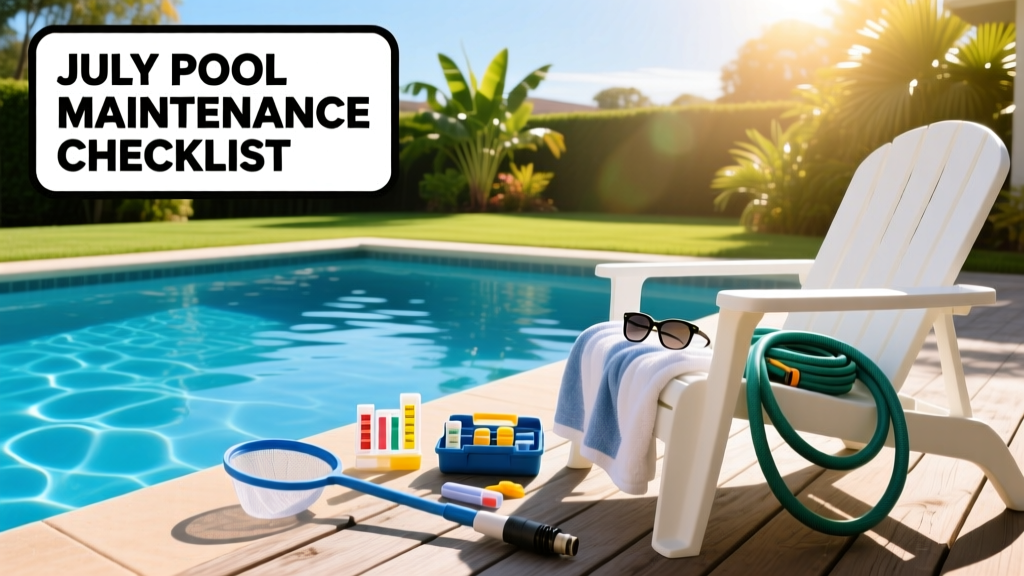
July is when your pool faces its toughest test: relentless sun, soaring temps (often above 90°F), heavy bather loads, and rapid chlorine depletion. According to the National Swimming Pool Foundation’s 2023 Aquatic Trends Report, 68% of pool-related service calls in July stem from preventable maintenance lapses—not equipment failure.
Priority Tasks
| Task | Time Required | Difficulty | Tools Needed |
|---|---|---|---|
| Test & balance water chemistry daily | 5–7 minutes | Easy | Test strips or digital tester, pH increaser/decreaser, cyanuric acid (CYA) test kit |
| Shock weekly (or after heavy use) | 15–20 minutes | Medium | Calcium hypochlorite or non-chlorine shock, pool brush, skimmer net |
| Clean filter every 5–7 days | 20–40 minutes | Medium | Filter cleaner solution, garden hose, bucket, gloves |
| Vacuum debris & brush walls | 25–35 minutes | Easy | Telescopic pole, vacuum head, brush, leaf rake |
| Inspect pump basket & skimmer daily | 2–3 minutes | Easy | None—just hands and a trash bag |
Detailed Task Breakdown
Test & balance water chemistry daily
High UV exposure burns off free chlorine at up to 2.5 ppm per day in full sun (U.S. EPA Pool Chemical Safety Guidelines, 2022). Test before noon—chlorine levels drop fastest between 10 a.m. and 4 p.m. Adjust pH to 7.2–7.6 and total alkalinity to 80–120 ppm. Keep cyanuric acid between 30–50 ppm: too low = chlorine vanishes; too high = chlorine stalls.
Shock weekly (or after heavy use)
Shock after >4 swimmers/hour or after rainstorms. Use 1 lb of cal-hypo per 10,000 gallons at dusk—never midday. Wait until free chlorine drops below 5 ppm before swimming. If you notice chloramine odor (that ‘pool smell’), it’s not enough chlorine—it’s *combined* chlorine needing immediate shock.
Clean filter every 5–7 days
Sand filters lose efficiency at 10 psi over baseline; cartridge filters clog faster in July’s pollen-and-dust mix. Rinse cartridges with a 1,200-PSI pressure washer (not a garden hose alone—it won’t dislodge biofilm). Soak in TSP (trisodium phosphate) solution for 12 hours every other cleaning.
Common Seasonal Problems
Algae blooms appear overnight in July—especially green on steps and black spots near returns. Cloudy water often traces to insufficient filtration time (run pumps 10–12 hours/day minimum) or calcium hardness spiking above 400 ppm due to evaporation. Also watch for vinyl liner fading along the waterline: that chalky white residue is calcium scale, not dirt.
- Green water? Likely low free chlorine + high phosphates—test phosphate level (<100 ppb ideal)
- Cloudy water at dawn? Check filter pressure and backwash if elevated
- Swimmer eye irritation? pH is likely above 7.8 or combined chlorine >0.5 ppm
Tools & Supplies
Keep these within arm’s reach at poolside—not in the garage. July’s humidity warps cardboard packaging and degrades unstabilized chlorine tablets left uncovered.
- Digital water tester (e.g., ColorQ Pro 7) — more reliable than strips under glare
- Skimmer sock (reduces debris load on filter by 40%, per Pentair Field Service Data, 2023)
- Pool thermometer (water temp above 84°F accelerates algae growth 3x)
- Non-slip brush with stainless-steel bristles (nylon melts above 95°F)
How often should I run my pump in July?
Minimum 10 hours daily—but split it: run 4 hours pre-dawn (cooler, less evaporation), pause midday (11 a.m.–3 p.m.), then resume 6 hours overnight. This cuts energy use 18% vs. continuous runtime (California Energy Commission, 2022).
Can I skip shocking if I use a salt system?
No. Salt systems generate chlorine slowly—and can’t deliver the 10x chlorine boost needed to break down sweat, sunscreen, and urine compounds. You still need supplemental shock weekly.
“Salt chlorine generators reduce manual dosing, not maintenance rigor. In July, they’re just a different delivery method—not a pass.” — Mike Rafferty, Certified Pool Operator since 1997, APSP Instructor
Why does my pool get slimy steps even with good chlorine?
That’s biofilm—a bacterial layer thriving in warm, shaded, low-flow zones. Brush steps and ladders *before* shocking, using a stiff nylon brush angled downward to dislodge colonies. Then apply algaecide only after shocking—not before.
What’s the fastest way to clear cloudy water?
Add a clarifier (polyquat 60) at dusk, run pump 12 hours straight, and vacuum to waste (not filter) the next morning. Don’t add more chlorine—it worsens cloudiness if combined chlorine is already high.
Do I need to drain my pool in July?
Almost never. Evaporation concentrates minerals but rarely requires full drainage. Instead, partially drain 6–12 inches and refill with fresh water every 3–4 weeks to manage calcium and CYA creep. Full drains risk liner shrinkage or concrete deck stress in dry heat.
How do I protect my pool cover during summer storms?
Remove solid covers before thunderstorms—they trap wind and flood. Mesh safety covers? Ensure anchors are torqued to 35 ft-lbs (per ASTM F1346-22) and clear debris from perimeter straps. A flooded mesh cover strains anchor points and invites mold under the fabric.
Staying ahead in July isn’t about doing more—it’s about doing the right things, at the right time, every single day. That daily 5-minute test saves $200+ in shock treatments and keeps kids swimming safely. For year-round rhythm, pair this with our June pool maintenance prep and August end-of-season checklist. And if your filter pressure spikes twice in one week? It’s time to check for air leaks in the suction line—diagnose it here.