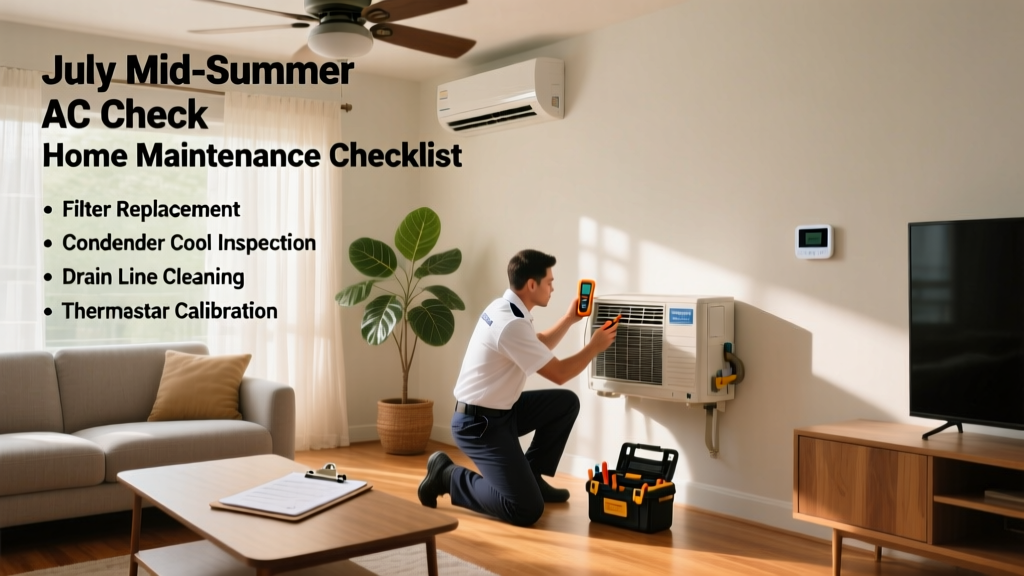
July is when most U.S. homes hit their highest cooling demand—and when hidden AC issues become urgent. According to the U.S. Department of Energy, air conditioners run 30–50% longer in July than in May, accelerating wear on compressors, coils, and capacitors. Skipping this mid-summer check can lead to 22% higher energy use (ENERGY STAR, 2023) and triple the risk of emergency service calls before August.
Priority Tasks
| Task | Time Required | Difficulty | Tools Needed |
|---|---|---|---|
| Clean or replace air filter | 10–15 minutes | Easy | Replacement filter, vacuum |
| Inspect and clean outdoor condenser unit | 30–45 minutes | Moderate | Garden hose, soft brush, fin comb, shop vac |
| Check refrigerant lines for ice or oil residue | 10 minutes | Moderate | Flashlight, gloves |
| Test thermostat calibration and settings | 15 minutes | Easy | Digital thermometer, smartphone (for smart thermostats) |
| Verify drain line flow and clear clogs | 20 minutes | Moderate | Vinegar, turkey baster, wet/dry vac |
Detailed Task Breakdown
Clean or replace air filter
Most systems need filter changes every 30 days during heavy July use—especially with pets or allergies. Pull the filter from its slot (usually behind a return grille or furnace door). Hold it up to light: if you can’t see through it, replace it. Use the MERV rating printed on the old filter as a guide—MERV 8–11 balances airflow and particle capture for most homes. Learn how to choose the right MERV rating.
Inspect and clean outdoor condenser unit
Turn off power at the disconnect switch first. Remove debris—leaves, grass clippings, mulch—within 2 feet of the unit. Use a garden hose with a gentle spray (never pressure wash) to rinse coil fins from top to bottom. If fins are bent, straighten them with a fin comb—bent fins reduce airflow by up to 30%, according to the Air Conditioning Contractors of America’s 2022 Field Manual. Let the unit dry fully before restoring power.
Check refrigerant lines for ice or oil residue
Ice forming on the larger copper suction line means low refrigerant or restricted airflow—both serious. Oil spots near fittings suggest a leak. Neither is a DIY fix, but catching them early avoids compressor failure. If you spot either, shut the system off and call a licensed HVAC tech within 48 hours. What refrigerant leak signs really mean.
Common Seasonal Problems
- Short cycling (unit turns on/off every 5–8 minutes): often caused by dirty filters, frozen coils, or overheating due to poor airflow
- Warm air from vents despite set temperature: could indicate refrigerant loss, capacitor failure, or blower motor strain
- Musty odor when AC starts: usually mold in the evaporator coil or drain pan—clean with a 50/50 vinegar-water solution
- Higher-than-usual electric bill with no change in usage: points to reduced efficiency from dirty coils or failing components
According to the National Institute of Standards and Technology (NIST, 2023), 68% of mid-summer AC failures stem from neglected maintenance—not age or manufacturing defects.
"A single dirty air filter can increase system runtime by 15% and raise indoor humidity by 5–7 percentage points—creating ideal conditions for mold growth in ductwork." — HVAC Technician Maria Chen, NATE-certified since 2014
Tools & Supplies
Keep these on hand before July hits:
- Replacement filters (match size and MERV rating—buy 3–4 for summer)
- Coil cleaner spray (non-acidic, EPA Safer Choice certified)
- Finned comb (for straightening bent condenser fins)
- Wet/dry vacuum (for clearing clogged condensate lines)
- Non-contact infrared thermometer (to verify supply/return temp differential)
Store supplies in a labeled plastic bin near your furnace or garage workbench. Build your seasonal home maintenance toolkit.
How often should I clean the condensate drain line in July?
Monthly—especially if you run AC 12+ hours daily. Algae and slime build up fastest in hot, humid weather. Pour 1/4 cup white vinegar into the access port; wait 30 minutes, then flush with water. If flow is slow, use a wet/dry vac on blow mode to dislodge blockages.
Is it safe to spray water on my outdoor AC unit while it’s running?
No. Always shut off power at the disconnect first. Spraying water on live electrical components risks short circuits and personal injury. Even misting near the unit while operating can cause thermal shock to hot coils.
Why does my AC smell like burning plastic when I turn it on?
That’s rarely normal—even brief. It could signal overheating wiring, a failing capacitor, or dust burning off the heat exchanger after months of dormancy. Turn off the system immediately and inspect the furnace compartment for discoloration or melted insulation. Call a technician before restarting.
Can I test refrigerant levels myself?
No—and don’t try. Refrigerant handling requires EPA Section 608 certification. Low charge readings from non-professional gauges are unreliable. What looks like low refrigerant is often a dirty coil or airflow issue. Leave diagnosis and charging to licensed pros.
My smart thermostat shows ‘Cooling’ but no cold air comes out—what’s wrong?
First, check if the outdoor unit is running. If silent, inspect the disconnect switch and circuit breaker. If the outdoor fan spins but no cold air, suspect a failed contactor, blown fuse on the control board, or refrigerant loss. Most smart thermostats log error codes—check yours under Settings > Diagnostics.
July isn’t just about surviving the heat—it’s about verifying your system can handle it without surprise failures. A focused 90-minute checklist now saves $320+ in emergency service fees later (HomeAdvisor 2023 national average). Keep this list taped inside your furnace closet—and revisit it every July 15th.