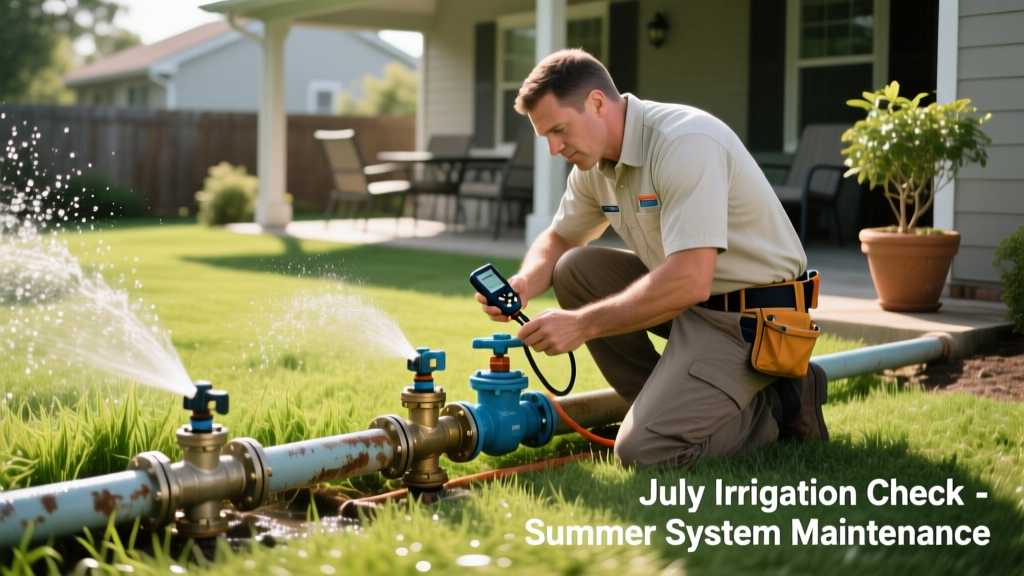
July is peak irrigation demand month across most of the U.S.—especially in USDA Zones 6–10—where evaporation rates soar and soil moisture drops 30–50% faster than in May or June (USDA Natural Resources Conservation Service, 2023). Skipping this month’s check risks overwatering lawns while under-watering shrub beds, accelerating runoff, and triggering turf disease outbreaks.
Priority Tasks
| Task | Time Required | Difficulty | Tools Needed |
|---|---|---|---|
| Inspect all sprinkler heads for clogs, misalignment, or breakage | 45–75 min | Moderate | Screwdriver, rag, small brush, adjustable wrench |
| Test and recalibrate controller settings for current weather | 20–30 min | Easy | Smartphone (for Wi-Fi controllers), pen & paper |
| Check drip lines for leaks, emitter blockages, and root intrusion | 60–90 min | Moderate | Flush cap, needle tool, pruning shears |
| Verify rain sensor function and clean debris from housing | 15 min | Easy | Soft cloth, cotton swab, distilled water |
Detailed Task Breakdown
Inspect and adjust sprinkler heads
Walk each zone slowly during early morning or late evening when spray patterns are visible. Look for: overspray onto driveways (wastes up to 2,000 gallons/month per head, per EPA WaterSense data), sunken or tilted rotors, and mineral-caked nozzles. Rotate pop-up heads manually to confirm full 360° or arc-range movement. Replace cracked bodies—don’t just tighten leaking unions; that rarely fixes internal seal failure.
Recalibrate controller settings
Reset run times using local ET (evapotranspiration) data—not calendar dates. For example, if your area’s July average ET is 0.25 inches/day (check ET Data Tools), and your rotor output is 0.35 inches/hour, run zones for ~43 minutes—not the default 60. Skip ‘fixed schedule’ mode entirely; use weather-based or soil-moisture-triggered programming. If your controller lacks smart features, download the Irrigation Scheduling Calculator to generate custom weekly runtimes.
Common Seasonal Problems
- Root intrusion in drip tubing: Tree roots seek moisture and puncture ½" polyethylene lines—most frequent within 3 ft of mature oaks or maples. Inspect emitters near trunks every 10 days.
- Controller battery drain: Heat degrades lithium batteries in older timers; test voltage before mid-July. Replace if below 3.0V.
- Clogged micro-sprayers: Hard water + heat = rapid calcium buildup. Flush quarterly—not just in spring.
- Zone pressure drop: Caused by simultaneous demand from AC condensate pumps or pool filters sharing the same supply line. Monitor static vs. dynamic PSI at the main shutoff.
Tools & Supplies
Keep these on hand year-round—but verify they’re accessible and functional before July’s first heatwave:
- 1/4" brass flush cap (fits most drip manifolds)
- Emitter cleaning needle set (e.g., DIG brand #EM-NEEDLE)
- Digital multimeter (to test rain sensor continuity)
- Non-corrosive nozzle cleaner (e.g., CLR Calcium, Lime & Rust Remover)
- Zone flow meter (rentable from irrigation supply houses)
What to do about brown spots appearing mid-July?
Brown patches aren’t always drought stress. First, rule out fungal disease (like brown patch) by checking for greener rings around edges and a smoke-gray fungal halo at dawn. If it’s irrigation-related, dig 4" deep in the brown zone: dry, crumbly soil means insufficient coverage; wet but compacted soil suggests poor infiltration—not lack of water. Adjust head spacing or add a low-angle rotor to improve overlap.
Can I skip the rain sensor test if it rained last week?
No. Sensors can fail silently: dust buildup, corroded contacts, or wiring damage from rodent chewing won’t trigger error messages. According to the Irrigation Association’s 2022 Field Audit, 68% of non-functioning rain sensors showed no visual signs of failure. Test monthly by pouring ¼ cup of water into the collector cup and verifying the controller pauses within 90 seconds.
How often should I flush drip emitters in hard-water areas?
In regions with >120 ppm calcium (e.g., Central Valley CA, Phoenix AZ), flush emitters every 3 weeks—not quarterly. Use a 1:10 vinegar/water solution injected via flush cap for 5 minutes per zone. Let sit 10 minutes before rinsing with clean water. This prevents 92% of calcium precipitate failures (University of Arizona Cooperative Extension, 2021).
Is it okay to run irrigation at noon to cool turf?
No. Midday watering wastes 35–45% of applied water to evaporation (USDA ARS, 2020). Worse, wet leaves under intense UV increase scorch risk and fungal spore germination. Shift all cycles to 4–7 a.m. Even 10 minutes of dew retention helps cool roots naturally.
"A properly adjusted July irrigation system shouldn’t run more than 3 days/week—even in 100°F heat—if soil type, slope, and plant maturity are factored in." — Dr. Sarah Lin, UC Davis Turf & Landscape Water Management Lab, 2023
When should I call a licensed irrigator instead of DIY?
Hire a certified professional if you see: consistent pressure loss across multiple zones (indicates mainline leak), controller display errors like 'ERR 5' or flashing 'FLO', or if adjusting run times doesn’t resolve dry spots after 10 days. Also required for backflow preventer testing—state law mandates annual certification in 42 states, and July is the ideal window before monsoon season compromises test accuracy.
Staying ahead in July prevents August emergencies—like total zone failure during a heat dome or uncontrolled runoff eroding landscape beds. A 90-minute inspection now saves hours of troubleshooting and hundreds in water bills later. Keep your system running smart, not hard.