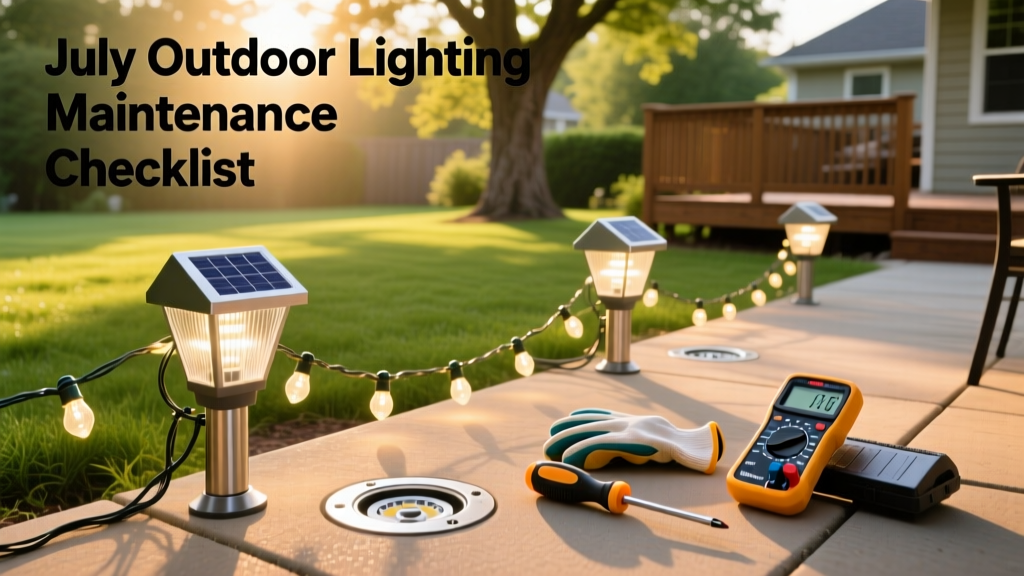
July’s intense heat, humidity, and sudden thunderstorms accelerate wear on outdoor lighting—especially fixtures exposed to direct sun or rain. Corrosion builds faster, wiring insulation degrades, and insect nests clog housings. A quick midsummer check catches issues before monsoon rains or fall frost make repairs harder.
Priority Tasks
| Task | Time Required | Difficulty | Tools Needed |
|---|---|---|---|
| Clean lens covers and housings | 15–25 min per fixture | Easy | Soft brush, microfiber cloth, mild vinegar solution |
| Inspect wiring & connections for corrosion | 20–40 min | Moderate | Wire cutters, dielectric grease, multimeter |
| Test photocell operation | 10 min | Easy | None (cover sensor to simulate dusk) |
| Replace burnt or dimming LEDs | 5–15 min per bulb | Easy | Ladder, replacement LED module (check wattage & base type) |
| Check ground-fault circuit interrupter (GFCI) outlets | 5 min | Easy | None (press TEST/RESET buttons) |
Detailed Task Breakdown
Clean lens covers and housings
Heat + pollen + rain = sticky film that cuts light output by 30–50%. Start with a dry soft brush to remove cobwebs and debris. Then wipe lenses with a 1:1 vinegar-water mix on a microfiber cloth—never ammonia or abrasive cleaners. For brass or copper fixtures, apply a thin coat of carnauba wax after drying to slow oxidation. Skip silicone sprays—they attract dust.
Inspect wiring & connections
Focus on junction boxes, wire nuts, and low-voltage transformer outputs. Look for white powdery residue (copper sulfate corrosion) or blackened insulation. According to the National Electrical Manufacturers Association’s Outdoor Lighting Safety Bulletin (2022), 68% of outdoor lighting failures trace back to corroded connections—not bulbs. Cut away damaged wire ends, strip ½ inch of fresh insulation, twist leads tightly, and seal with waterproof wire nuts plus dielectric grease.
Common Seasonal Problems
July brings three recurring issues: insect nests inside fixture housings (especially wasps in recessed soffit lights), condensation fogging in sealed units due to rapid day-night temperature swings, and GFCI tripping from moisture ingress at outlet boxes or buried low-voltage splices. If your path lights flicker only during evening dew buildup, it’s likely condensation—not faulty wiring.
- Wasps nesting in fixtures? Wait until dusk, spray with wasp freeze, then vacuum nests at dawn.
- Fogged lenses? Drill two 1/16" weep holes at the bottom of the housing—learn how to drill safely.
- GFCI trips after rain? Check conduit entry points for cracked seals and replace rubber grommets.
Tools & Supplies
Keep these on hand before you start:
- Step ladder (non-conductive fiberglass for overhead work)
- LED replacement modules (match lumen output and color temp—e.g., 2700K warm white for porch)
- Dielectric grease (Permatex 22058 is UL-listed for outdoor use)
- Vinegar-based cleaner or Simple Green Outdoor Formula
- Insulated screwdrivers and needle-nose pliers
- Waterproof voltage tester (see top-rated models)
Why do my solar path lights stop working in July?
It’s rarely the battery—it’s dirt buildup on the solar panel. Wipe panels weekly with a damp cloth. Dust + humidity creates a film that blocks 40%+ of UV absorption. Replace NiMH batteries every 2 years; lithium-ion lasts 5 but fails abruptly if overheated.
Can I upgrade halogen landscape lights to LED without rewiring?
Yes—if your transformer outputs 12V AC and supports LED loads (check label for “LED compatible” or minimum load rating). Most modern 12V transformers handle LED loads down to 5W. If yours requires >20W minimum, add a dummy load resistor or swap the transformer. Full compatibility checklist here.
How often should I test GFCIs serving outdoor lighting?
Monthly—per the U.S. Consumer Product Safety Commission’s 2023 Home Electrical Safety Guidelines. Press TEST (should trip instantly), then RESET. If it won’t reset or trips without load, replace it—don’t bypass.
My motion-sensor light stays on all night. What’s wrong?
July heat can desensitize PIR sensors. Adjust the sensitivity dial (usually under the lens) to “low” and ensure no HVAC exhaust or tree branches sway into detection zone. Also verify the “ON-TIME” setting isn’t cranked to max (some units default to 30 minutes after power-on).
"Corrosion on outdoor lighting terminals progresses 3× faster in humid, salty air—and July’s peak humidity makes it the most critical month for visual inspection." — NEMA Outdoor Lighting Maintenance Handbook, 2022 Edition
Don’t wait for flickering or total failure. A 30-minute July lighting check prevents costly replacements later—and keeps your walkways safe when summer evenings grow darker earlier. Pair this with your July gutter cleaning checklist for full curb appeal protection.