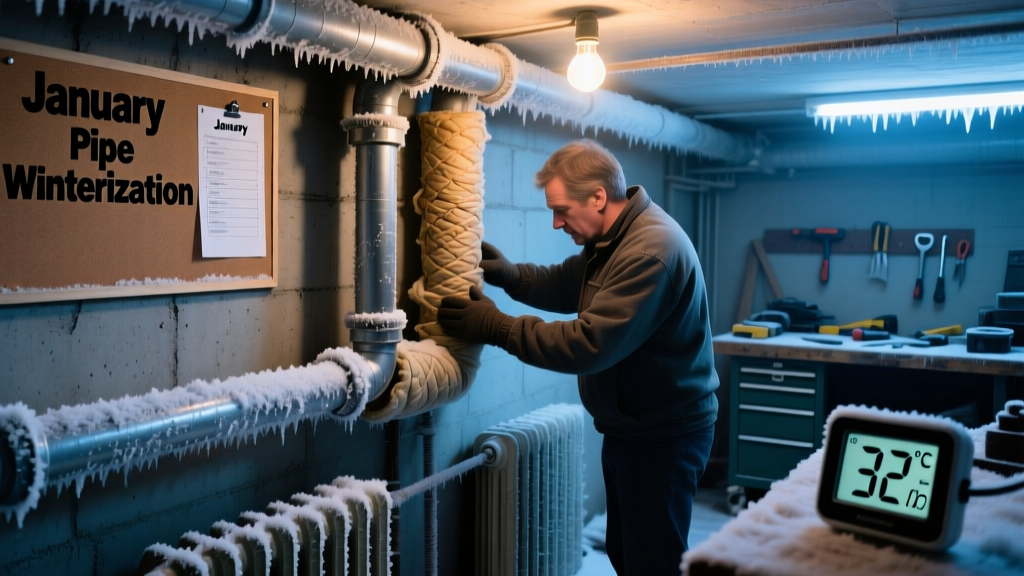
January is the peak risk month for frozen and burst pipes—especially in homes built before 2000 or with exterior walls, crawlspaces, or unheated garages. The U.S. Insurance Information Institute reports that water damage from frozen pipes accounts for nearly 25% of all winter home insurance claims, with average repair costs exceeding $12,000 (2023 data).
Priority Tasks
| Task | Time Required | Difficulty | Tools Needed |
|---|---|---|---|
| Insulate exposed pipes in basement, garage, and crawlspace | 1.5–2 hours | Moderate | Foam pipe sleeves, fiberglass wrap, utility knife, duct tape |
| Drain and shut off outdoor faucet lines | 20 minutes | Easy | Wrench, bucket, towel |
| Set thermostat to no lower than 55°F when away | 2 minutes | Easy | Smart thermostat or manual dial |
| Locate and label main water shutoff valve | 10 minutes | Easy | Permanent marker, label tape |
| Check sump pump operation and battery backup | 30 minutes | Moderate | Bucket of water, flashlight, multimeter (optional) |
Detailed Task Breakdown
Insulate vulnerable pipes
Focus on pipes running through unheated spaces: exterior walls (especially north-facing), attic access points, garage ceilings, and crawlspaces. Use pre-slit foam sleeves rated for R-4 or higher—avoid duct tape alone; secure seams with foil tape or UV-resistant zip ties. Pipes less than 1 inch in diameter need at least ½-inch insulation; larger lines require 1-inch thickness. Don’t forget the pipe nipple between your water heater and shutoff valve—it’s a frequent freeze point.
Winterize outdoor faucets and irrigation
Turn off the interior shutoff valve feeding each outdoor spigot—usually located in the basement or utility closet near the foundation wall. Open the outdoor faucet to drain residual water. Remove and store any attached hoses. For frost-free sillcocks, verify the internal valve seat isn’t cracked by checking for drips after shutting off; replace if leaking. According to the EPA’s WaterSense program, skipping this step contributes to 37% of preventable winter pipe bursts in single-family homes.
Common Seasonal Problems
- Slow or no water flow from one fixture (early sign of localized freezing)
- Frost on pipe surfaces or condensation that won’t dry (indicates cold bridging)
- Gurgling sounds in walls when running water (air trapped behind ice)
- Unusual musty odor near baseboards (possible micro-leak behind drywall)
- Thermostat dropping below 50°F overnight—even briefly—in unused rooms
If you spot any of these, act within 24 hours. A pipe frozen solid can burst within 6–8 hours of thawing if pressure builds behind the ice blockage.
Tools & Supplies
Keep these on hand before the first sub-20°F night:
- Foam pipe insulation (R-4 minimum, 6-ft lengths)
- Heat tape with built-in thermostat (UL-listed, for pipes under 2 inches)
- Insulated faucet covers (not fabric—use rigid foam with Velcro straps)
- Non-toxic antifreeze for RV-style systems (only for non-potable lines)
- Flashlight with red LED mode (preserves night vision during basement checks)
What temperature should I keep my house at when away?
Set your thermostat to 55°F minimum—even for short trips. The Insurance Institute for Business & Home Safety’s 2023 Cold Weather Preparedness Report found homes held at 50°F or lower had a 3.2× higher burst-pipe incident rate than those at 55°F or above.
Can I use heat tape on PVC pipes?
No—standard self-regulating heat tape exceeds safe surface temps for PVC (max 140°F). Use only UL-listed heat cable rated specifically for plastic piping, and never wrap it tightly. Always install over insulation, not directly on pipe.
My pipes froze last year—how do I prevent recurrence?
Map every pipe run using your home’s original blueprints (check county records or find home blueprints). Add insulation to any pipe within 2 inches of an exterior sheathing layer—and seal air gaps around pipe penetrations with expanding foam, not caulk. See our seal attic edges guide for airflow control tips.
Do I need to winterize my sump pump?
Yes—if your discharge line runs outside or through an unheated garage. Insulate the line with split-foam tubing and ensure the check valve isn’t frozen open. Test monthly by pouring 5 gallons of water into the pit: the pump should activate within 30 seconds and shut off cleanly. If it cycles rapidly or doesn’t start, inspect the float switch—debris jams are common in January.
Is pipe insulation enough—or do I need heat tape too?
Insulation alone works for most interior pipes in conditioned spaces. Heat tape is essential for pipes in attics, garages, or exterior walls with poor insulation (R-value <11), or where temperatures regularly dip below 20°F. Use heat tape only as a supplement—not a replacement—for proper insulation and air sealing.
How do I know if a pipe is frozen—or just clogged?
A frozen pipe affects only one fixture; a clog usually impacts multiple fixtures on the same branch. Try turning on both hot and cold at the affected faucet: if neither flows but others work fine, suspect freezing. Gently warm the pipe with a hair dryer (never open flame) starting at the faucet end—stop if you hear rushing water or see moisture. If no flow returns after 20 minutes of warming, call a licensed plumber.
"Most frozen pipe failures happen during the thaw—not the freeze. Pressure spikes behind melting ice cause 80% of bursts." — Plumbing-Design Handbook, ASPE, 2022 edition
January’s bite is predictable—but its damage doesn’t have to be. A focused two-hour session now protects against weeks of disruption later. Revisit your checklist after any extended cold snap below 15°F, and always test shutoff valves annually. For more seasonal prep, see our February HVAC tuneup guide.