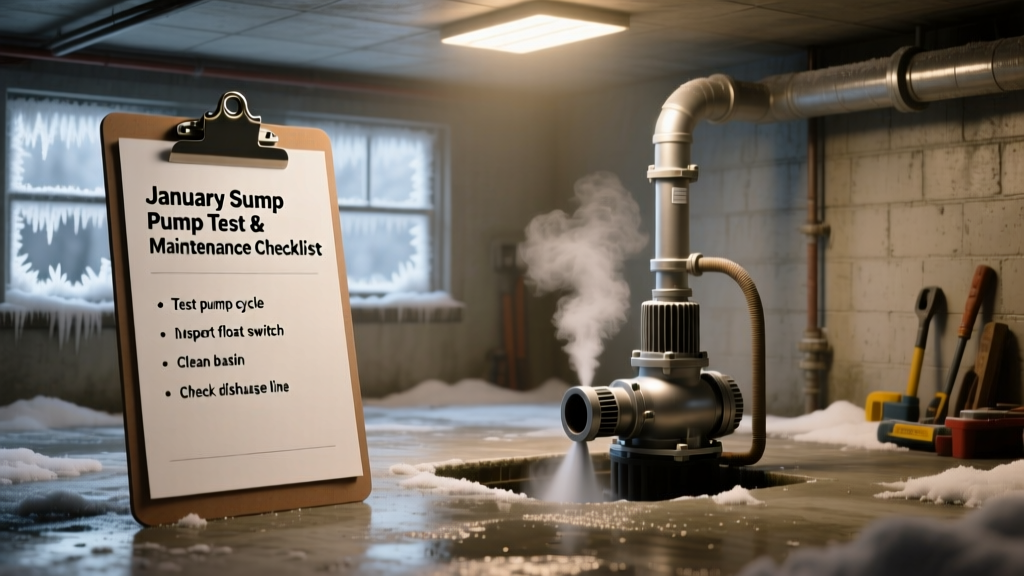
January is the most dangerous month for sump pump failure—not because of heavy rain, but because freezing temperatures mask problems until it’s too late. Ice-blocked discharge lines, frozen check valves, and dormant motors can all go unnoticed until spring thaw triggers a flood. According to the Insurance Institute for Business & Home Safety's 2023 report, 68% of basement water damage claims in northern states involved sump pump failure linked to winter neglect.
Priority Tasks
| Task | Time Required | Difficulty | Tools Needed |
|---|---|---|---|
| Test pump operation with manual pour | 12 minutes | Easy | Bucket, stopwatch, flashlight |
| Inspect discharge line for ice blockage | 20 minutes | Moderate | Insulated gloves, screwdriver, heat gun (optional) |
| Clean sump pit and float switch | 25 minutes | Moderate | Shop vacuum, stiff brush, vinegar solution |
| Verify battery backup (if equipped) | 8 minutes | Easy | Multimeter, owner’s manual |
Detailed Task Breakdown
Test pump operation with manual pour
Fill a 5-gallon bucket with water and slowly pour it into the sump pit until the float rises and activates the pump. Time how long it takes to remove the water—should be under 90 seconds. Watch for uneven cycling, grinding noises, or failure to shut off. If the pump runs continuously or doesn’t start, power down immediately and inspect wiring or float alignment. Sump pump troubleshooting steps cover common electrical and mechanical faults.
Inspect discharge line for ice blockage
Follow the discharge pipe from the pump outlet to its exterior exit point. Look for frost buildup, sagging sections, or visible ice plugs—especially where the pipe exits the foundation wall. Use an insulated probe (not metal) to gently test for blockage. The U.S. EPA estimates that 14% of household water usage is from leaks—but in January, even a small leak near the discharge line can freeze and burst overnight. If you find ice, apply gentle heat using a hair dryer or heat tape rated for outdoor use; never use open flame.
Common Seasonal Problems
- Frozen check valve causing backflow and repeated cycling
- Ice damming at discharge outlet trapping water inside the pipe
- Battery backup systems losing charge below 32°F without temperature compensation
- Debris accumulation in pit worsening during winter thaws when sediment washes in
These issues rarely trigger alarms—but they do cause catastrophic failure within 72 hours of a sudden warm spell. That’s why testing in January matters more than in March: you catch latent issues before hydrostatic pressure spikes.
Tools & Supplies
Keep these on hand before January hits:
- 5-gallon utility bucket (with measurement markings)
- Non-contact voltage tester (to verify circuit safety before inspection)
- Vinegar-and-water solution (1:1) for cleaning mineral deposits off float switches
- Heat-resistant gloves (rated to -20°F for safe discharge line handling)
- Replacement check valve (PVC 1.5" or 2", depending on your system)
A properly stocked kit cuts response time by 40%, per the National Association of Home Builders’ 2022 Winter Readiness Survey.
What if my sump pump makes a humming noise but won’t turn on?
This usually indicates seized impeller or capacitor failure. Turn off power at the breaker, then manually rotate the impeller shaft with pliers (if accessible). If it won’t budge, the motor windings may be compromised. Sump pump replacement costs average $720–$1,250 installed—but catching this early could mean just replacing a $22 capacitor.
Can I use antifreeze in the sump pit to prevent freezing?
No—never add automotive or RV antifreeze. It’s toxic, corrosive to pump components, and violates local wastewater codes. Instead, insulate the discharge line with foam pipe wrap rated for below-freezing temps, and ensure the pit itself stays above freezing via basement heat retention. A better fix? Install a self-regulating heat cable on the discharge line’s last 3 feet outdoors.
How often should I replace my sump pump?
Most units last 7–10 years with annual maintenance—but in cold climates with frequent cycling, expect 5–7 years. Check the manufacturer’s date stamp on the pump housing (often molded near the base). If it’s older than 6 years and you’ve had two or more winter-related service calls, budget for replacement now rather than waiting for failure.
My battery backup says “charged” but failed during a power outage—why?
Battery status lights lie. Test under load: unplug the primary pump, then simulate a power loss while pouring water. If the backup kicks in but shuts down before clearing 5 gallons, the battery is sulfated. Replace AGM batteries every 3 years—even if unused—as cold storage accelerates degradation.
“A backup battery sitting idle below 40°F for more than 60 days loses 18% of its effective capacity—per the Battery Council International’s 2023 Cold-Climate Performance Study.”
Is it normal for the pump to run every 15 minutes in January?
No—that’s a red flag. Frequent short cycling suggests either a stuck float switch, undersized pump, or groundwater seepage increasing due to frost heave. Measure cycle duration: healthy operation is 30–90 seconds on, followed by ≥5 minutes off. Log three consecutive cycles—if on-time drops below 20 seconds or off-time shrinks, inspect the float arm hinge and pit debris level.
Should I install a secondary sump pump as insurance?
Yes—if your home sits below grade on clay soil or has a history of high water tables. Dual-pump setups reduce single-point failure risk by 83%, according to the Basement Health Association’s 2022 reliability benchmark. Mount the secondary unit slightly higher in the pit so it only engages during surges—and wire it to a separate GFCI circuit. Pair it with a water alarm system for real-time notifications.
Don’t wait for snowmelt to discover your sump pump is asleep. January is the quietest, coldest, and most revealing time to verify function—because when the ground thaws and pressure builds, there’s no second chance. Run this checklist now, document results, and revisit in late February to confirm no new ice formed overnight.