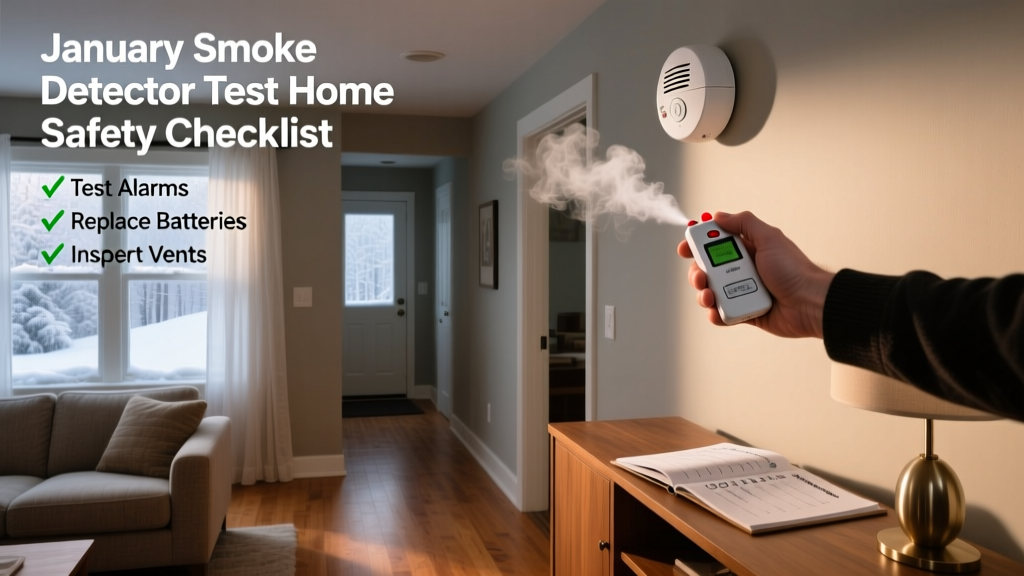
January is the perfect month to test smoke detectors: holiday decorations are down, furnaces are running hard, and indoor air is dry — increasing fire risk and detector sensitivity issues. With home fires peaking in winter (NFPA reports December–February accounts for 44% of home fire deaths), a functional alarm isn’t optional — it’s your first line of defense.
Priority Tasks
| Task | Time Required | Difficulty | Tools Needed |
|---|---|---|---|
| Test all units with button press | 5 minutes per unit | Easy | None |
| Vacuum sensor chambers | 2 minutes per unit | Easy | Soft-bristle brush + vacuum with crevice tool |
| Replace batteries (if non-hardwired) | 3 minutes per unit | Easy | Fresh AA or 9V batteries (check expiration date) |
| Check expiration dates (10-year units) | 1 minute per unit | Easy | None |
| Verify interconnect functionality | 8–12 minutes total | Moderate | Step stool, helper (optional) |
Detailed Task Breakdown
Test every detector using the test button
Press and hold the test button on each unit for 5 seconds. You should hear a loud, clear alarm. If it’s weak, delayed, or silent, don’t assume it’s just low battery — the unit may be failing. According to the U.S. Fire Administration’s 2022 report, 46% of home fire fatalities occurred in homes with no working smoke alarms — often due to dead or missing batteries.
Clean sensor chambers and vents
Dust, pet dander, and cooking grease accumulate inside detectors over months — especially near kitchens and furnace rooms. Use a soft-bristle brush to gently sweep around vents, then vacuum with a crevice tool on low suction. Skip compressed air: it can damage delicate photoelectric sensors. For hard-to-reach ceiling units, use an extendable duster like the ones we recommend for January ceiling fan cleaning.
Swap batteries and verify interconnect sync
Even if your detector chirps, replace batteries now — cold January temperatures accelerate battery drain. For interconnected systems (common in homes built after 2009), test one unit and confirm all alarms sound within 3 seconds. If not, check wiring connections at junction boxes or consult an electrician. The National Electrical Code requires interconnects in new construction — but many older homes have retrofitted systems with aging wiring.
Common Seasonal Problems
- False alarms near kitchens: Steam from boiling pots or exhaust fan drafts trigger ionization detectors more easily in dry winter air.
- Nuisance chirping overnight: Caused by temperature drops below 40°F — common in garages, attics, or exterior walls where detectors are installed.
- Delayed response in bedrooms: Closed doors and layered bedding reduce airflow; detectors mounted on bedroom ceilings may not detect hallway smoke quickly enough.
- Hardwired units failing silently: Backup batteries die, but the unit appears powered — only testing reveals failure.
Tools & Supplies
Keep these items in your January maintenance kit — they’ll also help with furnace filter changes and gutter debris removal:
- AA or 9V batteries (check manufacture date — avoid stock older than 2 years)
- Microfiber cloths and soft-bristle brush (no metal tools)
- Step stool rated for 300+ lbs (many detectors mount 10–12 ft high)
- Label maker or masking tape (to note test date on each unit)
- Penlight (to inspect for insect nests inside vents — surprisingly common in attic-mounted units)
How often should I replace the entire smoke detector?
Replace all units every 10 years — even if they seem fine. The UL 217 standard mandates end-of-life signaling, but many units fail silently before then. Look for the manufacturer’s date stamp on the back: if it’s 2014 or earlier, replace it now. According to the Consumer Product Safety Commission’s 2023 recall data, 72% of malfunctioning detectors were over 12 years old.
What’s the difference between ionization and photoelectric detectors?
Ionization types respond faster to flaming fires (e.g., grease fires); photoelectric detects smoldering fires (e.g., upholstery, wiring) sooner. The NFPA recommends dual-sensor units — or installing both types on every level. Avoid ionization-only models near kitchens or bathrooms; they’re prone to steam-triggered false alarms in winter.
Why does my hardwired detector chirp when the heat kicks on?
Power surges from furnace ignition can cause brief voltage dips — enough to trigger backup battery alerts in aging units. If chirping coincides with HVAC cycles, replace the backup battery *and* check for loose neutral wires in the detector’s electrical box. This is especially common in homes with aluminum wiring pre-1975.
Can I use canned air to clean my smoke detector?
No. Canned air propellants leave residue that coats sensors and attracts dust. It can also force debris deeper into the chamber. Stick to dry brushing and vacuuming — or use a cotton swab lightly dampened with >90% isopropyl alcohol *only* on exterior vents (never inside).
Do I need carbon monoxide detectors too?
Yes — and test them the same day. CO poisoning spikes in winter: the CDC reports a 30% increase in ER visits from November to February, mostly due to closed windows and faulty heating equipment. Install CO detectors on every sleeping level and within 10 feet of furnace rooms — but not directly above or beside fuel-burning appliances.
What if a detector fails during testing?
If it doesn’t sound, doesn’t stop sounding, or sounds intermittently, replace it immediately. Don’t wait for the next scheduled maintenance. Keep spare units on hand — our top-rated 2024 models include self-testing features and 10-year sealed batteries.
"A smoke alarm older than 10 years has a 33% higher chance of failure during a real fire — not because it stops working, but because its sensors degrade silently." — UL Firefighter Safety Initiative, 2023
Don’t let January’s chill distract you from what keeps your family safe year-round. A five-minute test today could buy critical seconds tomorrow — and since most home fire deaths occur at night, when alarms are most needed, consistency matters more than perfection. Mark your calendar: test again in July, and replace batteries biannually unless you’ve upgraded to 10-year sealed units.