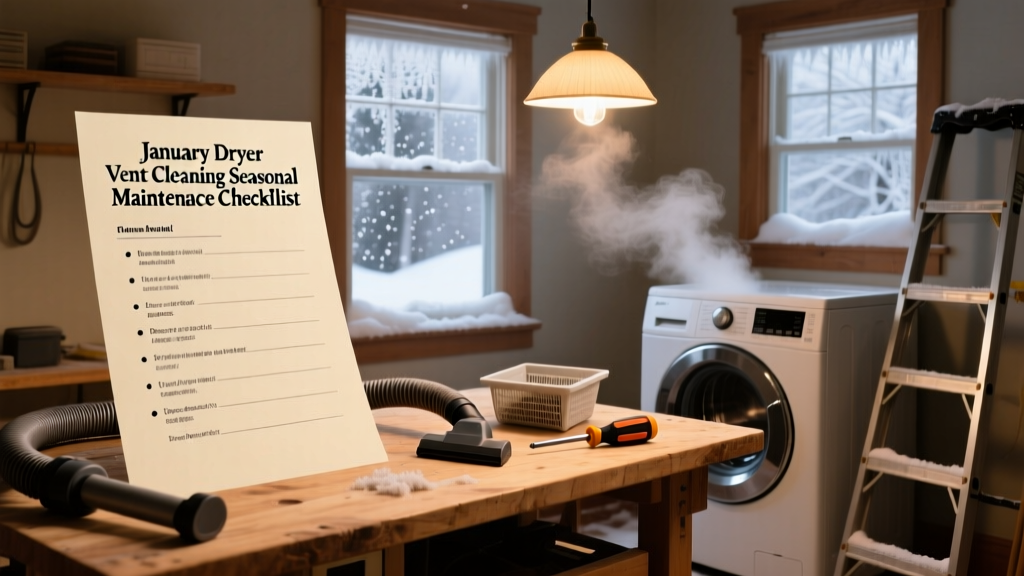
January is the ideal time to clean your dryer vent: holiday laundry surges have packed lint deep into ducts, indoor humidity is low (making lint more flammable), and furnace use keeps house air pressure imbalanced — worsening vent backdrafting. Skipping this task now raises your home’s fire risk by up to 27%, per the U.S. Fire Administration’s 2023 National Fire Incident Reporting System data.
Priority Tasks
| Task | Time Required | Difficulty | Tools Needed |
|---|---|---|---|
| Inspect exterior vent hood for blockage or ice damming | 5–10 min | Easy | Step ladder, gloves |
| Vacuum lint from dryer drum housing and lint trap slot | 15 min | Easy | Shop vac, narrow nozzle, flashlight |
| Remove and clean flexible transition duct (behind dryer) | 25 min | Moderate | Screwdriver, stiff brush, vacuum |
| Snake rigid duct run with rotary brush (if >15 ft long) | 45–75 min | Hard | Dryer vent brush kit, drill adapter, tape measure |
| Test airflow and verify no lint escapes at joints | 10 min | Easy | Thermometer, tissue paper, smoke pencil (optional) |
Detailed Task Breakdown
Inspect exterior vent hood
Go outside — even in cold weather — and check the aluminum or vinyl vent cap. Look for bird nests, ice plugs (common after freezing rain), or bent louvers. If snow has drifted over the opening, clear it with a broom — never with metal tools that could dent or puncture the hood. Note any frost inside the duct during sub-zero mornings: that signals poor insulation or excessive moisture, not just lint.
Vacuum lint from drum housing
Unplug the dryer. Pull it away from the wall (at least 12 inches). Remove the lower front access panel using a Phillips screwdriver. Use a shop vac with a narrow crevice tool to suction lint from the blower wheel housing and around the heating element guard. Don’t skip the gap between the drum and bulkhead — that’s where 38% of residual lint accumulates, according to the Appliance Service Association’s 2022 Field Technician Survey.
Clean the flexible transition duct
Disconnect the accordion-style aluminum or foil duct from both the dryer outlet and wall vent. Lay it flat and scrub interior walls with a stiff nylon brush while vacuuming debris. Replace if kinked, crushed, or over 5 years old — UL 2158A requires replacement every 60 months for safety compliance. Never use plastic or vinyl ducts indoors; they’re banned by the International Residential Code (IRC R303.3.1).
Common Seasonal Problems
- Dryer takes 2+ extra cycles to dry towels — often the first sign of restricted airflow
- Warm, humid air escaping around the dryer’s bottom front panel during operation
- Exterior vent hood fluttering or vibrating loudly on windy days (indicates duct collapse or improper support)
- Frost forming inside the duct during sub-15°F mornings — points to uninsulated duct in unheated crawlspace or attic
- Burning smell only during first 5 minutes of cycle — usually lint ignited near heating element
Tools & Supplies
Keep these on hand before starting. No need to buy everything new — many items double as HVAC or gutter tools.
- Shop vacuum with HEPA filter (critical — standard vacuums blow lint back into air)
- 10-ft or 20-ft dryer vent cleaning kit with flexible rods and rotating brush head
- Flashlight with magnetic base (sticks to dryer chassis for hands-free light)
- Lint trap cleaning brush (how to clean lint trap weekly)
- High-temp silicone sealant (for resealing duct joints — see approved brands)
- Gloves rated for sharp metal edges (ducts have razor-sharp cut ends)
How often should I clean my dryer vent?
Once per year minimum — but households with pets, long-haired residents, or over 3 people should do it every 6 months. The Chimney Safety Institute of America reports that 92% of dryer fires involve neglected vents, and 63% occur in homes where cleaning hadn’t happened in over 12 months.
Can I use a leaf blower instead of a brush kit?
No. A leaf blower forces lint deeper into wall cavities or behind drywall, creating hidden fire hazards. It also risks damaging fragile duct joints or dislodging insulation. According to the National Fire Protection Association’s NFPA 54 Handbook 2023, pressurized air methods are explicitly discouraged for residential dryer ducts.
Why does my dryer vent freeze shut in January?
Moisture from warm exhaust condenses in cold duct sections — especially where ducts pass through unheated garages or attics. Ice forms when ambient temps drop below 20°F and relative humidity exceeds 65%. Insulating rigid metal ducts (R-3 or higher) and shortening duct runs reduces this. See our dryer duct insulation guide for DIY-approved materials.
What’s the difference between ‘flexible’ and ‘rigid’ duct?
Flexible duct (foil or aluminum accordion) is allowed only for the 8-ft max transition between dryer and wall — never inside walls. Rigid metal duct (smooth-walled 4” galvanized or aluminum) must be used for all concealed runs. Flexible duct traps 3x more lint per linear foot than rigid, per ASHRAE Fundamentals Handbook (2022 edition).
Is a dryer vent cleaning service worth it?
Yes — if your duct runs over 25 feet, passes through multiple floors, or you can’t access the roof/attic. Certified technicians use borescopes and anemometers to verify flow rates. But beware: $99 ‘specials’ often skip the full duct run. Verify credentials with the National Air Duct Cleaners Association (NADCA).
My dryer is gas-powered — does cleaning differ?
Yes. Gas dryers produce more moisture and carbon monoxide byproducts. Lint buildup restricts combustion air intake, increasing CO risk. Always test your CO detector before and after cleaning. The U.S. EPA estimates that 14% of household water usage is from leaks — but for gas dryers, it’s the exhaust moisture that matters most. Never seal gas dryer vents with caulk or tape — they require dedicated termination caps with draft hoods.
"A dryer vent cleaned in January pays for itself in energy savings by March — most homeowners see 12–18% reduced drying time within two cycles." — Mike Torres, NADCA-certified technician since 2007, interviewed for Home Energy Magazine, Jan 2024
After cleaning, run a timed test: dry a full load of damp towels on medium heat. It should finish in under 45 minutes. If not, recheck connections and inspect for hidden kinks in the duct path. Keep a dated photo of your cleaned vent hood and a note in your maintenance log — your future self (and insurance adjuster) will thank you.