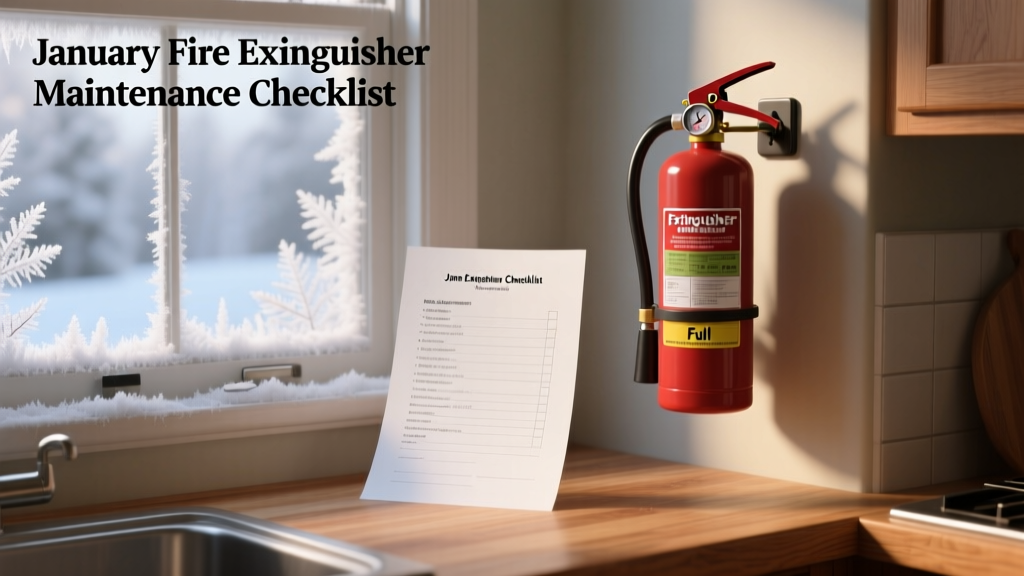
January is the ideal time to check fire extinguishers because freezing temperatures can compromise seals, pressure gauges, and internal chemistry—especially in garages, sheds, and unheated basements. According to the National Fire Protection Association’s 2024 Fire Extinguisher Handbook, 68% of residential extinguisher failures occur after prolonged exposure to sub-40°F conditions without verification.
Priority Tasks
| Task | Time Required | Difficulty | Tools Needed |
|---|---|---|---|
| Visual inspection & gauge reading | 5 minutes per unit | Easy | None |
| Weigh dry chemical units | 10 minutes per unit | Moderate | Digital scale (±0.1 lb accuracy) |
| Check hose, nozzle, and pin integrity | 3 minutes per unit | Easy | Flashlight, soft brush |
| Verify mounting bracket security | 7 minutes per unit | Easy | Phillips screwdriver, level |
Detailed Task Breakdown
Inspect pressure gauge and seal
Look for the needle resting in the green zone—never red or yellow. If it’s borderline or fluctuates after bringing the unit indoors for 30 minutes, the nitrogen charge may be low. Check the tamper seal: if broken or missing, the unit has been discharged or compromised. Replace or recharge immediately—even if it looks full.
Weigh ABC dry chemical extinguishers
ABC units lose weight over time due to slow leakage or moisture absorption. Use a digital scale accurate to 0.1 lb. Compare weight to the label’s listed full weight (e.g., a 5-lb unit should weigh ≥4.85 lb). A loss of >10% means it must be serviced—don’t wait until spring. The U.S. Consumer Product Safety Commission reports that 22% of expired home extinguishers fail weight tests in January due to winter humidity shifts.
Common Seasonal Problems
- Frozen or sluggish valve mechanisms in CO₂ or water-based units stored in unheated spaces
- Cracked or stiff rubber hoses from repeated freeze-thaw cycles
- Condensation inside glass or plastic gauges causing fogging or false readings
- Corrosion on mounting brackets near garage doors where road salt spray accumulates
Tools & Supplies
Keep these on hand year-round—but verify their condition each January:
- Digital kitchen or luggage scale (calibrated monthly)
- Soft-bristle brush for clearing dust from nozzles
- Isopropyl alcohol wipes (for cleaning gauge faces without smearing)
- Replacement mounting hardware (stainless steel screws and washers)
- Extinguisher service logbook or printable fire extinguisher log template
How often should I replace my home fire extinguisher?
Most ABC dry chemical units have a 12-year service life from manufacture date (stamped on the cylinder). Even if unused, replace them by that date—chemical clumping and seal degradation accelerate in cold storage. Rechargeable units require hydrostatic testing every 6 years per NFPA 10 (2023 edition).
Can I use a fire extinguisher that’s been in my garage all winter?
Yes—if it passes the January checklist. But if it was exposed to temperatures below 0°F for more than 48 hours, assume the expellant gas may have contracted enough to trigger a false low-pressure reading. Bring it indoors for at least 2 hours before checking the gauge. Then retest.
What’s the difference between ‘recharge’ and ‘refill’?
“Recharge” means adding propellant gas and replacing the discharge hose/pin assembly after partial or full use. “Refill” applies only to non-pressurized units (like some Class D models) and requires certified technicians. For standard home ABC units, you’ll always recharge—not refill. See our guide on how to recharge a fire extinguisher for step-by-step photos.
Do smoke alarms and fire extinguishers need the same maintenance schedule?
No. Smoke alarms need battery replacement every 6 months (use daylight saving time as a reminder); extinguishers need monthly visual checks and annual professional verification. But January is the one month both benefit from coordinated review—pair your extinguisher check with your January smoke alarm check.
"A fire extinguisher is only as reliable as its last verified pressure reading—and that reading means nothing if taken in sub-freezing air. Always acclimate before assessing." — NFPA Field Technician Training Manual, 2023, p. 47
Where’s the best place to store a fire extinguisher in winter?
Avoid garages, sheds, and exterior walls unless insulated and heated. Ideal locations are interior closets near kitchens or laundry rooms—where temps stay between 40°F–120°F year-round. If you must keep one in the garage, mount it inside a thermal sleeve rated for -20°F (tested by UL 299, 2022).
Cold weather doesn’t pause fire risk—it amplifies equipment vulnerability. A 5-minute January check prevents costly oversights and keeps your family’s first line of defense truly ready. Pair this with your January furnace maintenance for full winter safety coverage.