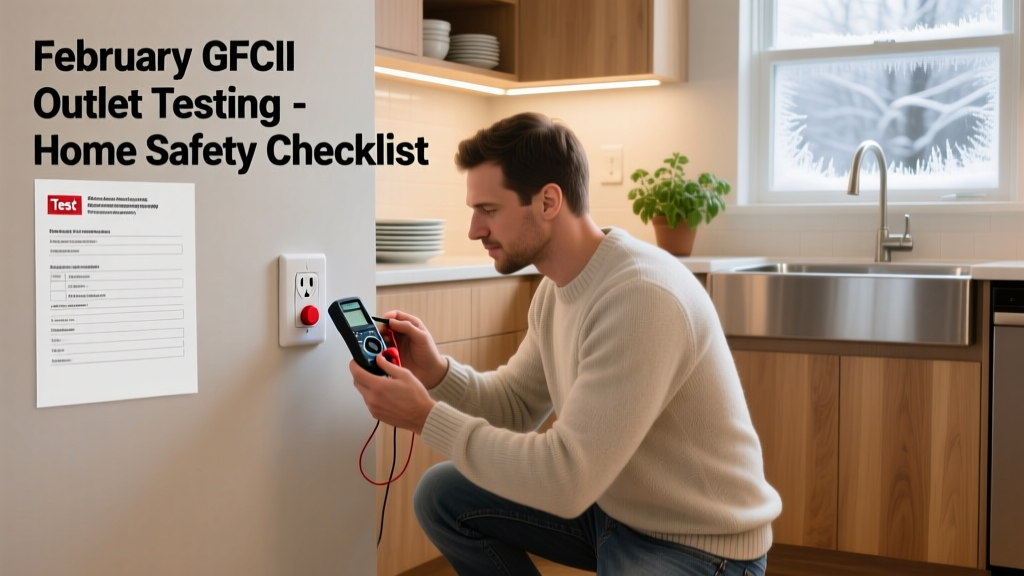
February’s freeze-thaw cycles, melting ice dams, and indoor humidity spikes create perfect conditions for ground-fault risks—especially in kitchens, bathrooms, garages, and basements where GFCIs protect lives. The U.S. Consumer Product Safety Commission estimates that 70% of electrocutions from household wiring could be prevented by properly functioning GFCIs (CPSC, 2022). That’s why February is the ideal time to verify every unit—not just reset them, but truly test them.
Priority Tasks
| Task | Time Required | Difficulty | Tools Needed |
|---|---|---|---|
| Test all GFCI outlets (including downstream receptacles) | 15–25 minutes | Easy | GFCI tester (optional), penlight, notepad |
| Reset tripped units and retest | 2–3 minutes per outlet | Easy | None |
| Inspect for corrosion, discoloration, or physical damage | 10 minutes total | Moderate | Screwdriver, flashlight, magnifying glass |
| Verify GFCI protection extends to nearby standard outlets | 5–8 minutes per circuit | Moderate | GFCI tester or lamp + extension cord |
Detailed Task Breakdown
How to properly test a GFCI outlet
Press the TEST button—not just once, but firmly until you hear a distinct click and power cuts off. Plug in a lamp or phone charger to confirm it’s dead. Then press RESET. If the lamp doesn’t come back on, the GFCI is faulty. Don’t assume “it clicked” means it works—always verify with load. According to the National Electrical Code (NEC 2023), GFCIs must trip within 25 milliseconds at 6mA fault current; older units (pre-2015) often degrade past that threshold.
Map GFCI-protected downstream outlets
Many standard outlets—especially in older homes—are wired downstream of a single GFCI. Test each one: plug in a lamp, then trip the GFCI upstream. If the lamp goes out, it’s protected. Label each protected outlet with tape and a marker (e.g., “GFCI-Protected – Bath 1”). This saves time during future inspections and helps when troubleshooting dead outlets. Keep a simple floorplan sketch in your home maintenance logbook.
Common Seasonal Problems
- Moisture intrusion behind outlet covers in garages or exterior walls—causing intermittent tripping or corrosion on terminals
- Ice melt residue tracked into basements or mudrooms, raising ambient conductivity near outlets
- Aging GFCIs (installed before 2010) failing silently—they may reset but won’t trip under real fault conditions
- Cold-induced brittleness in plastic faceplates cracking during reset/test button presses
If an outlet trips repeatedly without load—or won’t reset after pressing firmly—replace it immediately. Do not bypass or replace with a standard outlet. GFCIs are required by code in all wet/damp locations, and skipping replacement puts your home at risk during spring thaw leaks.
Tools & Supplies
- GFCI outlet tester (e.g., Klein Tools RT210 — verifies trip time and polarity)
- Non-contact voltage tester (for confirming de-energized circuits before inspection)
- Replacement GFCI outlets (tamper-resistant, 20A rated if on kitchen countertop circuits)
- Small Phillips screwdriver and wire stripper (for safe replacement if needed)
- Dielectric grease (apply sparingly to terminals in damp locations like crawlspaces)
Keep spares on hand—especially if your home has more than eight GFCIs. The average home installed between 2000–2012 has 5–9 GFCIs, and nearly 40% fail functional testing after 10 years (Electrical Safety Foundation International, 2023).
How often should I test GFCI outlets?
Monthly testing is recommended by the CPSC—but February is non-negotiable because seasonal stressors peak then. Think of it as your annual ‘cold-weather electrical tune-up.’ If you missed January, February is your last window before spring rains raise basement humidity and increase leakage paths.
What if my GFCI won’t reset after tripping?
First, unplug everything downstream. If it still won’t reset, check for moisture inside the box or loose wires. If dry and wired correctly, replace it—don’t keep resetting. A GFCI that won’t hold reset is either defective or detecting an actual ground fault (like damaged appliance cords or compromised insulation). Trace the circuit using your electrical panel labeling guide to isolate the issue.
Do outdoor GFCIs need special handling in February?
Absolutely. Even if covered, snowmelt can wick up conduit or seep behind weatherproof boxes. Remove the cover, inspect for ice crystals or condensation, and wipe terminals with a dry cloth before testing. Use only WR-rated (weather-resistant) GFCIs outdoors—standard models fail faster in freezing temps. Replace any unit installed before 2015; WR ratings became mandatory in NEC 2014.
Can I test GFCIs with a multimeter instead of the TEST button?
No—and here’s why: pressing TEST simulates a real ground fault by shunting current through an internal resistor. A multimeter only measures voltage presence, not trip functionality or response time. As electrician Maria Chen notes in Residential Wiring Handbook, 4th Ed. (2021): “If you’re not hearing the mechanical ‘click’ and verifying load interruption, you’re not testing—you’re hoping.”
“GFCIs older than 10 years have a 32% failure rate in functional testing—even if they appear to reset normally.” — Electrical Safety Foundation International, 2023 GFCI Reliability Study
Why does my bathroom GFCI trip when I turn on the heater?
That’s likely a shared neutral or overloaded circuit—not necessarily a GFCI fault. But in February, high-wattage space heaters combined with steamy showers create ideal conditions for nuisance tripping. Check whether the heater and GFCI share the same circuit. If so, consider relocating the heater to a dedicated 20A circuit. Also inspect the heater’s cord for cracked insulation—a common failure point after winter storage.
Should I replace GFCIs with AFCI/GFCI combo breakers instead?
Only if you’re upgrading your panel or rewiring. Combo breakers protect the entire circuit but don’t eliminate the need for point-of-use GFCIs in wet locations (NEC 210.8 requires both device-level protection and, where applicable, breaker-level). For most homeowners, replacing faulty GFCI outlets remains the fastest, code-compliant fix. You’ll find compatible replacements in our best GFCI outlets buying guide.
Don’t wait for a flicker—or worse, a tingle—to remind you. February’s quiet chill is the perfect time to verify these silent guardians. One minute of testing per outlet could prevent a shock, a fire, or a failed home inspection later this year. And if you discover three or more failing units? It’s time to schedule a licensed electrician—not next month, but this week.