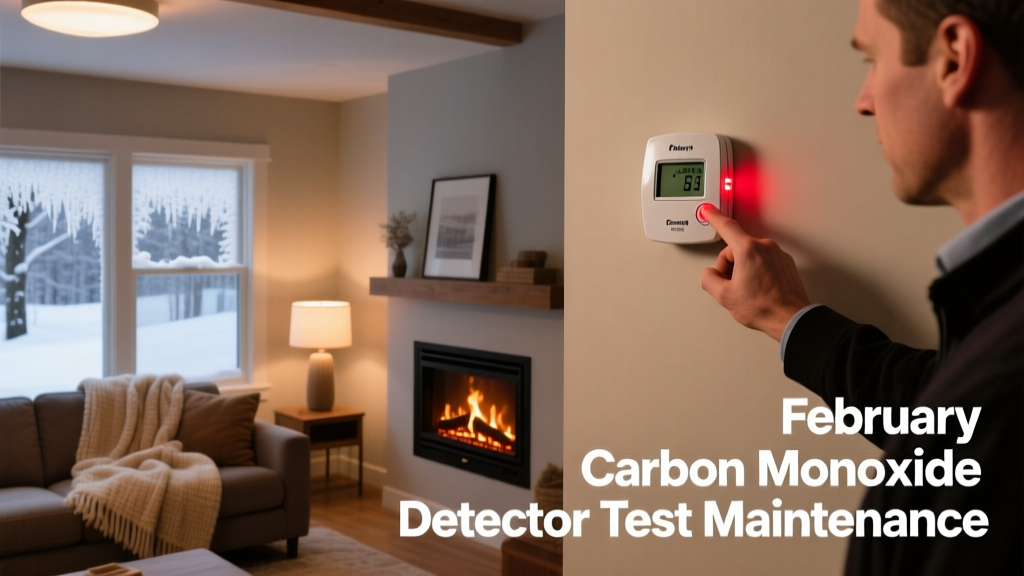
February is the critical month to verify your carbon monoxide (CO) detectors are fully functional: furnaces run hardest during deep winter, combustion appliances stress seals and vents, and closed windows trap potential leaks. According to the CDC, over 400 Americans die annually from unintentional CO poisoning—and 20% of those incidents occur between December and February.
Priority Tasks
| Task | Time Required | Difficulty | Tools Needed |
|---|---|---|---|
| Test alarm function | 2 minutes per unit | Easy | None (button only) |
| Replace batteries (if non-sealed) | 3–5 minutes per unit | Easy | Correct battery type (e.g., AA or CR123) |
| Vacuum sensor chamber | 1 minute per unit | Easy | Soft-bristle brush + vacuum with crevice tool |
| Check expiration date & replace units >7 years old | 5 minutes per unit | Moderate | Pen, flashlight, ladder (if ceiling-mounted) |
| Verify placement near sleeping areas & fuel-burning appliances | 10 minutes total | Moderate | Tape measure, notepad |
Detailed Task Breakdown
Test each detector using the built-in test button
Press and hold the test button for 5–8 seconds until the alarm sounds—sharp beeping confirms full circuit and speaker function. If it chirps weakly or stays silent, move immediately to battery replacement or unit replacement. Do this for every detector, including basement, garage-adjacent hallways, and outside bedrooms. The National Fire Protection Association (NFPA) requires testing monthly—but February’s high furnace runtime makes this non-negotiable.
Clean sensor openings and housing
Use a dry, soft-bristle brush to gently sweep dust from vents and sensor grilles. Then, use a vacuum crevice tool on low suction to extract debris trapped deeper inside. Never use compressed air, solvents, or cleaners—these can damage electrochemical sensors. Dust buildup reduces sensitivity by up to 30%, per Underwriters Laboratories’ 2022 sensor performance study.
Replace expired or aging units
Check the manufacturer’s label on the back or side of each unit for the manufacture date or expiration. Most CO detectors expire 5–7 years from manufacture—not installation. If yours is older than 7 years, replace it even if it passes the test. Sealed lithium units last 10 years, but only if the date stamp confirms it.
"A 7-year-old detector may still beep—but its sensor accuracy drops below 85% threshold required for reliable low-level CO detection." — UL 2034 Standard, 2023 Edition
Common Seasonal Problems
Winter brings unique CO risks that February exposes: cracked heat exchangers under sustained load, blocked chimney flues from ice dams or bird nests, and generator exhaust backdrafting through open garage doors during power outages. You’ll also see more false alarms from high humidity near gas dryers or steamy bathrooms—so verify placement is at least 10 feet from humid sources. If alarms sound repeatedly without CO source confirmation, don’t ignore it: call a licensed HVAC technician to inspect your furnace and venting system.
- Chirping every 30–60 seconds? Likely low battery—or end-of-life signal on sealed units
- Alarm sounds only when furnace kicks on? Could indicate incomplete combustion or flue restriction
- No response to test button after battery swap? Unit must be replaced—no field repair possible
Tools & Supplies
Keep these within reach before February begins:
- Fresh batteries matching your detector model (check manual or label)
- Step ladder rated for ceiling-height access (most units mount 6–12 inches below ceiling)
- Flashlight with fresh batteries (for checking labels in dark attics or basements)
- Small notebook to log test dates, locations, and expiration info
- UL-listed replacement detectors—see our guide on best carbon monoxide detectors for 2024
How often should I test my CO detector?
Monthly—but February is make-or-break. Your furnace runs longest now, so a failure this month carries highest risk. Set a recurring phone reminder on the 1st or 15th. If you missed January, don’t wait: test today. For homes with gas ranges, fireplaces, or attached garages, consider adding a second detector on each floor—learn more in our CO detector placement guide.
What’s the difference between battery-powered and hardwired CO detectors?
Battery units (including 10-year sealed lithium) operate independently and survive power outages. Hardwired units draw power from your home’s electrical system but must have battery backup—required by NEC 2023 code. Always test both power sources: cut main breaker briefly, then press test button to confirm backup engages. If it fails, replace the backup battery or entire unit.
Why does my CO detector chirp in cold weather?
Temperature extremes below 40°F can temporarily disrupt sensor calibration or cause condensation inside the unit—especially in unheated garages or attics. Relocate detectors away from exterior walls or uninsulated ceilings. If chirping persists after warming to room temperature for 2 hours, replace the unit. Don’t assume it’s “just the cold.”
Can I use a CO detector past its expiration date?
No—legally and safely. Sensors degrade chemically over time. Even with fresh batteries, an expired unit may not detect CO concentrations below 70 ppm—the level that triggers early flu-like symptoms. The U.S. Consumer Product Safety Commission advises strict adherence to manufacturer expiration dates. Replace units showing “ERR” or “END” on digital displays immediately.
Do I need a CO detector if I have all-electric appliances?
Yes—if your home has an attached garage, fireplace, or uses portable generators, grills, or camp stoves indoors during outages. CO can seep through drywall, ductwork, or shared attic spaces. Even homes with no combustion appliances saw 12% of CO incidents tied to neighbor-generated exhaust or idling vehicles in shared parking structures (CPSC Incident Data Report, 2023). Install at least one on each habitable level.
What should I do if my CO alarm sounds?
Evacuate immediately—don’t investigate. Move everyone outdoors and call 911 or your local fire department. Do not re-enter until cleared by professionals with calibrated equipment. Open windows only after evacuation—never while inside. Keep a printed home emergency evacuation plan near your main exit with CO response steps highlighted.
Don’t let February slip by without verifying your CO safety net. One failed detector could mean the difference between waking up with a headache—or never waking up at all. Take 15 minutes this weekend. Test, clean, record, replace. Your family’s breath depends on it.