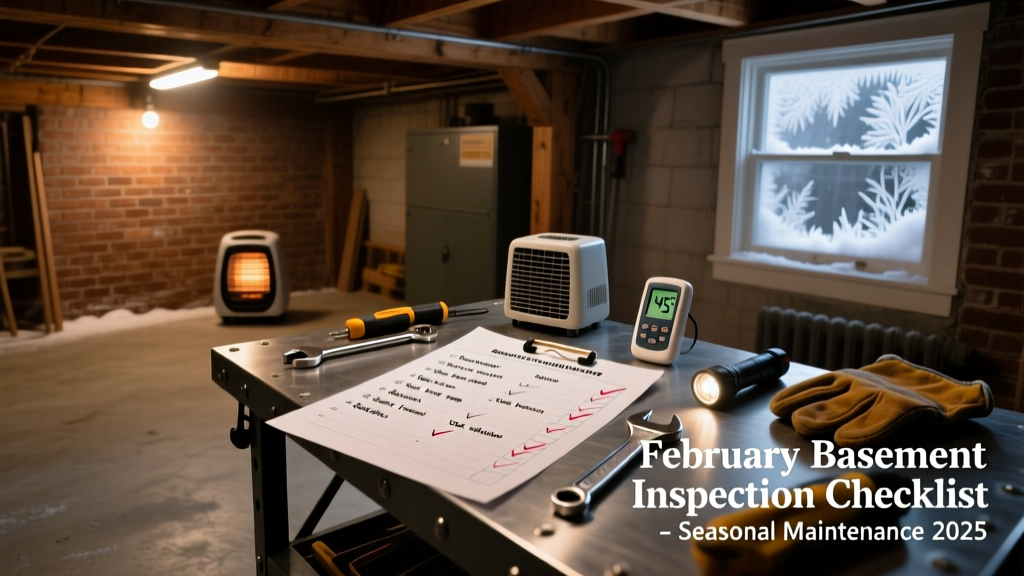
February is the quietest, coldest month—and that’s precisely why your basement needs attention now. Frozen pipes, ice dam pressure on foundations, and condensation buildup peak during sustained subfreezing temps. According to the Insurance Institute for Business & Home Safety's 2023 report, 68% of basement water intrusions begin with undetected cracks or sump pump failures that worsen during winter freeze-thaw cycles.
Priority Tasks
| Task | Time Required | Difficulty | Tools Needed |
|---|---|---|---|
| Check sump pump operation & discharge line | 25 minutes | Moderate | Bucket, flashlight, multimeter, garden hose |
| Inspect foundation walls for new cracks or efflorescence | 40 minutes | Easy | Flashlight, magnifying glass, notepad |
| Test dehumidifier settings & drain line | 15 minutes | Easy | Screwdriver, rag, measuring tape |
| Verify insulation integrity around rim joists | 30 minutes | Moderate | Stud finder, utility knife, fiberglass gloves |
| Clear floor drain grates & test flow | 20 minutes | Easy | Plumber’s snake, stiff brush, bucket |
| Inspect furnace & water heater venting for blockages | 35 minutes | High | Flashlight, mirror, ladder (3-ft), CO detector |
Detailed Task Breakdown
Test your sump pump—don’t wait for heavy rain
Pour 5 gallons of water slowly into the sump pit. The pump should activate within 30 seconds, run smoothly without grinding, and shut off cleanly after water drops below the float switch. Check the discharge pipe outside: ensure it extends at least 6 feet from the foundation and isn’t buried under snow or ice. If the pipe is frozen solid, use a hair dryer (not open flame) to thaw the first 2 feet—then insulate it with foam pipe wrap rated for subzero temps.
Map foundation cracks and moisture signs
Use a dry-erase marker to circle any new hairline cracks wider than 1/16 inch. Note location (e.g., “NW corner, 3 ft above floor”) and width using a ruler. Look for white, chalky deposits (efflorescence)—a sign of long-term moisture migration. If you spot dampness near a crack, press a piece of plastic tape over it for 24 hours; condensation underneath confirms active seepage.
Common Seasonal Problems
- Frozen sump pump discharge lines—especially where pipes exit through uninsulated foundation walls
- Condensation on cold water pipes leading to rust and dripping (common near water heaters)
- Rim joist air leaks causing frost buildup in floor framing, then spring rot
- Carbon monoxide risk from blocked furnace vents due to snow drifts or ice dams
- Dehumidifier coils freezing when basement temps dip below 60°F—causing overflow or shutdown
Tools & Supplies
Keep these within arm’s reach before starting:
- LED headlamp (hands-free lighting in tight corners)
- Non-contact voltage tester (for checking outlet grounding near sump pits)
- Hygrometer with min/max memory (to track humidity spikes overnight)
- Flexible inspection mirror on telescoping handle (for checking behind furnace)
- 5-gallon bucket marked with 1-gallon increments (for accurate sump pump testing)
What if my sump pump runs constantly in February?
That’s rarely normal—even with snowmelt infiltration. First, check the float switch: it may be stuck or tangled in debris. Next, verify the discharge pipe isn’t clogged or frozen downstream. If both are clear, measure how much water enters the pit in 10 minutes. More than 2 gallons suggests a hidden leak or compromised footing drain—call a licensed waterproofing contractor before March rains arrive.
Can I seal foundation cracks myself in winter?
Only surface-level, non-structural hairline cracks (under 1/8 inch) should be patched now—using hydraulic cement like Drylok Fast Plug. It sets in 3–5 minutes and works down to 20°F. But avoid epoxy or polyurethane injections below 40°F: they won’t cure properly. For wider cracks or horizontal splits, wait until soil temperatures rise above 50°F and consult a structural engineer—repair costs jump 37% when done in emergency mode.
Why does my basement smell musty even with low humidity?
Mustiness often points to microbial growth inside HVAC ductwork or behind baseboards—not just visible mold. Run your furnace fan continuously for 24 hours with a MERV 13 filter installed, then vacuum baseboard gaps with a crevice tool. If odor persists, check the underside of carpet padding—frost heave can lift slabs and trap moisture there. According to the U.S. EPA estimates that 14% of household water usage is from leaks, many of which originate in basements and go unnoticed for months.
Is it safe to insulate rim joists in February?
Yes—if indoor temps stay above 45°F and relative humidity stays under 55%. Use rigid foam board (XPS or polyiso) cut to fit snugly between joists, sealed at edges with low-expansion spray foam. Never use fiberglass batts here in winter—they absorb condensation and lose R-value. Wear gloves and goggles: cutting XPS releases fine particles that irritate skin and lungs.
How often should I test my carbon monoxide detector near the furnace?
Monthly—but February is the most critical month. Cold air density changes combustion efficiency, and snow-blocked vents increase CO risk. Press and hold the test button for 5 seconds: you should hear 4 beeps, pause, then 4 more. Replace batteries if chirping occurs, and replace the unit entirely if it’s older than 7 years. The National Fire Protection Association reports that 43% of CO fatalities occur between December and February.
"Winter basement inspections aren't about fixing everything—they're about catching the 3% of problems that become 80% of repair bills by April." — Sarah Lin, Certified Home Inspector, ASHI, 2022
February’s chill gives you the clearest view of your home’s weakest links—before snowmelt turns small issues into urgent ones. Tackle this checklist now, and you’ll avoid emergency calls in March. For deeper moisture analysis, consider adding a wireless humidity sensor network that alerts you via app when readings exceed 55% for more than 48 hours.