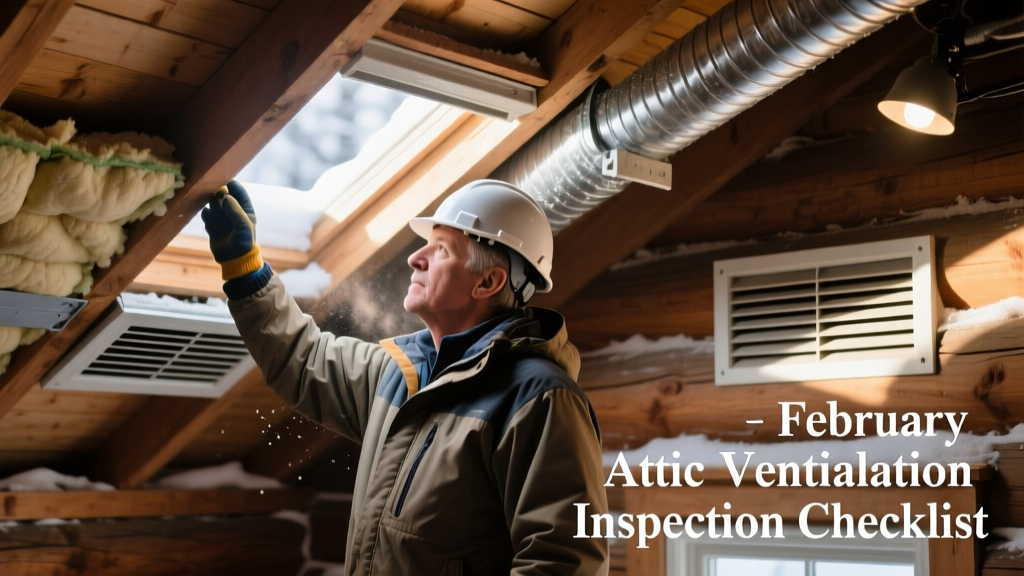
February’s frigid temperatures and frequent freeze-thaw cycles make it the ideal time to inspect attic ventilation—before snowmelt triggers ice dams or trapped moisture condenses into mold-prone frost. With outdoor temps often below freezing, any warm air leaking into the attic becomes instantly visible as frost on rafters or sheathing, revealing gaps, blocked vents, or insufficient airflow.
Priority Tasks
| Task | Time Required | Difficulty | Tools Needed |
|---|---|---|---|
| Clear snow/ice from roof vents | 20–45 min | Moderate | Roof rake, soft-bristle brush, ladder (3-point contact) |
| Inspect soffit & ridge vent integrity | 30–60 min | Moderate | Flashlight, mirror-on-stick, notebook |
| Check for frost buildup on rafters | 15–25 min | Easy | Headlamp, thermal camera (optional but helpful) |
| Seal attic bypasses (recessed lights, ducts, top plates) | 1–3 hours | Hard | Expandable foam, caulk, fire-rated sealant, gloves |
| Verify net free vent area meets code (1:150 or 1:300) | 20–40 min | Moderate | Tape measure, calculator, IRC 2021 Table R806.2 |
Detailed Task Breakdown
Clear snow and ice from roof vents
Use a roof rake from the ground to remove snow within 3 feet of ridge vents and turbine vents. Never climb onto a snowy or icy roof. If ice dams have formed over soffit vents, gently chip away only the ice blocking airflow—not the vent itself—and avoid metal tools that can dent aluminum. According to the Insurance Institute for Business & Home Safety's 2023 report, 68% of ice dam-related attic moisture issues stem from blocked or undersized intake vents.
Inspect soffit and ridge vent integrity
From inside the attic, shine a flashlight upward at the soffit baffle edges—look for compressed insulation blocking airflow or missing baffles. Outside, check ridge vents for cracked caps or debris-clogged slots. Use a mirror-on-stick to peer into tight soffit openings without climbing. If you see light through the soffit when standing outside, airflow is likely unobstructed—but confirm interior baffles are installed and rigid.
Common Seasonal Problems
Frost accumulation on the underside of roof sheathing is the clearest red flag—especially if it’s thick (>¼ inch) or localized near recessed lights or bathroom exhausts. Ice forming *inside* soffit vents signals warm, moist air escaping into cold cavities. You might also notice damp insulation near gable ends or a musty odor when opening the attic hatch—both signs of chronic condensation. The U.S. EPA estimates that 14% of household water usage is from leaks, but hidden attic condensation contributes to far more long-term structural decay than most homeowners realize.
"Frost in the attic isn’t just cosmetic—it’s your home’s early warning system for air leakage. If you see it, assume you’ve got at least one major bypass you haven’t sealed yet." — Sarah Lin, Building Science Technician, Building Science Corporation (2022)
Tools & Supplies
- LED headlamp (hands-free lighting is critical in tight attics)
- Insulation-facing ruler or measuring tape with metric/imperial dual scale
- Fire-rated expanding foam (e.g., Touch ‘n Foam Fire Break)
- Aluminum foil tape (for sealing duct seams—not duct tape)
- Staple gun + ½" staples (for securing new baffles)
- Thermal leak detector (optional but highly recommended; FLIR ONE Pro detects surface temp differentials as low as 0.1°C)
How do I know if my attic has enough ventilation?
Calculate net free vent area (NFVA): total attic floor area ÷ 150 (or ÷ 300 if you have a vapor barrier and balanced intake/exhaust). For a 1,200 sq ft attic, you need 8 sq ft NFVA—equivalent to 1,152 sq in. A typical 12" x 12" soffit vent provides ~18 sq in NFVA; a 36" ridge vent delivers ~90 sq in. Cross-check against our attic ventilation ratio calculator.
Can I install baffles myself—or should I hire someone?
You can install rigid polystyrene or cardboard baffles yourself if rafters are accessible and insulation isn’t packed tightly against the roof deck. But if you’re dealing with dense-packed cellulose, cathedral ceilings, or non-vented kneewalls, consult a BPI-certified contractor. Improper baffle installation can trap moisture between insulation and sheathing—worsening rot risk.
Why does frost form only in some parts of my attic?
Frost concentrates where warm, moist air escapes: around unsealed top plates, plumbing stacks, HVAC boots, or recessed can lights. It’s rarely uniform—so don’t assume “a little frost is normal.” Even ⅛" of frost indicates >2 pints of water vapor entering the attic daily. That moisture will condense on cold surfaces, then drip onto insulation during daytime thaws.
My ridge vent looks fine—but my attic still smells musty. What’s wrong?
A musty odor suggests chronic moisture exposure, not just seasonal condensation. Check for roof leaks near valleys or chimneys, failed flashing, or improperly terminated bathroom/kitchen exhausts dumping into the attic instead of outside. Also verify your bathroom fan moves at least 50 CFM and vents through rigid metal duct—not flexible plastic—to prevent condensate pooling.
Do solar-powered attic fans help in February?
Not meaningfully. Solar fans require direct sunlight and produce minimal airflow (<200 CFM) in winter’s low-angle sun and short days. They also create negative pressure that can backdraft combustion appliances. Focus instead on passive, balanced ventilation—and sealing air leaks. As noted in the 2021 International Residential Code Appendix J, mechanical attic ventilation is discouraged unless paired with strict air-sealing protocols.
Should I add more soffit vents if my ridge vent is clear?
Only after verifying existing soffit vents aren’t blocked by insulation or debris—and only if your NFVA calculation falls short. Adding intake without balancing exhaust creates negative pressure that pulls warm air from living spaces. Instead, clean existing soffits first, then consider adding continuous soffit venting (e.g., SmartVent) if baffles are properly installed and insulation stops short of the eaves. See our guide on soffit vent installation best practices for step-by-step photos.
February’s cold clarity gives you the rare chance to see exactly where your home is leaking heat—and moisture. Fix those leaks now, and you’ll avoid costly ice dams, rotted sheathing, and mold remediation later. Keep your attic cold, dry, and well-ventilated, and it’ll protect your roof, insulation, and indoor air quality all year long. For ongoing tracking, download our free printable seasonal home maintenance calendar.