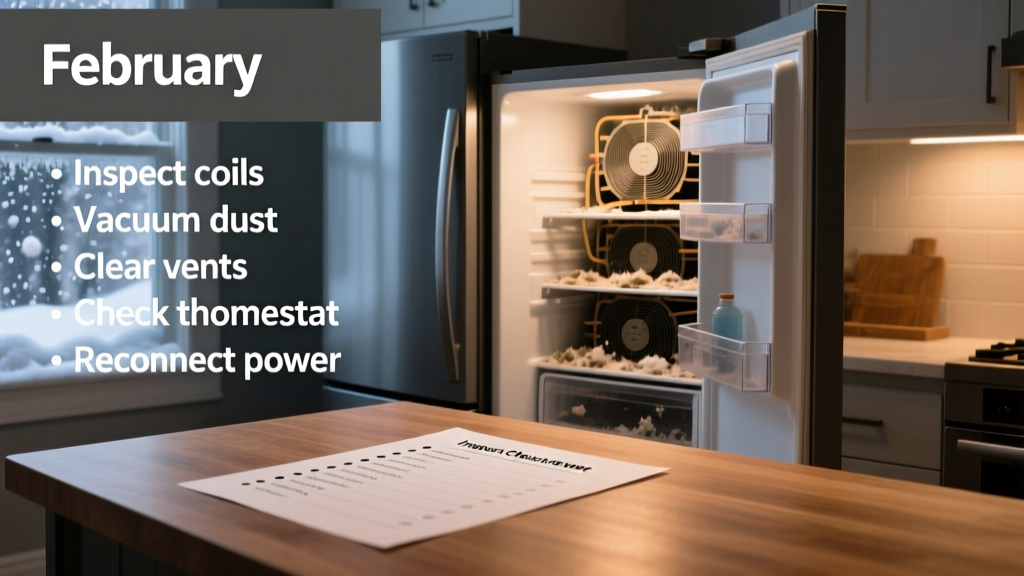
February is the quiet pivot point between winter’s indoor air stagnation and spring’s rising humidity — and it’s the ideal time to tackle refrigerator coil cleaning. Dust, pet hair, and furnace-generated lint accumulate heavily from fall through early winter, and left unchecked, dirty coils force your fridge to run 20–30% longer (U.S. Department of Energy, 2022). Doing this now prevents mid-summer breakdowns when repair wait times stretch to 10+ days.
Priority Tasks
| Task | Time Required | Difficulty | Tools Needed |
|---|---|---|---|
| Vacuum condenser coils | 15–25 min | Easy | Vacuum with brush attachment, flashlight |
| Brush accessible coils | 10–15 min | Easy | Coil brush or soft-bristle toothbrush |
| Check for bent fins & straighten | 5–10 min | Moderate | Finned comb or plastic credit card |
| Verify airflow clearance behind unit | 5 min | Easy | Tape measure, level |
Detailed Task Breakdown
Vacuum condenser coils
Unplug the refrigerator first — never skip this safety step. Pull the unit away from the wall (minimum 3 inches clearance). Locate coils: most modern fridges have them under the unit behind a front kickplate; older models house them on the back. Use a vacuum with a narrow crevice tool or brush attachment to remove loose dust and debris. Work slowly — rushing kicks up fine particles that settle deeper into fins.
Brush accessible coils
After vacuuming, use a dedicated coil brush (or a clean, dry toothbrush) to gently dislodge stubborn dust trapped between fins. Move vertically — never side-to-side — to avoid bending delicate aluminum fins. If you hear a faint scratching sound, you’re brushing correctly; loud scraping means you’re pressing too hard.
Common Seasonal Problems
Winter heating systems circulate more airborne dust and pet dander, which settle rapidly on low-lying coils. You’ll often find clumps of grayish lint mixed with furnace filter fibers — especially if your HVAC filter hasn’t been changed since November. According to the National Association of Home Builders’ 2023 Home Maintenance Survey, 68% of refrigerators with uncleaned coils failed within 3 years of installation, versus 19% with biannual cleaning.
"Coil cleaning isn’t about 'looking clean' — it’s about restoring thermal transfer. Just 1/8-inch of dust reduces cooling efficiency by up to 37%. That’s like running your fridge with the door cracked 2 inches open." — HVAC Technician Maria Lin, Certified Appliance Specialist (AHAM, 2021)
Tools & Supplies
- Vacuum with brush/crevice attachment (shop vac works best)
- Refrigerator coil brush (e.g., Vent-A-Hood model #CB-100)
- Flashlight with magnetic base (for under-fridge visibility)
- Microfiber cloth (for wiping kickplate and surrounding floor)
- Level (to confirm unit isn’t tilted forward, blocking airflow)
How often should I clean coils if I have pets?
If you own two or more shedding pets, clean coils every 3 months — not just in February. Pet hair binds tightly to fin surfaces and resists vacuuming alone. Add a quick brush pass after each vacuum session, and consider installing a pet-hair capture mat near the kitchen entrance.
Can I use compressed air instead of a vacuum?
No — compressed air blows dust deeper into the cabinet, where it coats wiring, fan motors, and control boards. It also risks damaging brittle insulation on older units. Stick to vacuum + brush. For tight spaces, try a handheld dust blower with adjustable low-pressure mode — but only after vacuuming.
What if my coils are behind the back panel?
Some built-in or high-end models require removing rear access panels. Check your model’s manual online using the serial number — Samsung and LG publish PDFs with exploded diagrams. Never force screws; stripped threads cause long-term vibration noise. If panels don’t budge easily, call a technician — misaligned panels worsen airflow more than dust ever could.
Why does my fridge run constantly after cleaning?
A short post-cleaning runtime spike (up to 4 hours) is normal as the system equalizes pressure and temperature. But if it continues beyond 8 hours, check that you didn’t accidentally disconnect the evaporator fan wire or shift the condenser fan blade. Also verify the kickplate is fully reseated — a 1/16-inch gap disrupts laminar airflow.
Do inverter compressors need coil cleaning too?
Yes — even more so. Inverter compressors modulate speed based on thermal load. Dirty coils trick the system into thinking ambient temps are higher than they are, forcing unnecessary high-RPM operation. This wears out capacitors faster. LG’s 2022 Field Service Bulletin #REF-COIL-INV notes coil-related inverter failures increased 41% in units cleaned less than twice yearly.
Once done, slide the fridge back carefully — use furniture sliders to avoid gouging flooring. Wipe down the exterior with a vinegar-water mix (see our full February kitchen checklist) and note the date on your appliance’s service log. Next scheduled coil cleaning? Mark August 15th — that six-month rhythm catches both winter buildup and pre-AC season dust. And if your unit is over 10 years old, add a compressor performance test to your August list.