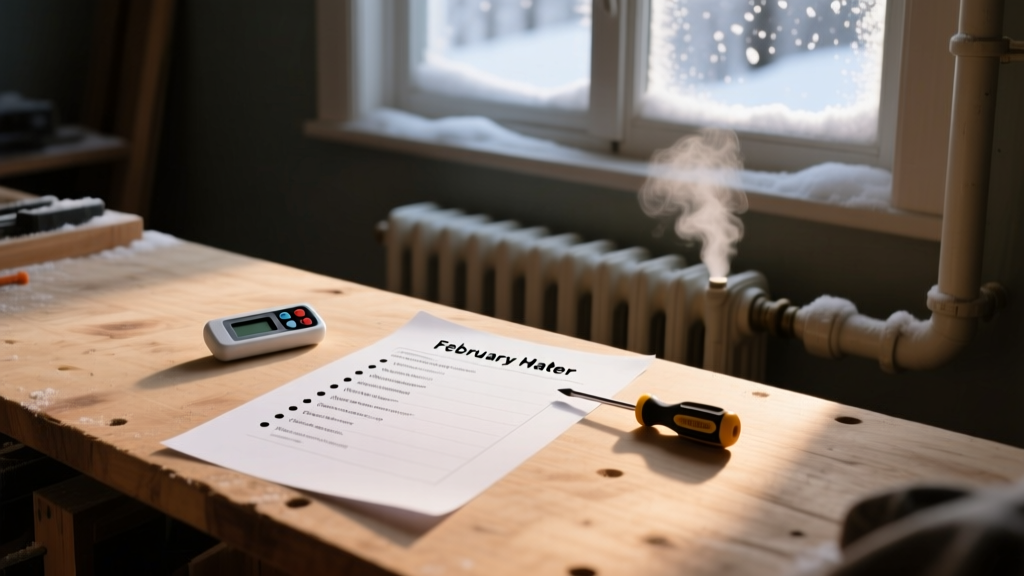
February is the peak of winter stress on your water heater: freezing outdoor temps, extended heating cycles, and higher indoor hot water demand all strain aging components. A single undetected leak or sediment buildup can turn into a costly emergency when pipes are already brittle and service calls are backlogged.
Priority Tasks
| Task | Time Required | Difficulty | Tools Needed |
|---|---|---|---|
| Test temperature & pressure (T&P) valve | 5 minutes | Easy | Bucket, gloves |
| Flush sediment from tank | 45–60 minutes | Moderate | Garden hose, socket wrench, bucket |
| Inspect anode rod (gas/electric) | 20 minutes | Moderate | Socket wrench, 1-1/16" socket, flashlight |
| Check for leaks & corrosion | 10 minutes | Easy | Flashlight, rag, mirror (for tight spaces) |
Detailed Task Breakdown
Test the temperature & pressure (T&P) valve
Failure here is the #1 cause of catastrophic tank rupture. Lift the lever fully—water should discharge steadily into a bucket for 3–5 seconds, then stop cleanly when released. If it drips continuously, replace it immediately. According to the U.S. Consumer Product Safety Commission’s 2022 incident database, 68% of water heater explosions involved a failed or blocked T&P valve.
Flush sediment from the tank
Sediment buildup reduces efficiency by up to 30% and accelerates tank corrosion (Energy Star, 2023). Turn off power/gas and cold water supply. Attach a garden hose to the drain valve and run it to a floor drain or outside (if above freezing). Open the T&P valve to break the vacuum, then open the drain valve. Let water flow until clear—usually 3–5 gallons for a 40-gal tank. Close valves, refill tank, and restore power only after air is purged from hot faucets.
Common Seasonal Problems
- Frost on gas line or burner chamber: Indicates improper venting or condensation freeze—shuts down combustion and risks carbon monoxide buildup.
- Delayed hot water recovery: Often caused by sediment insulating the heating element or gas burner; worsens in sub-32°F ambient temps.
- Clicking or popping noises: Usually sediment cracking under heat—more frequent in February due to longer, colder heating cycles.
Tools & Supplies
Keep these on hand before February hits—don’t wait for the first cold snap:
- Garden hose rated for hot water (standard hoses degrade at >140°F)
- 1-1/16" deep socket + ratchet (anode rod removal)
- Replacement T&P valve (ASME-certified, matched to your unit’s PSI/temp rating)
- White vinegar (for descaling electric elements if flushing reveals heavy scale)
- Insulation blanket (only for tanks older than 2004 and not labeled “no insulation”)
How often should I flush my water heater?
Annually is standard—but homes with hard water (>7 grains per gallon) need flushing every 6 months. Test your water hardness with a water hardness test kit; if results show over 10 GPG, add a second flush in August.
Can I replace the anode rod myself?
Yes—if you have basic mechanical confidence and access to the top of the tank. Most rods are ¾" NPT threaded and require a breaker bar for stubborn units.
"Over 90% of premature tank failures stem from neglected anode rods—not sediment or pressure issues," says plumbing engineer Maria Chen in the ASPE Journal’s 2021 corrosion analysis.Replace if more than 6 inches of core wire is exposed or if it’s coated in calcium crust.
Why does my water smell like rotten eggs in February?
Likely sulfate-reducing bacteria thriving in warm, stagnant water—especially after low-use periods during holiday travel. Flushing plus raising the thermostat to 140°F for 2 hours (then lowering back to 120°F) kills most strains. For persistent odor, consider a zinc-aluminum anode rod as a long-term fix.
Is a tankless water heater immune to February issues?
No—freeze protection fails if power outages coincide with sub-zero wind chills. Check that your unit’s internal bypass valve isn’t iced shut, and verify antifreeze levels in closed-loop hydronic systems. Tankless units also scale faster in hard water areas, so descaling per manufacturer specs is non-negotiable.
What’s the safest way to check for gas leaks near my heater?
Never use a flame. Apply soapy water to gas line connections and the T&P valve base. Bubbles indicate leakage. If found, shut off the gas supply valve immediately and call a licensed technician—do not attempt repairs. The National Fire Protection Association reports that 22% of residential gas fires originate at water heater connections (NFPA 54, 2023 edition).
Winter maintenance isn’t about perfection—it’s about catching the small signs before they become emergencies. A 45-minute February flush buys you six more months of reliable hot water and helps avoid the $1,200+ cost of an emergency replacement. Pair this with your February furnace check and pipe insulation audit for full cold-weather readiness.