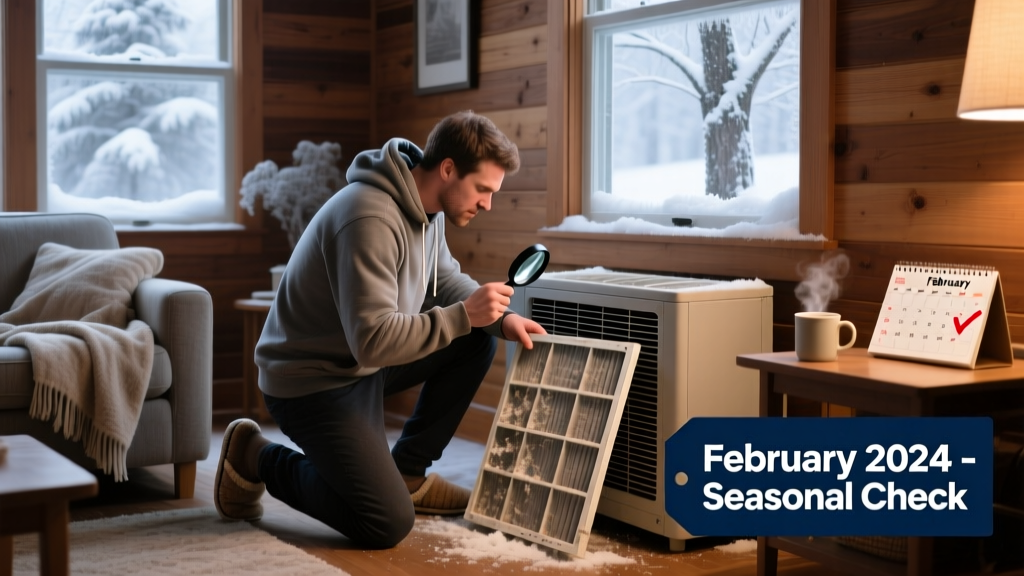
February is the coldest month across much of the U.S., meaning your furnace is likely running longer and harder than any other time of year. That puts extra strain on your HVAC system — and a clogged filter can reduce airflow by up to 30%, forcing your system to work overtime and raising energy bills by as much as 15% (U.S. Department of Energy, 2022).
Priority Tasks
| Task | Time Required | Difficulty | Tools Needed |
|---|---|---|---|
| Inspect HVAC filter | 2–3 minutes | Easy | None |
| Replace disposable filter | 5 minutes | Easy | New filter (correct size) |
| Clean reusable electrostatic filter | 15–20 minutes | Moderate | Garden hose, mild detergent, drying rack |
| Check return air grilles for dust buildup | 8 minutes | Easy | Vacuum with brush attachment |
Detailed Task Breakdown
Inspect and Replace Your Filter
Locate your main filter — usually behind a return air grille in a hallway, basement, or near the furnace. Slide it out and hold it up to a light. If you can’t see light through the fibers, it’s time to replace it. Most fiberglass filters should be swapped every 30 days in winter; pleated filters last 60–90 days — but February’s continuous runtime often means 30-day replacement is safer.
Clean Reusable Filters Properly
If you use a washable electrostatic filter, rinse it gently with cool water from a garden hose — never hot water or high pressure, which can warp the mesh. Apply a drop of mild dish soap if greasy residue remains. Let it air-dry completely (minimum 4 hours) before reinstalling. Installing a damp filter invites mold growth and restricts airflow.
Common Seasonal Problems
Short cycling (furnace turning on/off too frequently), uneven room temperatures, and musty odors are early warning signs of a saturated filter. According to the American Society of Heating, Refrigerating and Air-Conditioning Engineers (ASHRAE, 2023), over 68% of midwinter HVAC service calls involve filter-related airflow restrictions.
"A dirty filter doesn’t just cost money — it can shorten your furnace’s lifespan by 2–3 years due to overheating and excessive wear." — HVAC Technician Maria Lin, certified NATE instructor since 2011
Also watch for increased dust accumulation on furniture and dark streaks around return grilles — both indicate poor filtration and possible duct leakage.
Tools & Supplies
- Replacement filter (note exact dimensions: e.g., 16x25x1")
- Flashlight (to inspect filter slot and surrounding area)
- Vacuum with soft-brush attachment
- Microfiber cloth (for wiping grille frames)
- Permanent marker (to label installation date on new filter)
Keep a spare filter in your utility closet — learn how to read HVAC filter size markings if you’re unsure of your unit’s specs. Don’t guess: measuring twice prevents ordering the wrong fit.
How often should I check my filter in February?
Check it weekly if you run heat continuously, have pets, or use a wood stove. For most homes, checking every 7–10 days and replacing every 30 days is optimal. Track it on your calendar or use our free printable home maintenance calendar.
Can a dirty filter cause carbon monoxide risk?
Yes — severely restricted airflow can cause heat exchanger overheating and cracking. A cracked heat exchanger may leak CO into your home. While rare, it’s why the U.S. Consumer Product Safety Commission recommends annual furnace inspection — especially after noticing filter neglect symptoms like soot stains or yellow burner flames.
What MERV rating is best for February?
For most homes, MERV 8–11 balances particle capture and airflow. Avoid MERV 13+ unless your system is rated for it — many older furnaces can’t handle the resistance, leading to frozen coils or blower motor strain. Check your furnace manual or HVAC system compatibility guide before upgrading.
Why does my filter get dirty faster this month?
Winter air is drier and holds less moisture, making dust and skin cells more airborne. Closed windows trap indoor pollutants, and forced-air systems recirculate them constantly. Add pet shedding, holiday decorations (dust bunnies love tinsel), and fireplace ash — and February becomes the perfect storm for rapid filter loading.
Should I vacuum the filter instead of replacing it?
No. Vacuuming only removes surface dust and damages filter media fibers, reducing efficiency. It also risks pushing debris deeper into the pleats. Disposable filters are designed for single use — reusing them cuts filtration effectiveness by up to 40% after one cleaning attempt (AHAM Filter Performance Report, 2021).
Staying ahead in February sets the tone for spring HVAC prep — and keeps your family breathing easier while cutting winter energy costs. Don’t wait for your thermostat to complain: grab that flashlight and check your filter today.