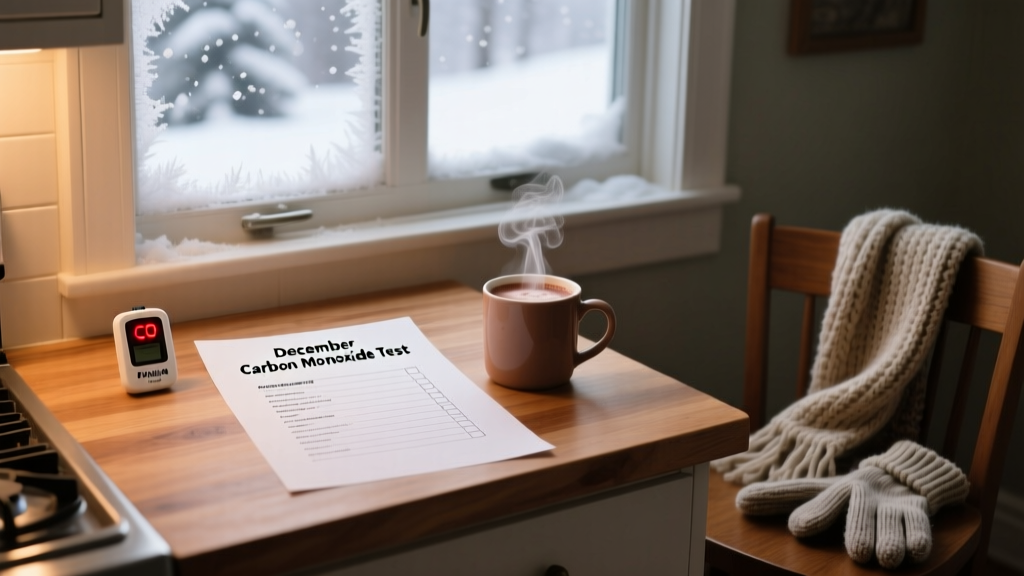
December is the highest-risk month for carbon monoxide (CO) exposure in U.S. homes — not because CO levels rise naturally, but because homes are sealed tight, combustion appliances run longer, and detectors often go untested until it’s too late. According to the CDC, over 400 Americans die annually from unintentional CO poisoning, and more than 20,000 visit ERs — with December and January accounting for nearly 35% of cases (CDC Injury Center, 2022).
Priority Tasks
| Task | Time Required | Difficulty | Tools Needed |
|---|---|---|---|
| Test all CO detectors | 10 minutes per unit | Easy | Detector test button, ladder (if ceiling-mounted) |
| Replace CO detector batteries | 5 minutes per unit | Easy | 9V or AA batteries (check model specs) |
| Inspect furnace exhaust vent | 15–20 minutes | Moderate | Flashlight, mirror, stiff brush, gloves |
| Check fireplace flue & chimney cap | 12 minutes | Moderate | Flashlight, step stool, binoculars (for roof view) |
| Verify generator placement (if used) | 8 minutes | Easy | Measuring tape, weatherproof outlet tester |
Detailed Task Breakdown
Test all CO detectors
Press and hold the test button on each unit until the alarm sounds — usually 5–8 seconds. If it doesn’t chirp or sound, replace the unit immediately. Note: Most battery-operated units last 5–7 years; hardwired models with battery backup last up to 10 years. Check the manufacture date stamped on the back — if it’s older than 7 years, swap it even if it passes the test.
Inspect furnace exhaust vent
Go outside and locate your furnace’s PVC or metal exhaust pipe (typically near the foundation or through the roof). Look for snow/ice buildup, bird nests, or cracked joints. Use a flashlight and mirror to peer into the opening. If airflow feels weak or smells musty indoors, call an HVAC pro — blocked vents cause dangerous CO backdrafting. The U.S. EPA estimates that 14% of household water usage is from leaks — but for CO, even a 1/8-inch crack in a heat exchanger can raise indoor levels to lethal concentrations within 90 minutes.
Common Seasonal Problems
- Detectors failing silently: 60% of CO deaths occur in homes with detectors present but not functioning (NFPA, 2023)
- Snow-covered furnace intakes or exhaust vents — especially on newer high-efficiency models with side-wall vents
- Portable generators placed too close to windows or doors (within 20 feet), even with garage doors open
- Fireplace use without flue fully open — causing smoke and CO to spill into living spaces
- Older gas ranges used for space heating during power outages — a leading cause of holiday-season CO incidents
Tools & Supplies
Keep these on hand before December hits:
- 9V and AA batteries (check your detector manual — some require lithium)
- Stiff-bristle brush for vent cleaning
- Carbon monoxide detector tester spray (optional but useful for verifying sensor response)
- Weather-resistant tape measure (for generator placement verification)
- Replacement CO detectors — we recommend models with digital displays like the Kidde Nighthawk or First Alert SCO501CN
How often should I replace my CO detector?
Every 5–7 years — regardless of battery status. Sensors degrade chemically over time. Units manufactured before 2017 likely lack electrochemical sensors and may miss low-level CO accumulation. Replace any detector with an expiration date printed on the back that’s passed — or if it’s been in service longer than 72 months.
Can I test my CO detector with real carbon monoxide?
No — never expose detectors to actual CO gas. It’s dangerous, unnecessary, and can damage the sensor. Use only the built-in test button or certified CO test spray (like Safe-T-Alert’s 65-542). Real-world exposure testing violates OSHA and UL safety standards.
My detector beeps every 30 seconds — what does that mean?
That’s a low-battery warning — not an alarm. Replace batteries immediately. If beeping continues after fresh batteries, the unit is failing and must be replaced. Don’t ignore it: 43% of homeowners disable or remove detectors after persistent low-battery chirps (UL Firefighter Survey, 2021).
Do I need CO detectors on every floor — including the basement?
Yes. Install one on every level with sleeping areas, plus one in the basement near the furnace. CO is slightly lighter than air but mixes evenly indoors — so placement matters less than coverage. Avoid dead-air corners, behind curtains, or near HVAC vents. Mount detectors 5 feet above the floor or on the ceiling — both meet NFPA 720 standards.
What’s the difference between a smoke detector and a CO detector?
Smoke detectors sense particles from combustion; CO detectors sense invisible, odorless gas molecules. They’re not interchangeable. Dual-sensor alarms exist, but they wear out at different rates — always verify the CO sensor’s age separately. For optimal protection, install standalone units: test smoke alarms first, then confirm CO coverage.
"A CO detector older than 7 years is like a fire extinguisher past its pressure gauge date — it looks ready, but won’t perform when you need it most." — Jim Hines, NFPA Senior Electrical Engineer, 2023
Cold weather doesn’t create carbon monoxide — but it traps it. By running this checklist before the first deep freeze, you’re not just checking boxes. You’re confirming that every heated room has breathable air, every sleeping family member has early warning, and every combustion appliance has a clear path to vent safely outdoors. Don’t wait for the snow to fall — do it now, while the sun’s still up and your ladder’s dry.