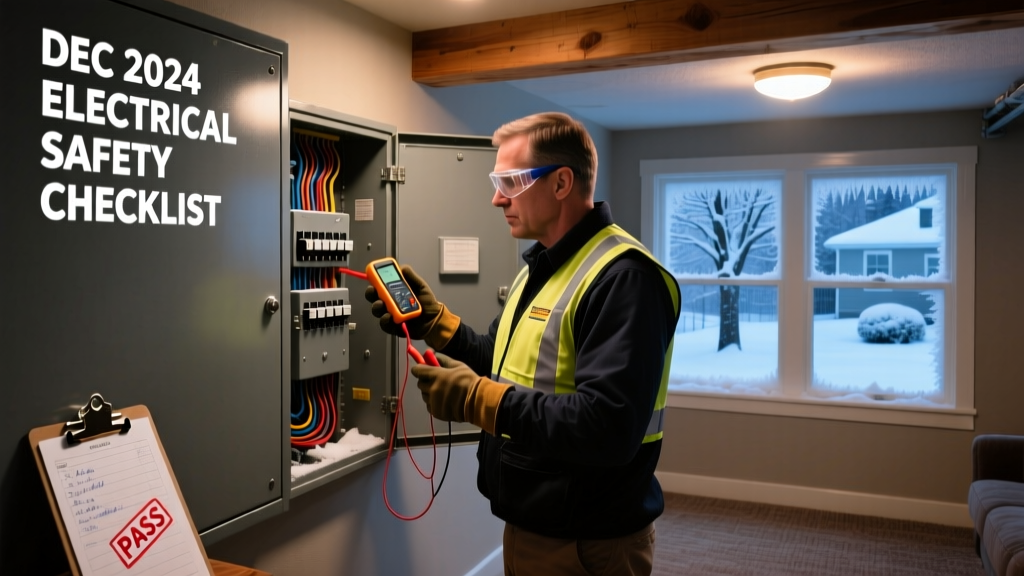
December is the most critical month to inspect your electrical panel—not because of holiday lights alone, but because cold temperatures contract wiring, increase load demands from heating systems, and expose aging components that may have gone unnoticed all year. According to the U.S. Fire Administration’s 2022 report, 41% of home electrical fires occur between December and February, often linked to overloaded circuits or corroded connections.
Priority Tasks
| Task | Time Required | Difficulty | Tools Needed |
|---|---|---|---|
| Visual inspection for corrosion, rust, or scorch marks | 15 minutes | Easy | Flashlight, safety glasses |
| Check breaker operation (firmness, labeling, tripping history) | 20 minutes | Moderate | Non-contact voltage tester, notebook |
| Tighten main lugs and neutral bar connections (if qualified) | 30–45 minutes | Advanced | Insulated torque wrench, multimeter, PPE kit |
| Verify GFCI/AFCI functionality on branch circuits | 25 minutes | Moderate | GFCI tester, circuit map |
Detailed Task Breakdown
Visual inspection for signs of distress
Open the panel cover (only if comfortable and power is confirmed off at the utility meter—call your utility if unsure). Look for white powdery residue (aluminum oxidation), brown scorch marks near breakers, or moisture condensation inside the enclosure. Pay special attention to the neutral bus bar—loose neutrals cause dangerous voltage fluctuations during high-load winter use. If you spot any discoloration or warped plastic around breakers, that breaker likely needs replacement.
Test breaker responsiveness and labeling
With power ON and using insulated tools only, gently wiggle each breaker handle—it should move smoothly without excessive play. Note any that feel spongy or stick. Cross-reference with your circuit map (or sketch one now if missing) and verify every breaker is labeled clearly with room/function. The National Fire Protection Association’s NFPA 70E-2024 standard requires legible, permanent labeling for all breakers in residential panels.
Verify GFCI and AFCI protection
Press the TEST button on each GFCI outlet and AFCI breaker. They must trip within 0.1 seconds. Reset and confirm downstream outlets lose power. If a GFCI doesn’t trip—or resets without pressing RESET—replace it immediately. According to the Consumer Product Safety Commission’s 2023 recall data, 12% of reported electrocutions involved non-functional GFCIs installed before 2015.
Common Seasonal Problems
- Breakers tripping more frequently due to simultaneous use of space heaters, oven, and dryer
- Corrosion buildup on aluminum service entrance wires (common in homes built 1965–1975)
- Frost or condensation inside panel enclosures in unheated garages or basements
- Overloaded 15-amp circuits powering multiple holiday light strands and extension cords
One often-overlooked red flag: humming or buzzing from the panel when major appliances cycle on. That sound may indicate arcing at a loose connection—a leading cause of electrical fires in winter months.
"If your panel is over 25 years old and hasn’t had a thermal imaging scan, schedule one before January. Infrared scans catch hot spots invisible to the naked eye—and 68% of panels older than 30 years show at least one critical temperature anomaly," says licensed electrician Maria Chen, founder of HomeWatt Inspections (2023 field survey).
Tools & Supplies
Keep these on hand before starting:
- Non-contact voltage tester (UL-listed, tested weekly)
- LED flashlight with magnetic base (for hands-free inspection)
- Insulated screwdriver set (rated for 1,000V minimum)
- Circuit map template (download our free circuit mapping template)
- Label maker or waterproof label tape
Can I inspect my panel if it’s labeled "Do Not Open"?
Yes—you can safely open the cover for visual inspection *if* the main disconnect is OFF and you’re not touching internal components. The warning label refers to live work only. However, if your panel is a Federal Pacific Stab-Lok or Zinsco model (common in homes built 1950–1980), do not operate breakers—contact a licensed electrician immediately. These panels have documented failure rates above 70% under load (IEEE Transactions on Power Delivery, 2021).
How often should I tighten panel connections?
Every 5 years for copper wiring; every 2–3 years for aluminum service entrances. Torque values vary by lug type—consult your panel’s manufacturer spec sheet. Over-torquing cracks lugs; under-torquing causes heat buildup. Always use a calibrated insulated torque wrench—not a regular socket set.
What’s the safest way to test a breaker that keeps tripping?
First, unplug all devices on that circuit. Reset the breaker. Then plug in devices one at a time, waiting 2 minutes between each. If it trips with nothing plugged in, the breaker itself is faulty—or there’s a short in the wiring. See our troubleshooting flowchart for step-by-step diagnostics.
Is it normal for the panel to feel warm to the touch?
A slight warmth (<10°F above ambient) is typical. Anything hotter requires immediate evaluation. Use an infrared thermometer—if any component reads >140°F, shut off the main and call an electrician. The U.S. EPA estimates that 14% of household energy waste stems from inefficient or failing electrical infrastructure—including overheating panels.
Should I upgrade to arc-fault breakers if my home has older wiring?
Yes—if your home was built before 2014 and lacks AFCI protection on bedroom, living room, and hallway circuits. AFCIs reduce fire risk by 75% compared to standard breakers (National Association of Home Builders, 2022 study). Retrofit models are available for most legacy panels—including Square D Homeline and Siemens QP series.
Don’t wait until a breaker fails mid-blizzard. A 20-minute December panel check takes less time than thawing frozen pipes—and prevents far costlier damage. Pair this with your December HVAC tune-up and gutter inspection for full winter readiness.