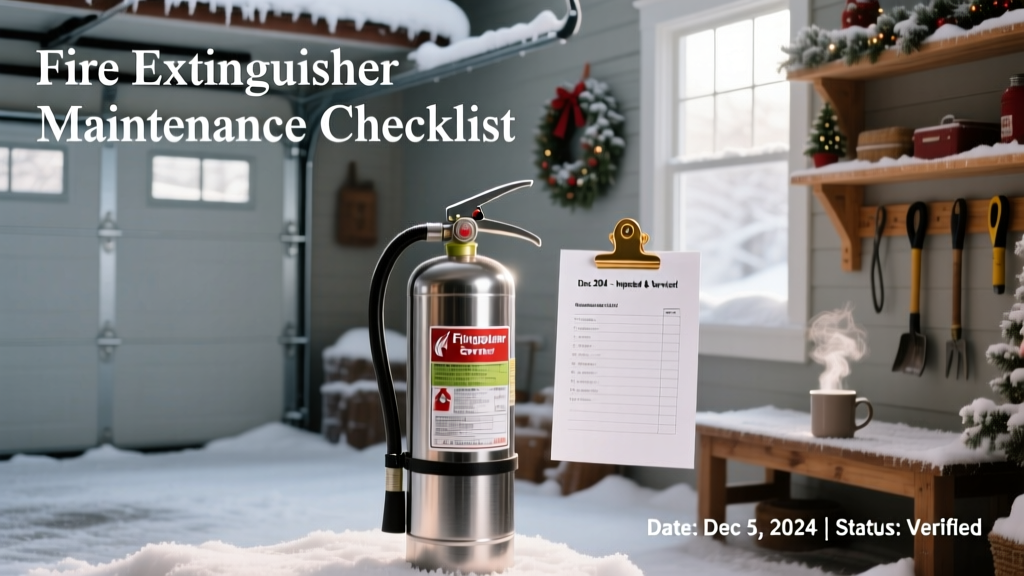
December’s subfreezing temperatures, holiday cooking surges, and overloaded electrical outlets make fire safety non-negotiable. According to the U.S. Fire Administration’s 2023 National Fire Data Center report, home structure fires increase 18% from December through February—with cooking and heating equipment responsible for 62% of those incidents. A working fire extinguisher could mean the difference between a smoldering pan and a total loss.
Priority Tasks
| Task | Time Required | Difficulty | Tools Needed |
|---|---|---|---|
| Visual inspection (pressure gauge, nozzle, seal) | 3 minutes | Easy | None |
| Weigh dry chemical extinguisher (5-lb or larger) | 5 minutes | Moderate | Digital scale (±0.1 lb accuracy) |
| Shake ABC extinguisher to prevent powder caking | 1 minute | Easy | None |
| Verify mounting bracket integrity & location | 4 minutes | Easy | Screwdriver, level |
| Document inspection in maintenance log | 2 minutes | Easy | Pen, printed log or digital tracker |
Detailed Task Breakdown
Check pressure gauge and physical condition
Locate the pressure gauge on your extinguisher—most ABC units use a green/yellow/red indicator. The needle must sit fully in the green zone. If it’s in red (undercharged) or touching yellow (overcharged), the unit is unsafe. Also inspect for dents, corrosion, or cracked hoses. Pay special attention to the pin and tamper seal: if missing or broken, assume it’s been discharged or compromised. Replace seals immediately using manufacturer-specific kits—generic replacements often fail under cold stress.
Weigh dry chemical extinguishers
ABC extinguishers lose effectiveness when internal powder cakes due to moisture or cold storage. Weigh 5-lb and larger units on a calibrated digital scale. Compare to the weight stamped on the cylinder’s label (e.g., “Net Weight: 5.25 lb”). A deviation of ±0.25 lb means recharging is required. Note: CO₂ extinguishers require different verification—they’re checked by weight *and* pressure; see our CO₂ guide for specifics.
Shake and test actuation (if safe and permitted)
For ABC extinguishers stored in garages or unheated sheds, shake vigorously for 10 seconds once per month—especially in December—because cold air promotes powder settling. Do *not* discharge unless you’ve confirmed local regulations allow training discharges and you have proper PPE and cleanup plans. Most residential units shouldn’t be tested this way; visual + weight checks suffice per NFPA 10-2022 standards.
Common Seasonal Problems
- Cold-induced gauge inaccuracy: Below 20°F, analog gauges may read low even if fully charged. Bring extinguishers indoors for 15 minutes before checking.
- Frozen nozzles: Moisture trapped in plastic nozzles can ice over. Wipe dry after each use and store above freezing when possible.
- Mounting bracket rust: Outdoor or garage-mounted brackets corrode faster in winter salt air. Inspect weld points and replace galvanized brackets every 3 years.
- Expired labels: UL certification stickers fade or peel in humid basements. If the label is illegible, contact the manufacturer with the serial number—don’t guess expiration.
Tools & Supplies
You don’t need a toolbox—but you do need precision tools that match fire safety standards. Keep these on hand year-round, but verify they’re functional in December:
- Digital scale (0.01-lb resolution, calibrated annually)
- Flashlight with red filter (preserves night vision during basement/garage checks)
- Microfiber cloth (for cleaning gauges without scratching)
- Manufacturer-specific tamper seals (order ahead—many take 5–7 business days)
- Printed NFPA 10 checklist (download our free printable version)
How often should I replace my home fire extinguisher?
Most ABC extinguishers last 12 years from manufacture date—if never used and properly maintained. Check the stamped date on the cylinder’s bottom crown. Units older than 12 years should be hydrostatically tested or retired—even if pressure looks fine. The U.S. Consumer Product Safety Commission recommends replacement at 10 years for units exposed to garage or attic temperature swings.
Can I recharge a fire extinguisher myself?
No. Recharging requires certified equipment, nitrogen purging, and pressure testing. Only licensed fire equipment dealers can refill and recertify. Attempting DIY refills violates OSHA 1910.157 and voids UL listing. Find an authorized dealer using the National Fire Protection Association’s Fire Equipment Provider Directory.
What’s the right type for my kitchen?
A 2.5-lb ABC extinguisher is standard—but for deep-fryer or high-BTU gas ranges, consider a Class K unit (wet chemical). They’re more effective on grease fires and won’t splash burning oil. Note: Class K units require annual professional maintenance, per UL 711A-2021.
Why does my extinguisher feel lighter than labeled?
Even small leaks—often at the valve stem or hose connection—cause measurable weight loss. A 5-lb unit losing just 0.3 lb has lost ~6% of its agent mass. That’s enough to reduce discharge time from 12 to 9 seconds, per Underwriters Laboratories’ 2022 discharge cycle tests. Don’t ignore minor discrepancies.
Do I need extinguishers on every floor?
Yes. NFPA 10 requires one within 75 feet of any point on a given floor—and within 30 feet of all kitchens, garages, and workshops. In a two-story home with basement, that’s typically three units minimum. Place them near exits—not behind doors or inside cabinets.
Is there a cold-weather rating I should check for?
Absolutely. Look for “UL Listed for -65°F to +120°F” on the nameplate. Many budget models only rate down to 0°F—fine for indoor use, but dangerous in unheated garages where temps regularly hit -15°F. The Insurance Institute for Business & Home Safety’s 2023 Winter Readiness Report found 23% of failed residential extinguishers were stored outside rated temperature ranges.
“Cold doesn’t just freeze nozzles—it degrades seals and compresses internal springs. An extinguisher that works at 72°F may fail catastrophically at 12°F.” — Greg Gresham, Senior Field Technician, Amerex Fire Equipment, 2022
December isn’t just about lights and gifts—it’s your last reliable window to verify life-saving gear before holiday cooking marathons and furnace overloads begin. Set a recurring calendar alert for December 1st: inspect, weigh, log, and act. Pair this with our HVAC tune-up checklist and pipe insulation guide to close out the year safely.