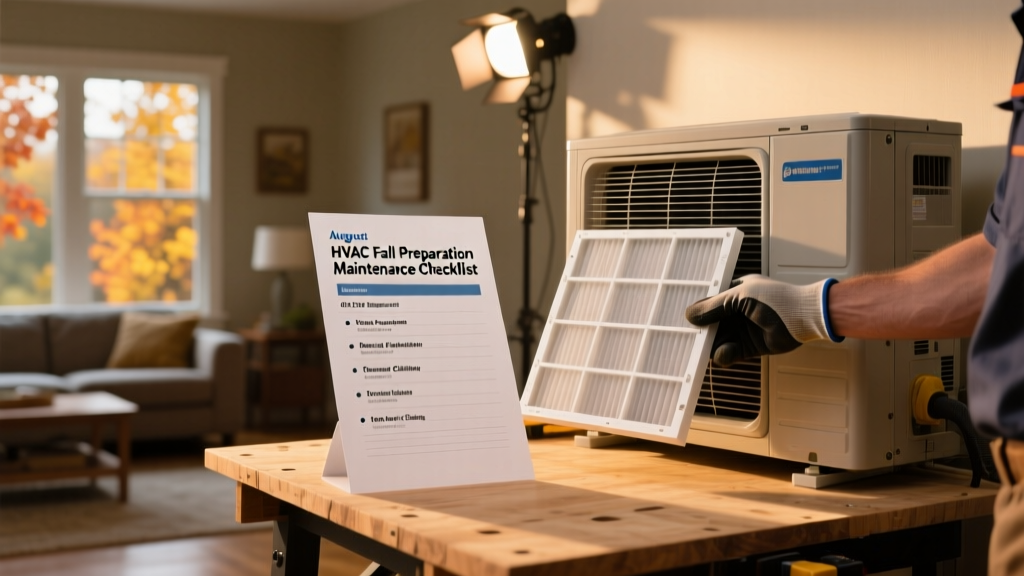
August is the quiet pivot point—too warm for heating, too early for furnace season—but it’s the last reliable window to prep your HVAC system for fall and winter. Skipping this month’s maintenance means risking mid-October failures when temperatures drop and service calls spike. According to the U.S. Department of Energy, routine seasonal maintenance can improve HVAC efficiency by up to 15% and cut repair costs by nearly 30% over five years.
Priority Tasks
| Task | Time Required | Difficulty | Tools Needed |
|---|---|---|---|
| Replace air filter | 5–10 minutes | Easy | Replacement filter (MERV 8–11), ladder (if needed) |
| Inspect and clean condensate drain line | 20–30 minutes | Moderate | Vinegar, turkey baster, wet/dry vacuum, shop towel |
| Check thermostat calibration & programming | 15 minutes | Easy | Smartphone or thermostat manual, thermometer |
| Examine outdoor unit for debris and airflow | 25 minutes | Moderate | Garden hose, soft brush, flashlight, gloves |
| Schedule professional tune-up | 5 minutes (call/email) | Easy | Calendar app, HVAC contractor contact info |
Detailed Task Breakdown
Replace air filter
Locate your filter—common spots include return grilles, furnace cabinet doors, or dedicated filter racks. Note the size printed on the old filter (e.g., 16x20x1). Use a MERV 8–11 pleated filter for balanced airflow and particle capture. Slide the new filter in with the arrow pointing toward the blower (not the return duct). Set a phone reminder for every 60–90 days—more often if you have pets or allergies.
Clean condensate drain line
A clogged drain line causes water leaks, mold growth, and emergency shutdowns. Locate the PVC pipe near your indoor air handler or furnace—often with a T-fitting and cap. Remove the cap, pour ½ cup white vinegar into the opening, wait 15 minutes, then flush with distilled water using a turkey baster. If flow is sluggish, use a wet/dry vacuum on ‘blow’ mode or a flexible drain snake.
"Over 60% of summer HVAC service calls related to 'no cooling' trace back to a blocked condensate line—not refrigerant or compressor issues." — HVAC Excellence Technician Certification Manual, 2022
Verify thermostat operation
Switch your thermostat to 'heat' mode and raise the setpoint 5°F above room temperature. Listen for the furnace inducer motor to start within 90 seconds. Confirm airflow from registers matches expected fan speed (not just 'fan only'). For smart thermostats, update firmware and test Wi-Fi connectivity—many fail silently during early fall power surges. Cross-check readings with a calibrated digital thermometer placed nearby; discrepancies over ±2°F warrant recalibration or replacement.
Common Seasonal Problems
- Short cycling after first cool morning—often caused by dirty flame sensor or failing limit switch
- Furnace ignitor failure in early October—symptom: clicking but no flame; preventative cleaning in August extends life by 2–3 seasons
- Thermostat disconnects from Wi-Fi after router updates—test remote access now, not during a cold snap
- Outdoor unit fan motor bearing wear—listen for grinding or high-pitched whine during AC run; lubrication isn’t possible on sealed units, so early detection avoids full replacement
- Gas valve hesitation—delayed ignition or repeated lockouts may indicate moisture ingress from summer humidity; professional inspection required
Tools & Supplies
Keep these on hand before August begins—don’t wait until the weekend before school starts:
- MERV 8–11 filters (stock 3–4 sizes matching your system)
- White vinegar (for drain line cleaning)
- Flashlight with fresh batteries (for inspecting furnace chambers)
- Non-contact voltage tester (safety check before touching any control board)
- Soft-bristle brush (for coil cleaning—never use wire brushes)
- Condensate pan tablets (e.g., Nu-Calgon Pan-Treat) to inhibit algae year-round
How often should I replace my furnace filter in August?
If your system ran heavily all summer, replace it now—even if it looks clean. Dust buildup inside the filter media restricts airflow more than visible grime suggests. Check your manufacturer’s spec: most forced-air systems need replacement every 60 days in active cooling months. Learn more about filter replacement schedules by system type.
Can I clean my evaporator coil myself?
You can safely vacuum loose dust from accessible coil surfaces using a soft brush attachment—but never spray water or chemical cleaners without shutting off power and verifying coil compatibility. Most residential coils require professional coil cleaning every 2–3 years. DIY attempts risk bent fins or refrigerant line damage. See our guide on safe evaporator coil care for step-by-step visuals.
Why schedule a tune-up in August instead of October?
Contractors book 3–4 weeks out by late September. A pre-season tune-up includes gas pressure checks, heat exchanger inspection, blower motor lubrication (if applicable), and safety shutoff verification—all things that prevent carbon monoxide risks or catastrophic failure. The Insurance Institute for Business & Home Safety’s 2023 report found homes with documented annual HVAC maintenance had 42% fewer emergency furnace repairs between November and February.
What’s the biggest mistake homeowners make in August HVAC prep?
Assuming 'it worked fine all summer, so it’ll be fine in fall.' HVAC systems degrade gradually—ignition delays, reduced airflow, and minor refrigerant loss rarely trigger alarms until ambient temps shift. One missed capacitor or cracked heat exchanger won’t show symptoms until demand spikes. Don’t wait for cold weather to reveal the problem.
Do I need to cover my outdoor AC unit for winter?
No—and covering it invites moisture retention, rodent nesting, and corrosion. Modern units are built for winter exposure. Instead, clear leaves, pine needles, and grass clippings from around the base and fins. Trim shrubs to maintain 18 inches of clearance on all sides. If you live in an area with heavy ice storms, consider installing a simple overhead canopy—not a full cover—to deflect falling branches.
Is it worth upgrading my thermostat in August?
Yes—if yours is over 10 years old or lacks adaptive recovery, geofencing, or humidity control. Modern thermostats like the Honeywell Home T9 or Ecobee SmartThermostat reduce heating runtime by 12–18% annually (ENERGY STAR, 2023). Install it in August while temps are mild—no rush, no sweat, and full time to learn its features before heating season begins. Explore compatible models in our heating-season thermostat comparison.
August HVAC prep isn’t about fixing what’s broken—it’s about catching what’s quietly wearing down. A few hours now protect your comfort, budget, and indoor air quality through the coldest months. Mark your calendar, gather your supplies, and treat your system like the critical infrastructure it is—because when the first frost hits, you’ll be glad you did.