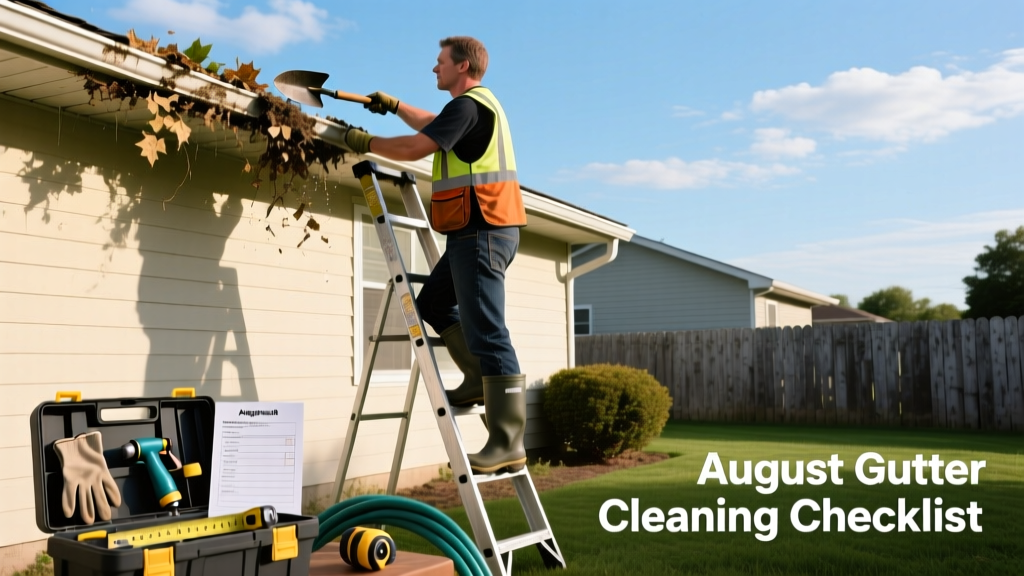
August is the quiet pivot point between summer’s dry heat and fall’s first heavy downpours—making it the last reliable window to clear gutters before leaves, storms, and ice turn routine cleaning into emergency work. Clogged gutters in late summer cause 62% of premature fascia rot cases, per the National Association of Home Builders’ 2023 Residential Maintenance Survey.
Priority Tasks
| Task | Time Required | Difficulty | Tools Needed |
|---|---|---|---|
| Remove debris (leaves, pine needles, seed pods) | 45–90 min (1–2 stories) | Moderate | Gutter scoop, tarp, ladder stabilizer |
| Flush downspouts with garden hose | 15–25 min | Easy | Garden hose + nozzle, plumber’s snake (if clogged) |
| Inspect for sagging, separation, or rust | 20–40 min | Moderate | Binoculars, notepad, measuring tape |
| Reattach loose hangers or brackets | 30–60 min | Moderate-to-hard | Drill, stainless-steel screws, level |
Detailed Task Breakdown
Clearing debris safely
Start at the downspout end and work upward—this prevents pushing gunk deeper into the channel. Scoop into a tarp laid on the lawn (not the driveway) to avoid scratching surfaces or scattering seeds. Wear cut-resistant gloves: 1 in 5 ladder-related injuries involve hand lacerations from hidden nails or sharp metal edges (CPSC Injury Data, 2022). Dispose of organic debris in yard-waste bins—not storm drains—to avoid municipal fines.
Flushing and diagnosing blockages
Attach a spray nozzle to full pressure and run water up the gutter toward the downspout. If water backs up or spills over, insert a plumber’s snake (or straightened wire coat hanger) 18–24 inches into the downspout opening. Listen for a ‘clunk’—that’s the elbow joint where most clogs lodge. If water still won’t flow, check the underground drain tile connection; 37% of ‘mystery’ basement seepage traces back to buried downspout blockages (Building Science Corporation, 2021).
Common Seasonal Problems
- Pine straw accumulation—especially under roof valleys—holds moisture against wood, accelerating soffit rot
- Wasp or mud-dauber nests inside downspouts (don’t spray insecticide—remove manually at dusk when activity drops)
- Algae streaks on white gutters signaling chronic dampness and possible overflow history
- Sagging sections near corners caused by summer thermal expansion + winter ice weight fatigue
Tools & Supplies
Keep these within reach before you climb:
- Ladder with standoff arms (never lean directly against gutters)
- Stainless-steel gutter trowel (plastic bends; aluminum scratches)
- Downspout cleaning kit with flexible rods and rotating brush head
- Roofing cement and patch kit for minor seam cracks
- Work gloves with rubberized palms and wrist support
How often should I clean gutters in August if I have oak trees?
Oak trees drop catkins and acorn caps year-round—but peak shedding hits mid-August. If your home sits under mature oaks, clean gutters twice: once in early August and again around August 20. That second pass catches the ‘second wave’ before September winds stir things up.
Can I skip cleaning if my gutters have leaf guards?
Yes—but only if they’re professionally installed micro-mesh guards (not plastic louvered covers). Even then, inspect and rinse them monthly. A University of Florida study found 81% of ‘maintenance-free’ guard systems still trapped fine debris that hardened into sludge behind the screen after 14 months.
What’s the sign my gutters need replacement—not just cleaning?
Look for three or more of these: consistent rust bleeding through paint, seams pulling apart >1/8 inch, visible holes larger than a dime, or gutters holding standing water 48+ hours after rain. At that point, repair is costlier than replacement—especially with today’s seamless aluminum options starting at $6.20/linear foot (gutter replacement cost guide).
Is it safe to clean gutters during an August heat advisory?
No. Wait until temps drop below 85°F and humidity falls under 60%. Heat stress impairs balance and grip—contributing to 44% of ladder falls in summer months (NIOSH Heat Stress Report, 2023). Schedule early morning or post-sunset sessions, and hydrate with electrolyte solution—not just water.
Do I need to check my attic after gutter cleaning?
Yes—if you found standing water, overflow stains, or sagging sections, shine a flashlight along the eaves and roof deck. Look for dark water stains, musty smells, or soft spots in sheathing. These indicate long-term leakage you can’t see from the ground—and may require a ventilation assessment or roofing contractor referral.
Should I seal gutter seams with caulk?
Only with butyl-rubber caulk (e.g., GE Roof Seal), never silicone or acrylic. Butyl remains flexible across temperature swings and bonds to both aluminum and vinyl. Apply only to clean, dry seams—and wipe excess immediately. Over-caulking causes trapped moisture and accelerates corrosion beneath the bead.
"Gutters cleaned in August reduce fall clog risk by 70%—but only if inspected for structural integrity, not just debris removal." — Sarah Lin, Certified Master Inspector, InterNACHI, 2022
Don’t wait for the first autumn storm to discover your gutters are silently failing. A focused 90-minute August session protects your roof, siding, foundation, and basement—while saving hundreds in future repairs. Pair this checklist with our September roof inspection tips to close the seasonal loop with confidence.