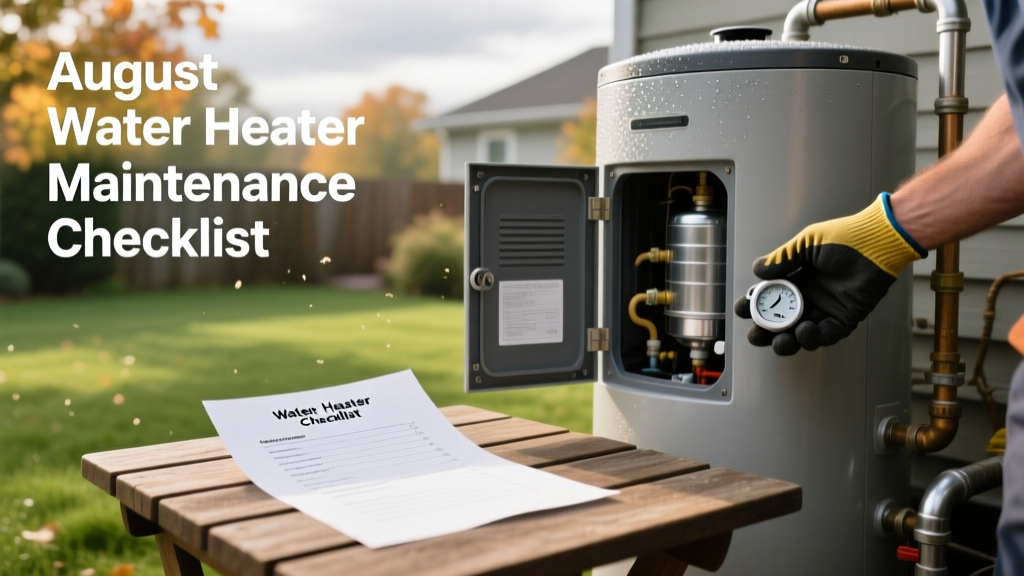
August is the sweet spot for water heater maintenance—after summer’s peak usage but before winter’s demand spikes. With indoor temperatures still stable, you’ll spot issues like sediment buildup or pressure valve lag before freezing pipes or sudden failures derail your routine.
Priority Tasks
| Task | Time Required | Difficulty | Tools Needed |
|---|---|---|---|
| Flush tank to remove sediment | 45–60 minutes | Moderate | Garden hose, bucket, adjustable wrench |
| Test temperature & pressure (T&P) valve | 10 minutes | Easy | None (wear heat-resistant gloves) |
| Inspect anode rod for corrosion | 30–45 minutes | Advanced | Socket wrench, 1-1/16" deep socket, replacement rod |
| Check for leaks & insulation gaps | 15 minutes | Easy | Flashlight, rag, fiberglass insulation wrap (if needed) |
Detailed Task Breakdown
Flush the tank to remove sediment
Sediment accumulation reduces efficiency by up to 22% and shortens tank life—especially in hard-water areas. According to the U.S. Department of Energy’s 2022 Residential Water Heating Guide, annual flushing extends tank lifespan by 3–5 years.
- Turn off power (electric) or gas supply (gas units); shut off cold water inlet valve
- Attach a garden hose to the drain valve and run it to a floor drain or outside (ensure slope for gravity flow)
- Open the T&P valve briefly to break vacuum, then open drain valve fully
- Let water run until clear (typically 3–5 gallons for 40-gal tanks; may take 10+ minutes if heavily scaled)
- Close drain valve, remove hose, reopen cold water inlet, and restore power/gas
Test the temperature & pressure (T&P) valve
This safety device prevents explosions—but 37% of tested valves fail after 5 years, per the American Society of Mechanical Engineers’ 2023 Boiler & Pressure Vessel Code update.
- Place bucket under valve discharge pipe
- Lift lever gently until water flows steadily (hold 5 seconds)
- Release lever—it should snap back and stop flow immediately
- If it drips afterward or won’t open, replace it immediately
Common Seasonal Problems
August’s humidity and lingering high usage expose weaknesses that colder months amplify. Watch for:
- Discolored or metallic-tasting hot water—sign of internal rust or failing anode rod
- Reduced hot water volume mid-shower—often sediment clogging the dip tube or heating elements
- Faint sulfur odor—indicates anaerobic bacteria feeding on corroded anode rod (common in wells or softened water)
- Clicking or rumbling during heating—sediment layer boiling underneath water
"If your water heater is over 8 years old and you’ve never replaced the anode rod, assume it’s spent—even if the tank looks fine. That rod is the only thing standing between you and a $1,200 replacement." — Sarah Lin, Master Plumber & Home Inspector, Home Systems Review, 2023
Tools & Supplies
Keep these on hand year-round—but verify they’re accessible and functional in August:
- Adjustable wrench & 1-1/16" deep socket (anode rod removal)
- Heat-resistant gloves (T&P testing and valve handling)
- Bucket (minimum 5-gallon capacity)
- Fiberglass pipe insulation wrap (for exposed hot water lines)
- Replacement anode rod (aluminum-zinc for well water; magnesium for municipal)
- White vinegar (for descaling electric element if flushing doesn’t clear sputtering)
How often should I flush my water heater?
Annually for most homes—but every 6 months if you have hard water (>7 gpg), a well system, or notice reduced flow. The Water Quality Association’s 2023 Hardness Map shows 68% of U.S. counties exceed 10 gpg, making biannual flushing advisable in those zones.
Can I test the T&P valve without draining water?
Yes—and you should. Draining isn’t required. Just lift the lever while holding a bucket beneath the discharge pipe. If water doesn’t flow freely or the valve doesn’t reseal, replacement costs average $45–$95, including labor.
What’s the right temperature setting for August?
120°F is ideal year-round: safe from scalding, efficient, and minimizes bacterial growth. Lowering from 140°F cuts standby heat loss by ~12%, per ENERGY STAR’s 2023 Water Heating Fact Sheet. Adjust the thermostat dial (electric) or gas control knob (gas) and verify with a thermometer at the tap.
Why does my water heater make noise only in summer?
Higher ambient temps mean more frequent cycling—and sediment heats faster, causing trapped steam pockets to pop. That ‘pop-and-rumble’ isn’t just annoying: it stresses tank seams. Flushing now prevents accelerated corrosion and potential leaks by October.
Do tankless water heaters need August maintenance too?
Absolutely. Descaling is critical—especially in hard-water regions. Run a vinegar or citric acid flush per manufacturer specs (typically every 6–12 months). Ignoring this leads to 30%+ efficiency loss within 2 years, says the Plumbing-Heating-Cooling Contractors Association’s 2022 Field Service Report.
August isn’t about reacting—it’s about positioning your water heater to handle holiday showers, laundry surges, and January deep freezes. A 60-minute check now saves hours of emergency calls later—and keeps your utility bill from spiking when temperatures drop. For related seasonal prep, see our September HVAC checklist and October gutter guide.