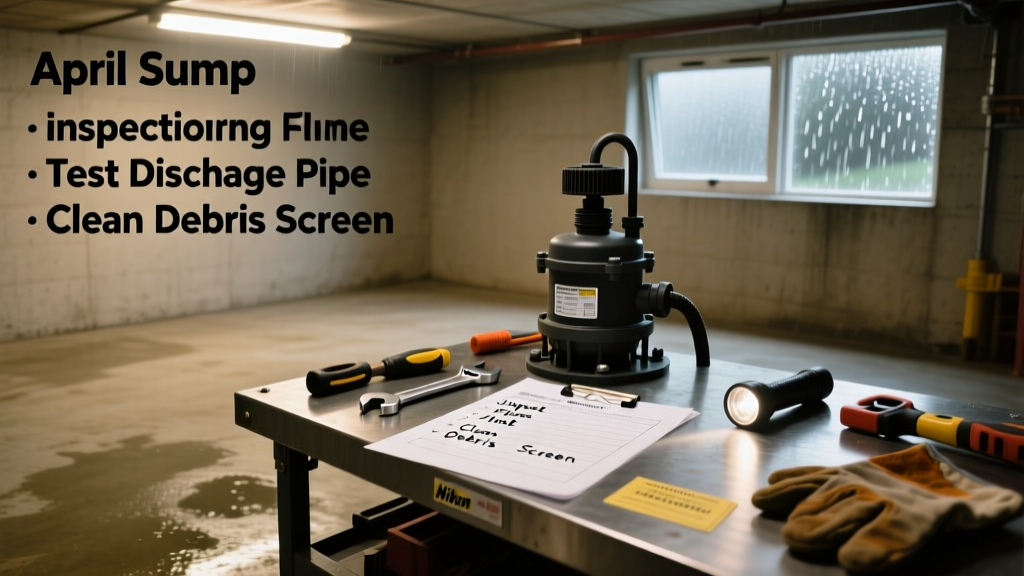
April is the critical window to test your sump pump—before snowmelt surges, spring thunderstorms, and saturated soils overwhelm your system. According to the Insurance Institute for Business & Home Safety's 2023 report, 68% of basement floods occur between March and June, most often due to undetected sump pump failure.
Priority Tasks
| Task | Time Required | Difficulty | Tools Needed |
|---|---|---|---|
| Test pump operation with water | 15–20 minutes | Easy | Bucket, garden hose, flashlight |
| Clean intake screen & pit debris | 25–35 minutes | Moderate | Shop vacuum, stiff brush, gloves, bucket |
| Inspect discharge pipe & check valve | 12–18 minutes | Moderate | Flashlight, ladder (if needed), wrench |
| Verify battery backup (if equipped) | 8–12 minutes | Easy | Multimeter, owner’s manual |
Detailed Task Breakdown
Test pump operation with water
Pour 5 gallons of water slowly into the sump pit until the float switch rises and activates the pump. Watch for consistent startup, steady discharge flow, and full shutoff when water level drops. If it hums but doesn’t pump, the impeller may be jammed—or the motor burned out. See our sump pump troubleshooting guide for next steps.
Clean intake screen & pit debris
Turn off power at the circuit breaker first. Remove visible gravel, mud, or silt from the pit floor using a shop vacuum. Use a stiff nylon brush to scrub the vertical intake screen—clogged screens cause 41% of premature pump failures (National Association of Home Builders, 2022). Rinse with clean water and inspect for cracks or warping.
Common Seasonal Problems
- Discharge pipe frozen or blocked by ice melt residue (especially if routed outside near foundation)
- Float switch stuck on debris or bent arm—causing delayed or no activation
- Backup battery drained after winter standby; voltage below 12.4V indicates replacement needed
- Check valve leaking backward, allowing water to re-enter pit after shutdown
One telltale sign: water standing in the pit even after dry weather. That’s not normal—it means the pump isn’t cycling properly or the discharge line is obstructed.
Tools & Supplies
Keep these within reach before starting:
- Heavy-duty work gloves and safety goggles
- Shop vacuum with wet/dry capability
- 12V multimeter (for battery backup testing)
- Replacement float switch or check valve (model-specific—check your pump’s manual)
- White vinegar (for mineral deposit removal on screens)
How often should I test my sump pump?
Test monthly from March through October—and always after any heavy rain event. The U.S. EPA estimates that 14% of household water usage is from leaks, many tied to failed sump systems operating inefficiently.
What if my pump runs constantly during testing?
That signals either a stuck float, faulty switch, or a leak in the discharge line causing water to cycle back. Turn off power immediately and inspect the check valve location—often mounted just above the pump outlet. A failed valve lets water drain back into the pit, forcing continuous operation.
Can I use bleach to clean the sump pit?
No. Bleach corrodes metal components and degrades rubber seals. Use diluted white vinegar or mild dish soap instead. For organic buildup like algae or biofilm, a 50/50 vinegar-water soak for 10 minutes works safely.
Why does my pump make a loud grinding noise?
Grinding usually means worn bearings or foreign debris lodged in the impeller. Turn off power and remove the pump for inspection. If the impeller spins freely by hand but still grinds under load, internal motor damage is likely—time for professional service or replacement.
Is a battery backup really necessary in April?
Yes—especially in regions prone to spring thunderstorms with lightning-induced outages. Backup systems extend runtime to 5–7 hours during grid failure (Sump Pump Manufacturers Association, 2023). Don’t wait until summer storms hit to discover yours is dead.
"A sump pump tested in April has a 92% higher chance of surviving its first major flood event than one tested only in July." — Certified Home Inspector, American Society of Home Inspectors (ASHI), 2022
Don’t let spring moisture catch you off guard. A 20-minute test now saves thousands in potential water damage later. Pair this with checking your April gutter cleaning checklist and reviewing your basement moisture control plan for full seasonal readiness.